

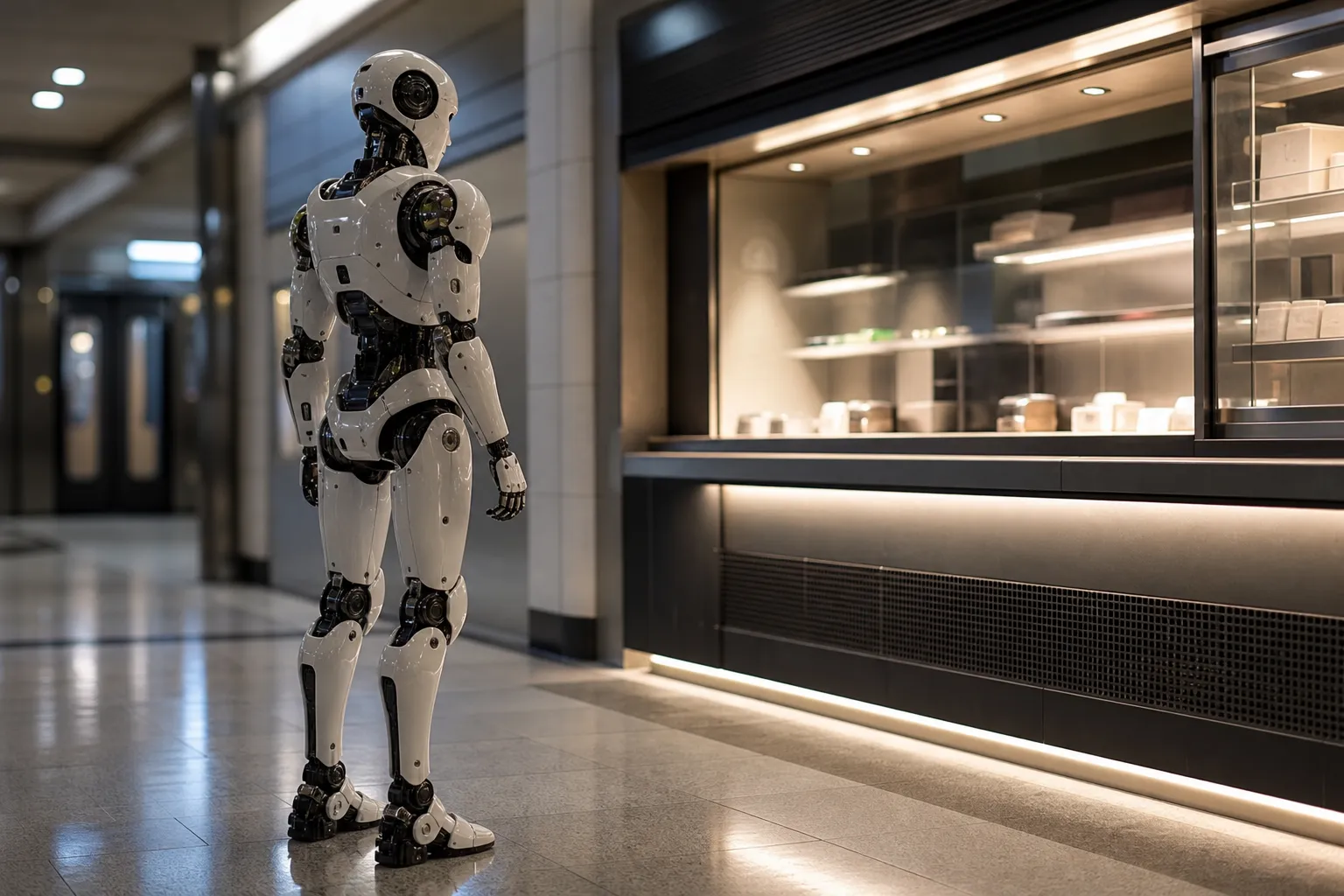
In Shenyang, China, robots from Lingmei Intelligent are giving their first public demonstration of customer service in a METRO store. They hand out samples, present products and answer shoppers’ questions.
From 31 October to 1 November, the METRO store in Tiexi district is hosting embodied-intelligence robots on its sales floor. The presentation is part of the chain’s 30th anniversary in China. It marks a new step for Lingmei Intelligent, which is moving its robots from back-of-store operations to direct interaction with customers.
How the robots prepare and serve food samples
In the supermarket’s tasting area, the robots carry out a series of handling tasks. They pick up black sesame crisps, portion them into tasting cups and hand them to shoppers.
According to Lingmei Intelligent, the entire sequence of grasping, portioning and serving is performed autonomously. The robots combine these physical tasks with a spoken presentation of the products on offer.
The demonstration shows an application of embodied intelligence in which the robot works directly with consumers, rather than being limited to the store’s logistics operations.
Can the robots answer product questions? Voice interaction with customers
The robots can also answer shoppers’ questions. When a customer wants to know a product’s sugar content, calorie count or ingredients, the robots draw on a retail-specific knowledge base to formulate their answers.
The exchanges are not limited to a single question. The robots are described as able to sustain several turns of conversation, providing further details about a product’s characteristics one after another.
During the presentation, some customers tried these interactions after watching the samples being served. Some appreciated being able to get several pieces of information by asking out loud, without having to look up each detail on the packaging.
Key technical features: visual recognition and motion control for retail
Lingmei Intelligent attributes three main technical capabilities to its robots: multi-turn voice interaction, visual image recognition and compliant motion control.
Combining these functions is meant to let them understand shoppers’ requests, look up product information and handle items of different shapes, sizes and materials.
The manufacturer also presents its systems as capable of reasoning based on the information available in their retail knowledge base. This function is used in particular to answer questions about ingredients and nutritional characteristics.
Lingmei Intelligent moves its robots from the back room to the sales floor
Until this presentation, the applications discussed for embodied-intelligence robots in supermarkets mainly involved staff-only areas. Restocking shelves and preparing bakery products were among the typical tasks for these uses.
With this demonstration at METRO, Lingmei Intelligent is exploring another role: that of a sales assistant able to work in the areas where shoppers go.
The company wants to use these interactions to supplement the services stores offer, make product presentation easier and increase product visibility among shoppers.
It also plans to develop replicable business models for brick-and-mortar retailers. The deployment shown in Shenyang is a public demonstration in a live retail setting, combining product handling and customer advice.
The initiative is part of the celebrations marking 30 years of METRO’s presence in China, following the opening of its first Chinese store in Shanghai in 1996.