

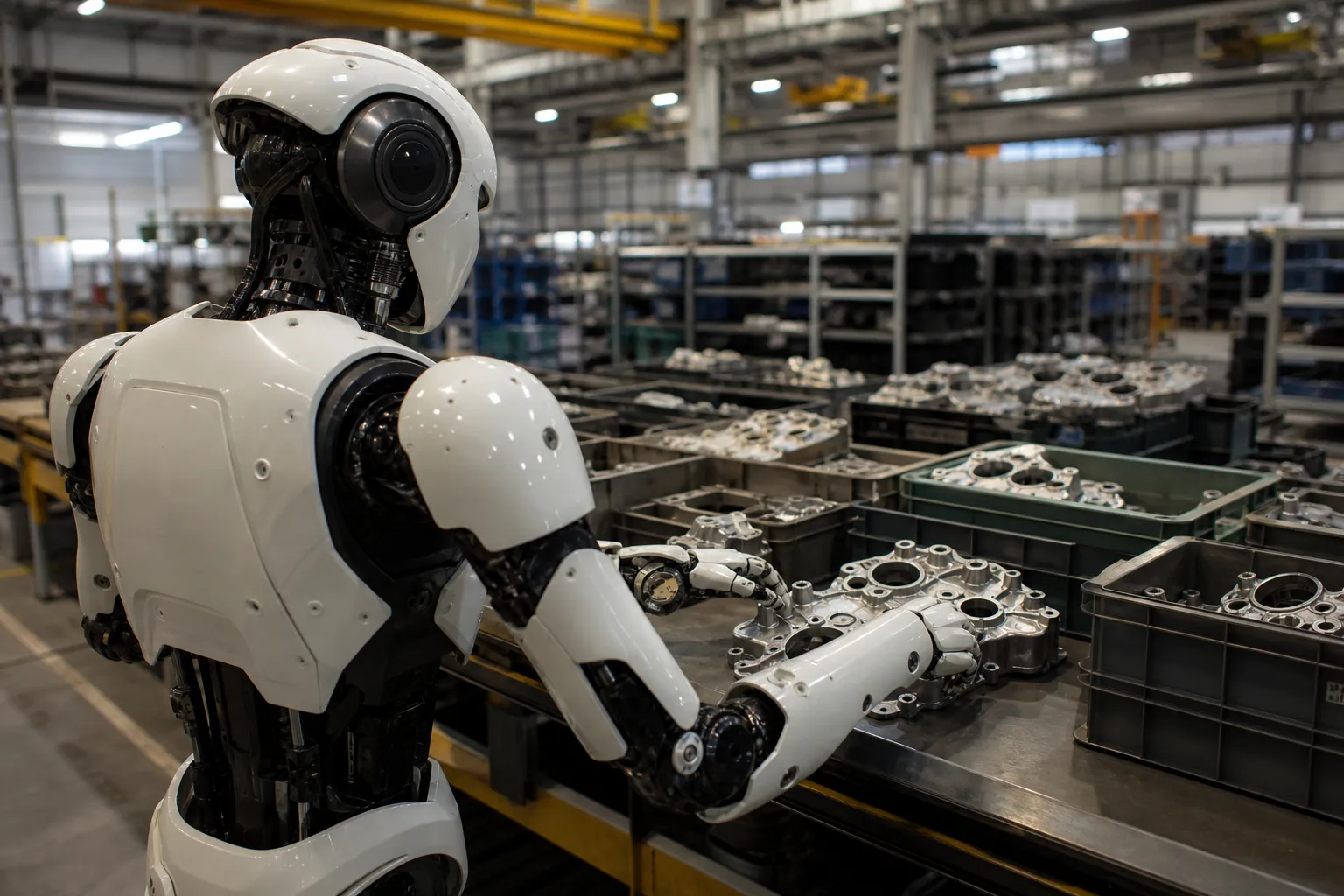
On 3 November, Xiaomi released a video showing two humanoid robots sorting car parts for 8 hours in its factory. The demonstration involves centre console covers, and the manufacturer says the robots detect anomalies autonomously.
The footage published by Xiaomi Tech shows two humanoids moving components between large containers mounted on mobile platforms and vertical racks fitted with individual slots. A counter displays the cumulative working time. The video also carries on-screen notes indicating autonomous operation, along with sequences sped up to 5x and 100x.
How Xiaomi’s humanoid robots sort car parts on the production floor
The task consists of moving centre console side covers between storage containers and the racks that receive the parts. The robots have to handle each component, reach the correct slots and coordinate their movements with the equipment around the workstation.
The demonstration takes place in a setting with containers, storage racks and mobile equipment used to carry components around the factory.
Xiaomi says its robots can detect and correct anomalies autonomously while coordinating with the production line. The manufacturer describes this capability in the communication accompanying the video.
From a 3-hour factory trial to an 8-hour demonstration
In March, Xiaomi reported a success rate of 90.2% in a 3-hour autonomous trial at its electric vehicle factory in Beijing. That trial involved installing self-tapping nuts on two sides simultaneously while keeping to a 76-second production cycle, according to the manufacturer.
The new demonstration covers a different operation: sorting side covers. The 90.2% success rate reported in March applies only to nut installation, so it is not a performance measure for this new task.
Xiaomi also presented its CyberOne V2 humanoid at its Investor Day. At that event, robots handed out gift bags and interacted with attendees as part of a public demonstration.
Which carmakers are testing humanoid robots for parts handling
Xiaomi’s trials are part of a wider series of industrial experiments focused on handling and supplying car components.
Audi, for example, is working with Agile Robots on a parts preparation project at its production lab in Ingolstadt. The aim is to pick components from containers and arrange them for assembly operations, with support from Dassault Systèmes and NVIDIA.
Other automotive projects involve BMW and Figure, Hexagon’s AEON robot and Boston Dynamics’ Atlas humanoid. These initiatives are at different stages of development and focus in particular on handling and moving parts.
Is 8 hours the battery life? Working time versus autonomy
With this new video, Xiaomi highlights a sorting operation repeated over an extended working period. The 8 hours are the cumulative duration of the task shown, not a battery life demonstrated on a single charge.
To assess the industrial performance of this sorting station, the key indicators will be the number of parts handled per hour, the share of successful grasps and how often humans have to step in.