
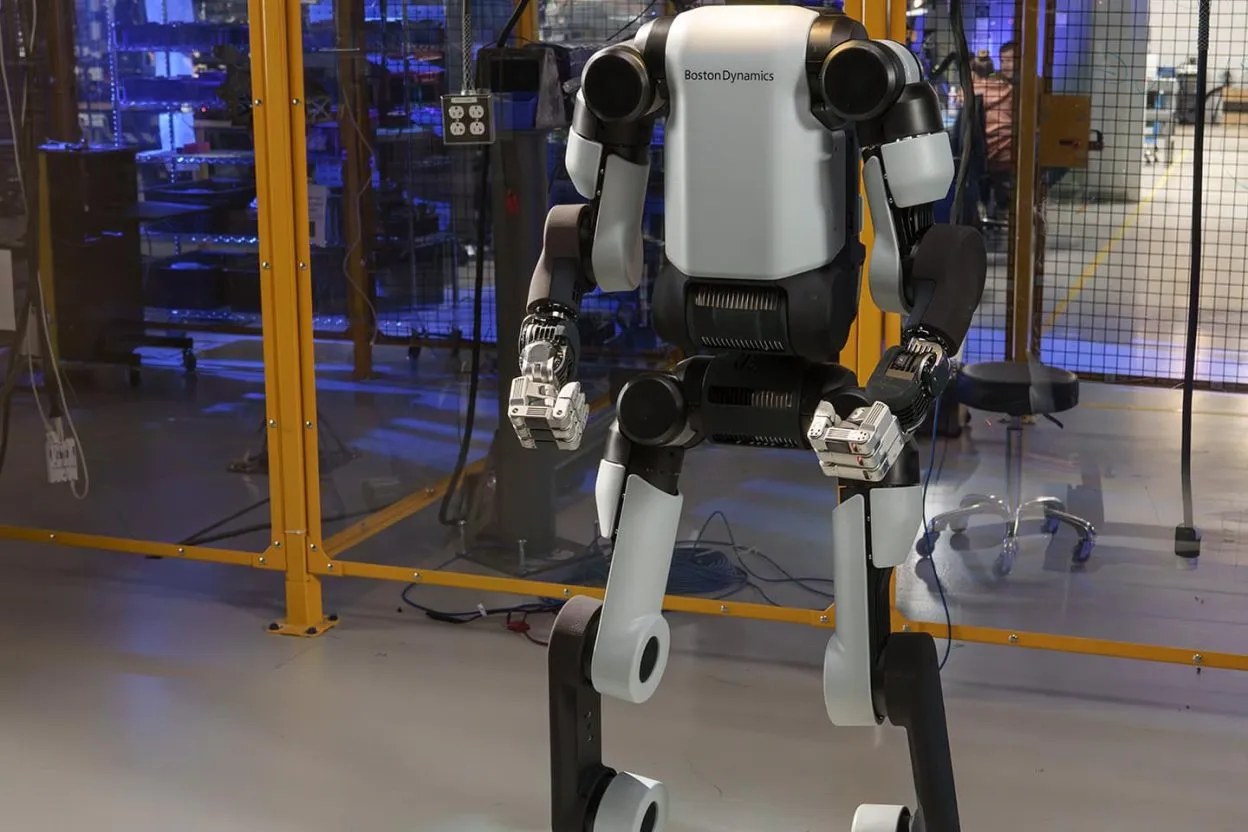
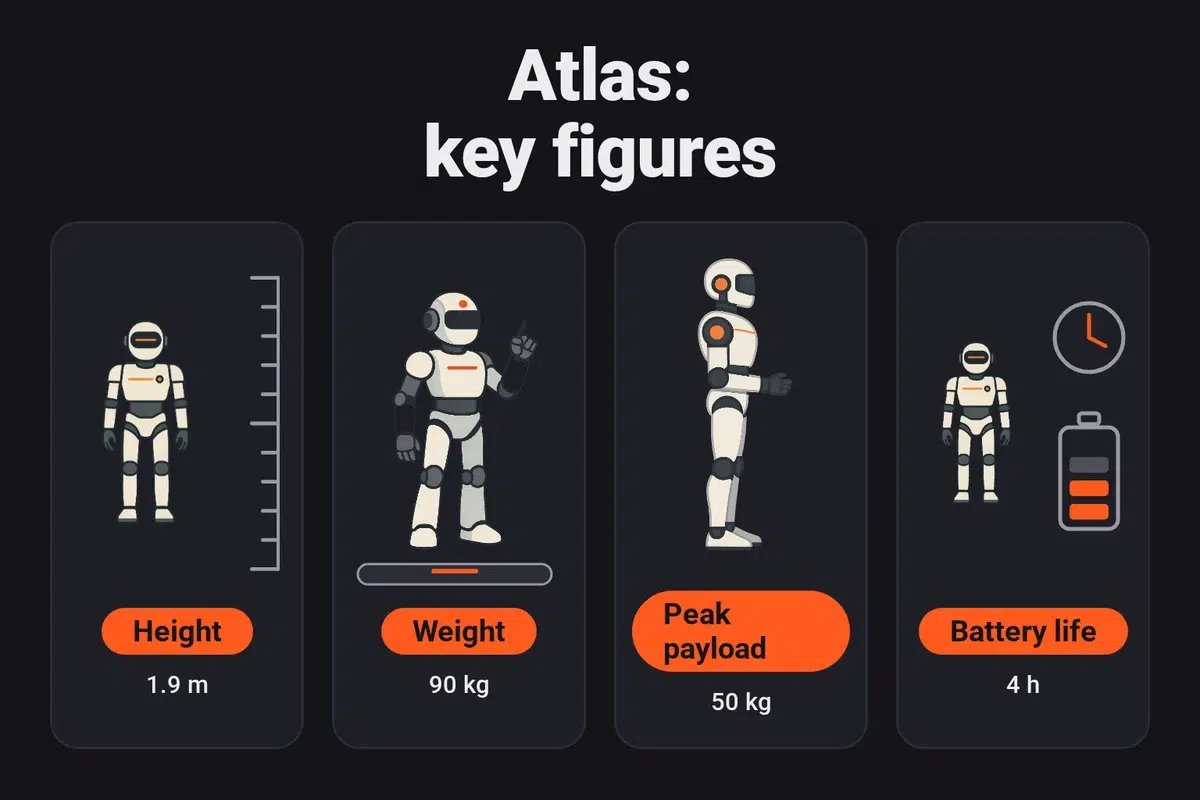
Atlas is Boston Dynamics’ all-electric humanoid robot, designed for manipulation and logistics tasks in industrial environments. It stands 1.9 m tall, weighs 90 kg and has 56 degrees of freedom. Its claimed battery life is four hours, and it can swap its own battery. Hyundai is taking part in its first customer pilot, which covers sorting and sequencing parts.
The official spec sheet published by Boston Dynamics describes a humanoid that can handle loads of up to 50 kg instantaneously and 30 kg in sustained use. Its design combines a wide range of motion, 360° vision and tactile sensors.
Atlas is central to Hyundai’s and Kia’s industrial plans. Trials already involve automotive components, and Hyundai has set a target of 25,000 Atlas robots in its factories by 2030. The program relies on a gradual ramp-up of humanoid robotics and on training methods that combine human demonstrations with simulation.
Boston Dynamics Atlas specifications
The specifications below come from Boston Dynamics’ official product sheet, consulted on 20 October 2026. They describe the capabilities claimed by the manufacturer.
| Specification | Official value |
|---|---|
| Manufacturer | Boston Dynamics |
| Model | Atlas |
| Type | All-electric humanoid robot |
| Height | 1.9 m |
| Weight | 90 kg |
| Instantaneous payload | 50 kg |
| Sustained payload | 30 kg |
| Degrees of freedom | 56 |
| Reach | 2.3 m |
| Range of motion | Continuous, according to Boston Dynamics |
| Claimed battery life | 4 hours |
| Battery | Self-swappable at a charging station |
| Operating temperature | -20 to 40 °C |
| Ingress protection rating | IP67 |
| Vision | Cameras providing a 360° view |
| Tactile sensing | Yes |
| First users | Selected group of early adopters |
| First named customer pilot | Hyundai |
Atlas height, weight and payload: 1.9 m and up to 50 kg
Atlas is 1.9 m tall and weighs 90 kg. Boston Dynamics claims an instantaneous payload of 50 kg and a sustained payload of 30 kg. The two figures reflect two levels of load: a maximum short-term capacity and a capacity intended for prolonged handling.
The robot has 56 degrees of freedom, a figure that describes how its jointed structure can move. The manufacturer also claims a continuous range of motion, an important property for performing successive movements and changing position.
Its reach is 2.3 m according to the official sheet. Together with the payload figures, this defines its handling workspace, particularly when it has to pick up or move parts in a production environment.
The all-electric design is one of the defining features of this generation of Atlas. The robot shown in the Hyundai trials drops the hydraulic architecture in favour of electric actuators.
Atlas battery life: four hours and a battery the robot swaps itself
Boston Dynamics claims four hours of battery life for Atlas. The manufacturer has also built in an automatic battery swap system: the robot can go to a charging station and replace its own battery.
The aim is to make recharging part of the robot’s normal operation. Changing the battery becomes a robotic task rather than a routine manual intervention.
Atlas is rated to operate at temperatures between -20 and 40 °C. It also carries an IP67 rating, which describes its resistance to dust and water.
Its perception combines cameras with 360° coverage and tactile information. Both types of data are used to understand its surroundings and to interact physically with the objects it handles.
Atlas at Hyundai: sorting roof rack components
Hyundai is the partner Boston Dynamics names for Atlas’s first customer pilot. The tasks involve sequencing parts under real conditions in an automotive production environment.
One application shown at Hyundai involves sorting roof rack components bound for an assembly line. Atlas sorts these parts in an operation described as autonomous.
Sequencing means preparing components in the order the production line expects them. It is not just a matter of moving an object from one place to another, but of helping organize the flow of parts that feeds a line.
The Hyundai site described in the presentation has more than 1,000 industrial robots and nearly 1,500 people. Atlas therefore joins an environment where automation is already in place, with specific handling tasks assigned to the humanoid.
Development of the robot is led by Zach Jackowski. The work presented also involves NVIDIA processors in the technical ecosystem used for its training.
RMAC in Savannah: where Atlas is tested
The Robotics Metaplant Application Center, or RMAC, is located on the grounds of Metaplant America, near Savannah, Georgia, in the United States. The centre plays an important role in Hyundai’s plans to integrate Atlas robots into its manufacturing operations.
Atlas robots there are already performing parts sorting, sequencing and logistics tasks. These are the industrial applications Hyundai and Boston Dynamics are working on to prepare the robot for use in factories.
An expansion of the RMAC is planned for 2027. One of the options under consideration is a tenfold increase in its floor space. The project would support the growth of the trials and of the centre’s capacity to prepare robotic applications.
The RMAC is therefore a site for testing and operational preparation, which is not the same as a rollout of Atlas across all of Hyundai’s and Kia’s production lines.
How Atlas is trained: teleoperation, motion capture and simulation
Atlas’s training relies in part on human demonstrations. The methods presented combine a virtual reality headset, motion capture and training in simulated environments.
Human movements used to train the robot
Human demonstrations provide examples of movements and handling sequences. Teleoperation and motion capture make it possible to collect information on how a task should be performed.
This data feeds the training process meant to develop Atlas’s manipulation skills. Using demonstrations allows work on concrete operations, such as those shown in the sorting of automotive components.
More than 4,000 virtual copies trained in parallel
The training work presented also involves more than 4,000 virtual copies of Atlas, trained for six hours in simulation.
The approach consists of multiplying digital instances of the robot to run training in a virtual environment. It complements human demonstrations and trials on physical machines.
The six hours are the training time reported for this simulation, not a complete training period that guarantees mastery of every industrial task.
Integrating Atlas into manufacturing processes remains a gradual process. The reported work suggests that a permanent installation could take several years of development and adaptation.
Hyundai’s target: 25,000 Atlas robots by 2030
Hyundai has set a target of 25,000 Atlas robots in its factories by 2030. The robots, supplied by Boston Dynamics, are to be spread across Hyundai and Kia industrial sites.
The figure is a deployment goal for 2030, not a fleet of 25,000 machines already installed. The activities currently described mainly involve industrial trials and the operations carried out at the RMAC.
The program also includes setting up Atlas production in the United States, with a target capacity of up to 30,000 robots a year. This is a planned manufacturing capacity, which is not the same as the number of robots actually produced or installed.
The planned ramp-up therefore has two dimensions: building the humanoids and integrating them into car plants. The first concerns the ability to manufacture the robots, while the second depends on adapting them to factory operations.
Workforce concerns over Hyundai’s humanoid robot plans
The growth of humanoid robotics at Hyundai and Kia is also drawing reactions from employees. Kia’s union has called for the appointment of an official responsible for protecting workers’ rights as artificial intelligence and robotics expand.
Hyundai, for its part, is trying to play down concerns about possible job cuts. These discussions are taking place alongside the plans for Atlas’s industrial deployment.
Atlas vs Spot: two Boston Dynamics robots with different roles
Atlas is a humanoid designed for handling components and for the industrial tasks shown at Hyundai. Boston Dynamics also develops Spot, a quadruped robot already used for inspection work.
At Hyundai, Spot is used in particular for quality checks that verify components are present on vehicles. These applications differ from those of Atlas, which works on sorting and sequencing parts.
Boston Dynamics reports more than 1,500 Spot robots in use with its customers. Published information on its deployments also mentions a presence in hundreds of facilities.
The two platforms represent two forms of automation: industrial manipulation with Atlas and mobile inspection with Spot. Their physical designs and stated missions are not the same.
What we do not know yet
As of 20 October 2026, several pieces of information have not been disclosed or lack sufficiently detailed public results.
- Price: there is no official public price for Atlas. Prices for Spot and Stretch are not given in the available information either.
- General availability: Boston Dynamics mentions an initial rollout to a selected group of early adopters, with no date for Atlas’s general commercial release.
- France and Europe: sales and availability terms for Atlas in these markets have not been specified.
- Independent performance data: Atlas’s specifications are those claimed by Boston Dynamics. Independent measurements of its battery life, manipulation capabilities and performance in operation are not available in the information reviewed.
- Number of Atlas robots deployed: the exact number of physical robots already installed and operating at Hyundai, Kia or other early adopters has not been established.
- Industrial production: the production rate actually achieved for Atlas and the detailed timeline for scaling up capacity have not been specified.
Atlas therefore has a detailed official spec sheet and its first industrial applications shown at Hyundai. Its move to large-scale operation will depend on the continuation of the pilots, the development of its production and its integration into industrial processes.
See also: Spot, Boston Dynamics’ quadruped robot; Can you buy a Boston Dynamics robot?; Atlas sorts parts at Hyundai using human-guided training; Hyundai plans 25,000 Atlas robots in its factories by 2030.
The newsletter
Get the latest on humanoid robots
A selection of announcements, prices and demonstrations, with no advertising. Unsubscribe in one click.