
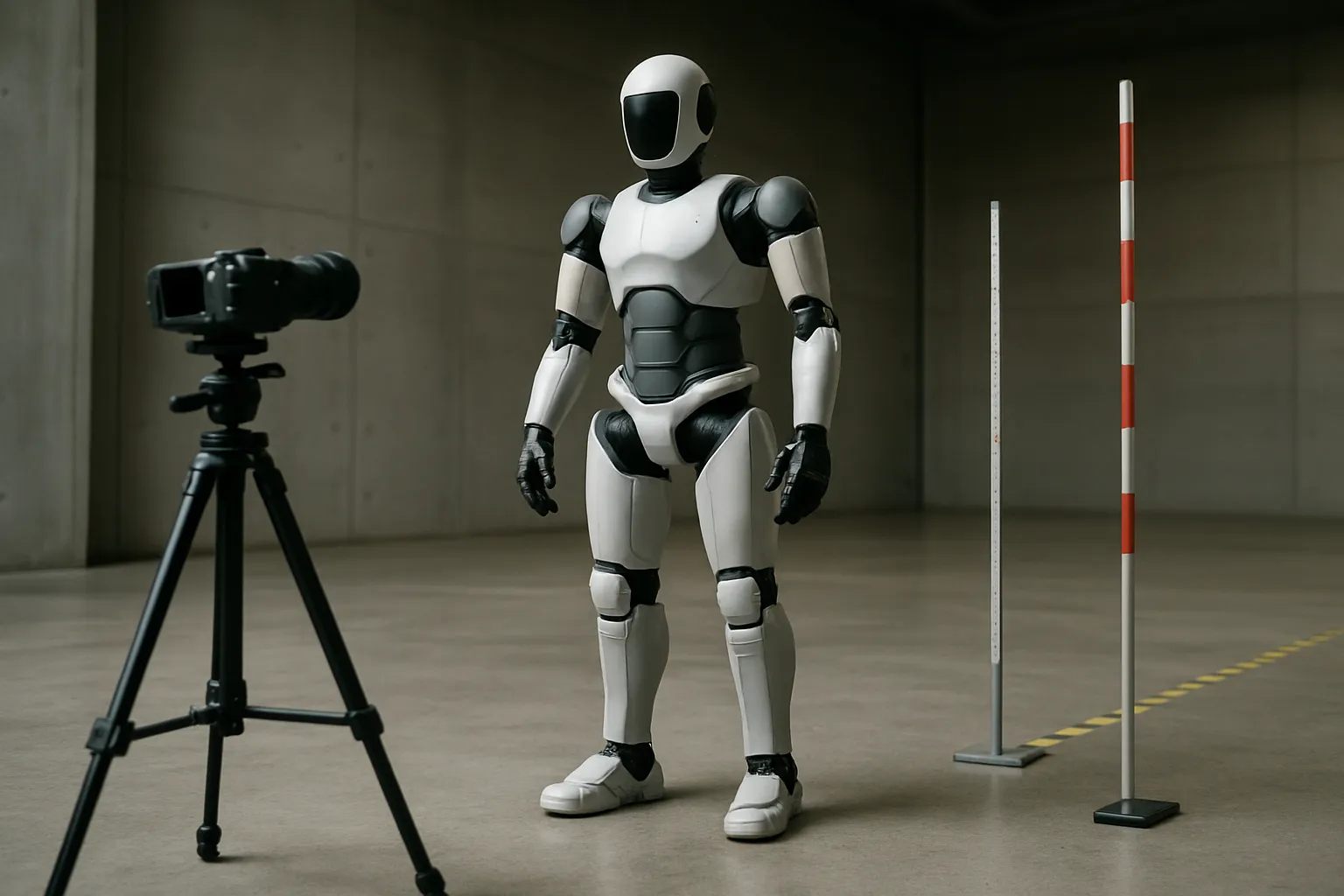
The Unitree G1 keeps appearing in public, from boxing demos to group dance routines and field trials. These sequences show a humanoid capable of a wide range of movements, but they also reveal limits in stability and operational battery life. Published reports make it possible to draw an initial assessment of its capabilities, though they are no substitute for an independent test.
Developed by Chinese manufacturer Unitree, the G1 is a humanoid robot standing 1.32 m tall and weighing about 35 kg, with 23 degrees of freedom in its standard configuration. Its official spec sheet lists about two hours of battery life and a starting price of $13,500, excl. taxes and shipping.
The demos at CES 2026 and IFA 2026, along with the Chimborazo expedition, highlight different aspects of how it behaves. In France, the company Instadrone is also adapting it for rescue, security and inspection missions. These experiences are the main evidence available for judging the G1 beyond its spec sheet.
Unitree G1 at CES 2026: a simulated boxing demo with no real punches
At CES 2026, Unitree presented a simulated boxing demonstration featuring its G1 humanoid robot. The sequence, reported by NeoZone, showcased the robot’s perception and reaction capabilities on the manufacturer’s booth.
What set this presentation apart was that it was simulated: no real punches were thrown. The demo focused on the robot’s reactions during a dynamic interaction, not on its ability to absorb physical impacts.
The sequence shows why coordination between perception and movement matters. The G1 officially comes with a depth camera and a 3D LiDAR, two components that help it perceive its surroundings.
CES therefore offered an example of reactive behaviour in a scenario organised by the manufacturer. It was neither a real sporting bout nor a mechanical endurance test.
The sequence is covered in detail in the Unitree G1’s simulated boxing demo at CES 2026.
Unitree G1 dance demo at IFA 2026: several robots, uneven smoothness
IFA 2026 brought another group demonstration: several Unitree G1 robots performed a dance in formation. This presentation put more emphasis on sequences of movements and visual coordination between several humanoids.
The robots completed their routine, but their behaviour was not uniformly smooth. Some G1 units showed noticeable wobbling during the movements.
This observation is a concrete limitation of the performance. Completing a group routine shows that the machines can execute motor sequences, while the wobbling reveals uneven execution quality.
The formation dance and the simulated boxing show two complementary sides of the G1: chaining coordinated movements and reacting to an interaction. In both cases, these were public demonstrations with predefined scenarios.
Unitree G1 on Chimborazo: a modified robot reaches 6,200 m with human assistance
The Chimborazo expedition is one of the experiences that differs most from trade show presentations. A Unitree G1 named Pemba reached the summit of the Ecuadorian volcano, at an altitude of 6,200 metres, after a 16-hour expedition, according to Humanoids Daily.
The robot had undergone several modifications for the operation. They concerned thermal management, ventilation and joint protection, three aspects tied to its operation in the conditions encountered during the climb.
Human assistance played a decisive role. On sections with slopes steeper than 30 degrees, Pemba was carried by people. The robot therefore did not walk the entire ascent.
This detail changes the significance of the achievement. The expedition shows that a specially prepared G1 was able to take part in a high-mountain climb and reach the summit with a human team. It does not amount to a fully autonomous ascent by a standard model.
Humanoids Daily also mentions other planned expeditions, including to Everest. These are announced projects, separate from the Chimborazo climb that took place.
The modifications and the course of the operation are described in the Chimborazo ascent by Pemba, a modified Unitree G1.
Instadrone in Béziers: adapting the Unitree G1 for rescue and inspection
In France, the Béziers-based company Instadrone is working on adapting the Unitree G1 for rescue, security and inspection missions. This initiative, reported by Futura, is an example of the robot being integrated into a project led by a French company.
The approach involves adapting an existing humanoid platform to specific operational needs. It differs from trade show demos, whose main goal is to show off the robot’s movements and reactions.
Futura reports a stated battery life of one hour for the G1, compared with about two hours on Unitree’s official spec sheet. Both figures should be kept with their respective sources, as they give different indications of operating time.
The outlet also mentions a price generally below €16,000 for the robot alone. This amount, reported by Futura, is not the official dollar price listed by Unitree.
The Instadrone project shows the value of adapting the G1 to defined missions. It is integration work, not a demonstration that on its own establishes validated operational performance in real rescue situations.
The company’s activities and the planned missions are covered in Instadrone’s project to adapt the Unitree G1 in Béziers.
Unitree G1 and G1 EDU specs: official specifications compared
The specifications published by Unitree put these demos in the context of the hardware of the robot’s two versions. The standard G1 has 23 degrees of freedom, while the G1 EDU can have up to 43 depending on its configuration.
The two models share, among other things, their dimensions, perception architecture and connectivity. The EDU version offers more options for articulation and development.
| Specification | Unitree G1 | Unitree G1 EDU |
|---|---|---|
| Dimensions standing | 1,320 × 450 × 200 mm | 1,320 × 450 × 200 mm |
| Dimensions folded | 690 × 450 × 300 mm | 690 × 450 × 300 mm |
| Weight with battery | About 35 kg | About 35 kg or more |
| Degrees of freedom | 23 | 23 to 43 |
| Joints per leg | 6 | 6 |
| Waist joints | 1 | 1, plus 2 optional |
| Joints per arm | 5 | 5 |
| Articulated hand | Not specified | Dex3-1, three fingers and 7 degrees of freedom, optional |
| Wrist | Base configuration | 2 additional degrees of freedom, optional |
| Maximum knee torque | 90 N·m | 120 N·m |
| Maximum arm payload | About 2 kg | About 3 kg |
| Battery | Lithium, 13 cells, 9,000 mAh | Same |
| Official battery life | About 2 h | About 2 h |
| Charger | 54 V, 5 A | 54 V, 5 A |
| Main processor | 8-core CPU | 8-core CPU |
| Additional computing | Not specified | Several modules available, including Orin |
| Perception | Depth camera and 3D LiDAR | Same |
| Audio | 4 microphones, 5 W speaker | Same |
| Connectivity | Wi-Fi 6, Bluetooth 5.2 | Same |
| Remote control | Yes | Yes |
| OTA updates | Yes | Yes |
| Secondary development | Not specified | Yes, SDK |
| Stated warranty | 8 months | 18 months |
| Manufacturer price | $13,500, excl. taxes and shipping | On request |
These figures come from Unitree’s official spec sheet, consulted on 20 October 2026. The manufacturer states that the maximum torque refers to the most powerful joint motor and that the payload an arm can handle varies considerably depending on its posture. Parameters may also change depending on the configuration.
The battery can be removed quickly. The depth camera and 3D LiDAR are common to both versions, as are the remote control and over-the-air updates.
Configuration details are also available in the full Unitree G1 spec sheet.
Unitree G1 strengths seen in the demos
A range of movements shown in public
The simulated boxing at CES and the group dance at IFA highlight two types of motor sequences. The robot can take part in a scripted interaction and perform movements in formation with other units.
This variety is the G1’s first observable strength. It relies on a jointed architecture that includes, in particular, six degrees of freedom per leg and five per arm on the standard model.
A platform that can be adapted
The Pemba expedition and the Instadrone project show two approaches to modifying or adapting the robot. In the first case, the work focused on hardware elements needed for a high-mountain expedition. In the second, the aim is to steer the platform towards rescue, security and inspection missions.
These initiatives show that the G1 can serve as a base for projects that differ from its commercial presentations.
A documented technical architecture
Unitree publishes the main mechanical and electronic specifications of its humanoid: dimensions, weight, number of joints, maximum knee torque, battery, sensors and communication options.
The distinction between the G1 and G1 EDU also makes it possible to identify differences in joint capabilities and development options. Maximum knee torque rises from 90 to 120 N·m, and the stated maximum payload per arm from about 2 to 3 kg.
Unitree G1 limitations reported so far
Visual stability that could be better during the dance
The wobbling observed on some robots at IFA is the most directly visible limitation in the reported demos. Not all the movements were equally smooth.
This behaviour is particularly worth noting in a group routine, where differences between robots become apparent within the same sequence.
Performance shown under controlled conditions
At CES, the boxing simulation involved no real punches. The robot displayed reactions in a scenario designed for the demonstration.
On Chimborazo, the use of hardware modifications and of human carrying on sections steeper than 30 degrees is an integral part of the reported achievement.
Both experiences provide useful information, but they concern different situations: a simulated interaction at a trade show and an assisted expedition with a specially prepared robot.
Stated battery life that varies by source
Unitree lists about two hours of battery life for both the G1 and G1 EDU. Futura, for its part, reports a stated battery life of one hour in its coverage of the Instadrone project.
This gap matters when assessing how long the robot can be used. It underlines the value of measurements taken under defined conditions, with specific tasks and configurations.
Unitree G1 price: how much does it cost?
On its official spec sheet, consulted on 20 October 2026, Unitree lists the standard G1 at $13,500, excl. taxes and shipping. The G1 EDU price is available on request.
Prices seen at German retailers are different. According to information published by MonsterDealz.de and Notebookcheck, offers listed on 2 September 2026 ranged from €17,884 to €27,370 depending on the seller.
Another survey, dated 3 April 2026, showed €17,884 at Joybuy, shipping included, and €27,275.89 at Reichelt.
Accessories also add to the cost of equipping the robot. One retailer offered a spare battery at €839.99 and a remote control at €297.50. The three-fingered hands are not included with the base model.
Six German retailers listed the G1, but only one promised delivery within fourteen working days. Listed prices and delivery times are therefore two separate aspects of what is on offer.
Detailed prices and configurations are presented on the page dedicated to the Unitree G1 price.
Unitree G1 review: our verdict based on published demos
The picture for the Unitree G1 is mixed. The public demos show a machine able to perform several categories of movement, take part in group presentations and serve as a platform for adaptation projects.
The simulated boxing at CES illustrates reactions in an organised interaction. The IFA dance shows group sequences with uneven smoothness. The Chimborazo expedition reflects a particular use of a modified robot, backed by human assistance. The Instadrone project adds another angle: integration into defined professional missions.
The G1’s main strength lies in this range of documented situations. Its observable limitations include the wobbling during certain dance sequences and the need for human assistance on the steepest sections of the Pemba expedition.
The specifications published by Unitree provide a precise technical baseline, but assessing real-world behaviour depends on the conditions under which the robot operates. The G1 shown at CES, the robots at IFA and the modified Pemba do not share a common test protocol.
Our view, then, is of a humanoid platform whose movement capabilities are illustrated by several demos, but whose practical performance has yet to be documented through independent, reproducible testing.
What we do not know yet
None of the available reports includes a full independent test of the Unitree G1 with a reproducible measurement protocol. Our newsroom has not carried out a hands-on test of the robot. Locomotion performance, stability in different conditions, resistance to stress and actual battery life in working conditions all remain to be measured independently.
Several technical details are not specified by the manufacturer: the exact camera and LiDAR models, their range and field of view, the main processor model, the battery’s energy in Wh and the charging time. The name and contents of the SDK are not specified, nor is the availability of an SDK for the standard version.
The full terms of the eight-month warranty for the G1 and the eighteen-month warranty for the G1 EDU have yet to be examined in the contractual documentation. The French price, actual availability in France and local after-sales service arrangements have not been established.
Finally, the published demos provide no independent, standardised comparison between the standard G1 and the G1 EDU. Exact performance by configuration, task and operating conditions remains an open question.
See also: Unitree: the manufacturer and its robot range; Unitree G1: specs and features; Unitree G1 price and listed offers; G1 at CES 2026: the simulated boxing demo; Pemba: the modified G1 on Chimborazo; Instadrone in Béziers: adapting the G1 for rescue and inspection missions.
The newsletter
Get the latest on humanoid robots
A selection of announcements, prices and demonstrations, with no advertising. Unsubscribe in one click.