
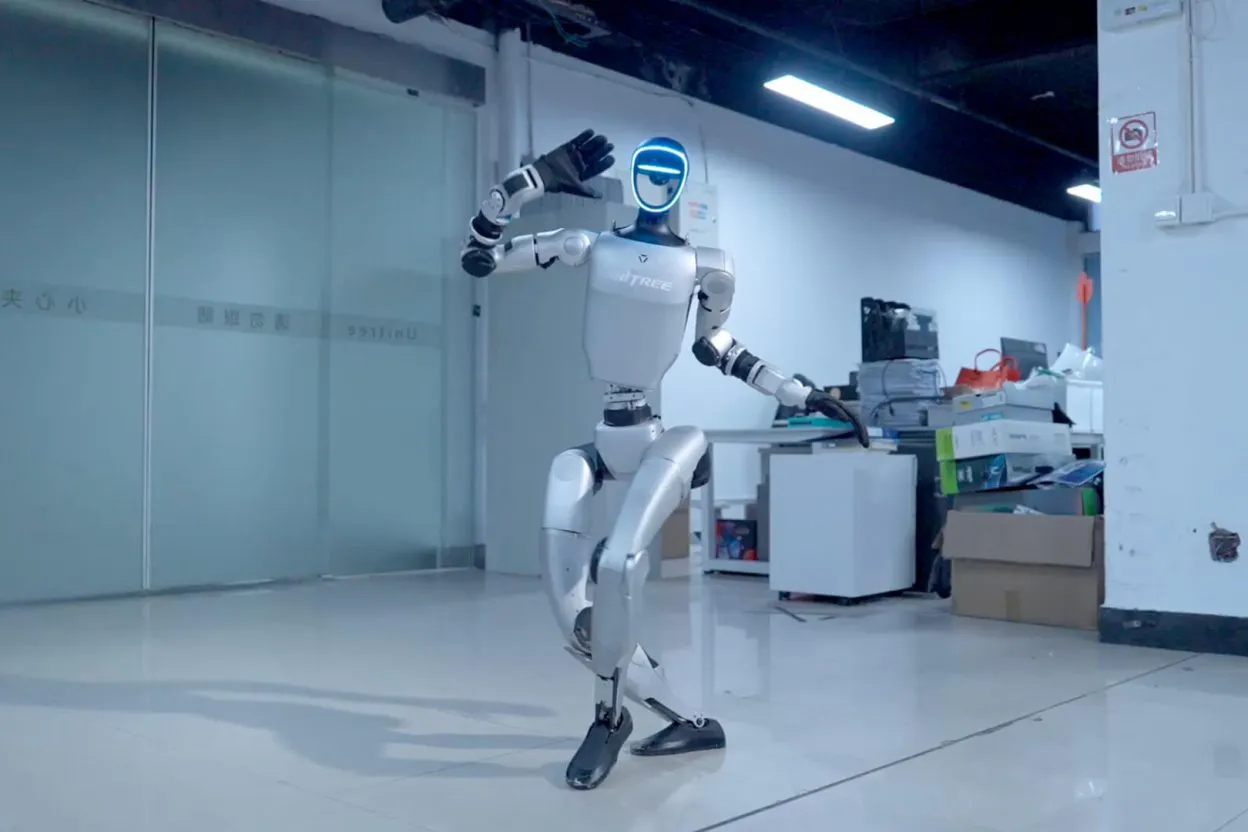
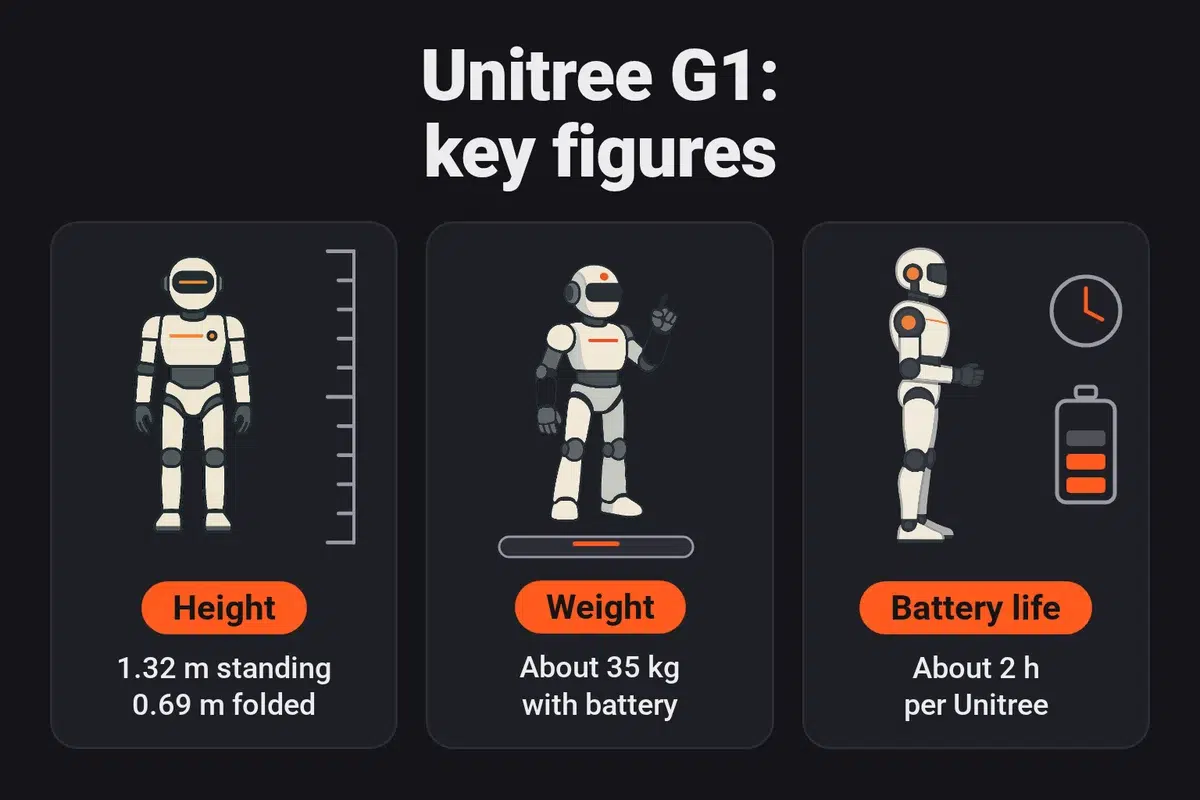
The Unitree G1 is a humanoid robot that stands 1.32 metres tall and weighs about 35 kg. It carries a depth camera, a 3D LiDAR and a removable battery. The Chinese manufacturer sells two versions, the standard G1 and the G1 EDU. They differ mainly in their joints, their payload capacity and their development options. The standard model has an official price of $13,500, excl. taxes and shipping.
Within the Unitree range, the G1 has been shown in demonstrations of perception, reaction and coordinated movement. It has also served as the base for more specialised projects, including a robot modified for a high-altitude climb and a unit adapted in France for rescue and inspection missions.
Unitree G1 and G1 EDU specs
The manufacturer’s official spec sheet, consulted on 20 October 2026, lists two versions with the same dimensions and the same perception architecture. The G1 EDU, however, offers more joint options and a higher arm payload.
| Specification | Unitree G1 | Unitree G1 EDU |
|---|---|---|
| Official price | $13,500, excl. taxes and shipping | On request |
| Standing dimensions (H × W × D) | 1,320 × 450 × 200 mm | 1,320 × 450 × 200 mm |
| Folded dimensions | 690 × 450 × 300 mm | 690 × 450 × 300 mm |
| Weight with battery | About 35 kg | About 35 kg and above |
| Total degrees of freedom | 23 | 23 to 43 |
| Degrees of freedom per leg | 6 | 6 |
| Waist degrees of freedom | 1 | 1, plus 2 optional |
| Degrees of freedom per arm | 5 | 5 |
| Articulated hand | Not specified | Optional three-finger Dex3-1, 7 degrees of freedom with force feedback |
| Additional wrist joints | Not specified | 2 optional degrees of freedom |
| Maximum knee torque | 90 N·m | 120 N·m |
| Maximum payload per arm | About 2 kg | About 3 kg |
| Battery | Lithium, 13 cells, 9,000 mAh | Lithium, 13 cells, 9,000 mAh |
| Battery replacement | Quick release | Quick release |
| Official battery life | About 2 hours | About 2 hours |
| Charger | 54 V, 5 A | 54 V, 5 A |
| Main computing | 8-core CPU | 8-core CPU |
| Additional computing module | Not specified | Several brands and models, including Orin |
| Perception sensors | Depth camera and 3D LiDAR | Depth camera and 3D LiDAR |
| Audio | 4 microphones, 5 W speaker | 4 microphones, 5 W speaker |
| Connectivity | Wi-Fi 6, Bluetooth 5.2 | Wi-Fi 6, Bluetooth 5.2 |
| Remote control | Yes | Yes |
| OTA updates | Yes | Yes |
| Secondary development (SDK) | Not specified | Yes |
| Stated warranty | 8 months | 18 months |
Unitree notes that the maximum torque figure refers to the most powerful joint motor. The load an arm can carry varies considerably with the robot’s posture. Specifications may also change depending on the robot’s configuration.
Unitree G1 size, joints and mechanical capabilities
Standing 1,320 mm tall, 450 mm wide and 200 mm deep, the G1 is relatively compact. Folded, it measures 690 × 450 × 300 mm. The stated weight of the standard version, battery included, is about 35 kg.
The main difference between the two versions lies in their mechanical design. The standard G1 has 23 degrees of freedom, while the G1 EDU has between 23 and 43 depending on its configuration. Both have six degrees of freedom per leg and five per arm.
On the EDU version, Unitree offers two additional waist joints and two additional degrees of freedom at the wrist. A three-finger Dex3-1 hand with seven degrees of freedom and force feedback is also available as an option.
The G1 EDU also has a maximum knee torque of 120 N·m, compared with 90 N·m for the standard G1. The stated maximum payload per arm rises from about 2 kg to about 3 kg. These are the manufacturer’s figures, subject to the caveats on posture and configuration.
Unitree G1 battery life, charging and sensors
Both versions use a 13-cell, 9,000 mAh lithium battery designed for quick removal. Unitree claims a battery life of about two hours and specifies a 54 V, 5 A charger.
A different figure appears in the French press. In its report on Instadrone’s work in Béziers, Futura cites a stated battery life of one hour for the G1, compared with about two hours on Unitree’s official spec sheet. The two figures therefore come from different published sources.
To perceive its surroundings, the robot combines a depth camera and a 3D LiDAR. It also has a four-microphone array and a 5 W speaker.
Computing is handled by an eight-core processor. The EDU version can take an additional computing module, with Unitree listing Orin among the options. Both versions have Wi-Fi 6, Bluetooth 5.2, a remote control and over-the-air (OTA) updates.
Unitree G1 demos: what the robot has shown
The G1 has appeared in several public demonstrations with very different aims. Some focus on the robot’s reactions, others on the coordination of its movements. Projects using modified units also show how it performs in specific environments.
CES 2026: a simulated boxing match
At CES 2026, Unitree staged a perception and reaction demonstration built around a simulated boxing match. On the manufacturer’s stand, the G1 responded to an interaction modelled on a boxing bout.
No real punches were thrown. It was a simulation designed to show the robot’s reactions, not a physical fight. This distinction is essential to understanding what was shown at the show.
IFA 2026: several G1 robots dance in formation
At IFA 2026, several G1 units performed a dance in formation. The group demonstration featured coordinated movements across multiple humanoid robots.
The performance was not perfectly even, however. Some of the G1s wobbled and the movements were not always smooth. The demonstration showed a group choreography, with visible irregularities as it unfolded.
Pemba: a modified G1 reaches 6,200 metres on Chimborazo
A G1 named Pemba was used for an ascent of Chimborazo, reaching its 6,200-metre summit. According to Humanoids Daily, the expedition lasted 16 hours.
The robot had been modified for the operation, with changes to thermal management, ventilation and joint protection. It was therefore not identical to the standard configuration listed in Unitree’s catalogue.
The ascent also required human assistance. On sections steeper than 30 degrees, Pemba was carried by members of the expedition. The summit was reached, but not through a climb completed entirely by the robot itself.
Further expeditions are being considered, including on Everest. That project is separate from the Chimborazo ascent already completed.
The operation is covered in detail in Pemba’s ascent of Chimborazo as a modified G1.
Instadrone adapts the G1 for rescue and inspection missions in France
In Béziers, the French company Instadrone is adapting a Unitree G1 for rescue, security and inspection missions. The project illustrates another use of the robot, based on modifying an existing platform.
The work covers three areas: rescue operations, security and inspection. The company is adapting the G1 for these missions, going beyond the movement demonstrations shown at trade shows.
The project is described in Instadrone’s work on the G1 in Béziers, based on information reported by Futura.
How much does the Unitree G1 cost? Official price and German retailer prices
On its official spec sheet, consulted on 20 October 2026, Unitree lists the standard G1 at $13,500. This price excludes taxes and shipping. For the G1 EDU, the manufacturer only states that pricing is available on request.
Prices published by German retailers are different. According to figures reported by MonsterDealz.de and Notebookcheck, six retailers listed the G1 on 2 September 2026, at prices ranging from €17,884 to €27,370 depending on the seller.
Another check, carried out on 3 April 2026, found the G1 at €17,884 at Joybuy, shipping included, and at €27,275.89 at Reichelt. These are retailer offers, not Unitree’s published list price.
Availability also varied. Of the six German retailers listing the G1, only one advertised delivery within fourteen working days.
Additional equipment may be priced separately. At one German retailer, a spare battery was listed at €839.99 and a remote control at €297.50. The three-finger hands are not included with the base model.
In its report on the Instadrone project, Futura cites a price generally below €16,000 for the robot alone. This figure is an indication reported by the outlet, separate from the manufacturer’s official price and from the offers seen in Germany.
The various prices and their context are covered on the page dedicated to the Unitree G1 price and in the comparison of humanoid robots listed by German retailers.
What we do not know yet
Several of the G1’s specifications are not given on the official spec sheet consulted on 20 October 2026. These include the exact processor model, the camera and LiDAR models, and the range and field of view of the sensors.
Battery capacity is given in milliamp-hours, but its energy in watt-hours is not stated. The time needed for a full charge is not given either.
On the software side, Unitree confirms that secondary development is possible on the G1 EDU, but the name and exact contents of the SDK have not been established. Whether an SDK is available for the standard G1 has not been disclosed either.
The stated warranties are eight months for the G1 and eighteen months for the G1 EDU. The manufacturer refers to a separate brochure for the full warranty terms, which are not detailed in the spec sheet.
The commercial situation in France also involves several unknowns: actual availability of the G1 in France, French pricing, local after-sales service arrangements and support terms. No verified French price can be derived from the official dollar price or from the German offers. The page Unitree in France: availability and distribution covers this market.
Finally, independently measured performance, including real-world battery life, locomotion capabilities and sensor performance, is not documented by independent test results in the available information. Public demonstrations and Unitree’s stated specifications are the facts currently established.
See also: the Unitree range, Unitree G1 prices, Unitree in France, the Unitree R1 humanoid robot, the Unitree Go2 robot, the Pemba expedition on Chimborazo, Instadrone’s adaptation of the G1, the simulated boxing match at CES 2026 and humanoid robot offers in Germany.
The newsletter
Get the latest on humanoid robots
A selection of announcements, prices and demonstrations, with no advertising. Unsubscribe in one click.