
Helix is the artificial intelligence system Figure has developed to control its humanoid robots. Described as a generalist vision-language-action model, it combines perception of the environment, reasoning and motion control. It has evolved through Helix 02, announced in January 2026, and then Helix 2.5, unveiled in September 2026 with evaluation results from 30 unfamiliar homes.
At Figure AI, Helix is the robot’s software layer. The company says the system runs directly on board the Figure 03, in real time, without following a pre-programmed script. Its stated goal is to let the robot acquire new skills and apply them to different situations.
Figure’s successive announcements have focused on whole-body autonomy, learning from human behavior and generalization to domestic environments. The test presented with Helix 2.5 includes a quantified comparison between a policy trained from scratch and a policy pre-trained on Index.
What is Helix, Figure’s AI model?
Figure defines Helix as a generalist Vision-Language-Action (VLA) model, meaning a system that combines vision, language and action. The architecture is designed to connect what the robot perceives with the decisions needed to carry out a physical task.
The company’s official presentation gives Helix three core functions: perception, movement and reasoning. Figure says these functions run on board the robot, in real time.
The principle it claims is integrated control. The system analyses its surroundings, decides which actions to take and drives the robot’s movements. Figure also describes Helix as a generalist intelligence that learns and gradually improves as it acquires new skills.
Helix is presented as the system that runs the Figure 03 without following a script. The company highlights several categories of demonstrations: handling laundry, logistics, making coffee and dynamic walking. Its official presentation also mentions sequences related to BMW, the Figure 03’s battery and voice reasoning.
Helix vs Helix 02 vs Helix 2.5: the three versions explained
Helix’s public development spans several generations of robots and software. Figure links the origins of Helix to the Figure 02, before presenting the Helix 02 and Helix 2.5 updates in 2026.
Helix: the original humanoid control system
The first generation of Helix established the vision-language-action model as the basis for controlling Figure’s humanoid robots.
The company associates its arrival with the Figure 02. When it retired that generation of robots in September 2026, Figure listed the birth of Helix as one of the key milestones reached with the F.02.
Figure also credits this generation with its first deployments at BMW and in logistics, as well as its first household tasks.
Helix 02: whole-body autonomy, announced in January 2026
On 27 January 2026, Figure announced Helix 02 under the title “Full-Body Autonomy”, focused on autonomy of the robot’s entire body.
This version was then tied to several presentations of household tasks. On 9 March 2026, Figure published an announcement about tidying a living room with Helix 02. On 8 May, another presentation covered tidying a bedroom.
These demonstrations place Helix 02 in the manipulation and movement work needed to carry out household tasks.
Helix 2.5: generalization to 30 homes in September 2026
On 17 September 2026, Figure presented Helix 2.5 in an announcement titled “Zero-Shot 30-Home Generalization”.
This update emphasizes the ability of a pre-trained model to work in environments it did not encounter during its task-specific adaptation.
Figure accompanied the presentation with an evaluation carried out, according to the company, in 30 homes in the San Francisco Bay Area, California.
Helix 2.5 tested in 30 homes: protocol and claimed results
Figure says it evaluated Helix 2.5 in 30 Bay Area homes. The stated protocol relies on three household tasks, the same model checkpoint for every home and a so-called “zero-shot” evaluation.
The three tasks selected were:
- Tidying a living room containing between 13 and 15 toys.
- Folding towels.
- Making a bed.
Figure says it applied a success criterion with no partial credit. An incomplete task therefore did not count as a success.
The company also says it kept the same frozen checkpoint for all 30 homes. The reported evaluation therefore covers a single shared policy, not a different version adapted to each home.
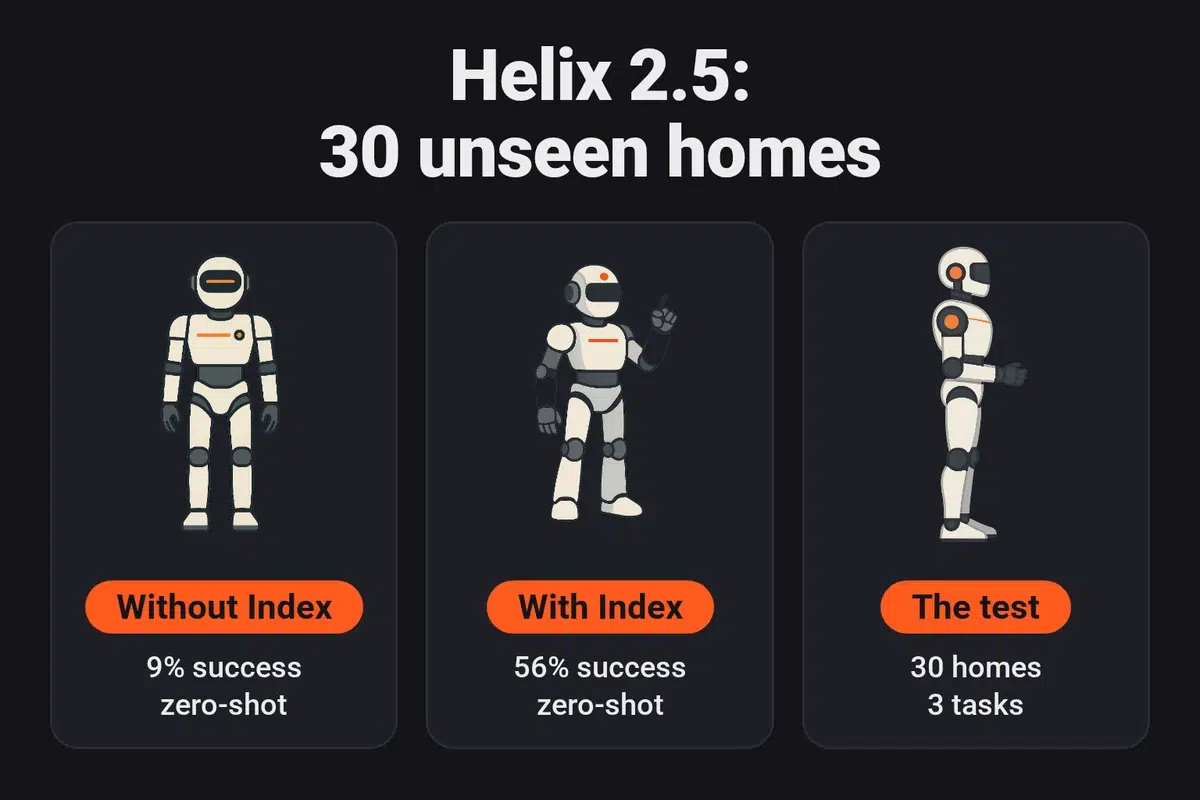
9% vs 56% success rate, according to Figure
The headline result presented by Figure is a comparison between a policy trained from scratch and a policy pre-trained on Index.
| Policy evaluated | Reported success rate |
|---|---|
| Policy trained from scratch | 9% |
| Policy pre-trained on Index | 56% |
Figure thus reports a success rate more than six times that of the policy trained from scratch. The gap is 47 percentage points.
The company also says Helix 2.5 matches the success rate of Helix 02 with half as much adaptation data.
These results come from the evaluation presented by Figure. The demonstrations and the associated figures come from the company and have not been independently verified.
What is Index? The dataset used to train Helix 2.5
Index is central to the training method presented with Helix 2.5. Figure describes it as a large-scale dataset of human behavior, used to pre-train its foundation model.
The company officially announced Index on 25 August 2026, a few weeks before unveiling Helix 2.5.
In the 30-home evaluation, Figure compares a policy trained from scratch with a policy that benefits from this pre-training. The comparison is meant to measure the claimed contribution of human behavior data to the robot’s ability to complete the requested tasks.
Scaling law: how performance changes with more training data
Figure says it studied a scaling law using four models trained on subsets of Index. The data volumes considered span a factor of eight across the configurations studied.
The aim is to examine how performance changes as the amount of pre-training data increases.
The company also states that none of the tasks used in the evaluation accounts for more than 1.90% of the pre-training dataset.
This detail supports its generalization claim: Helix 2.5 is presented as able to draw on skills from broad training to carry out tasks in different homes.
How Helix controls the Figure 03’s movements
Figure presents Helix as a system that controls the entire loop linking perception, reasoning and movement. Its operation is directly tied to the Figure 03, a humanoid robot standing 1.73 m tall and weighing 61 kg.
The official Figure 03 spec sheet lists the following characteristics:
| Characteristic | Official Figure value |
|---|---|
| Artificial intelligence system | Helix, generalist vision-language-action model |
| Stated control functions | Perception, movement and reasoning |
| Execution | On board the robot, in real time |
| Associated robot | Figure 03 |
| Figure 03 height | 1.73 m |
| Figure 03 weight | 61 kg |
| Figure 03 payload | 20 kg |
| Figure 03 battery life | 5 hours |
| Figure 03 speed | 1.2 m/s |
| Figure 03 actuation | Electric system |
These values are the Figure 03’s official hardware specifications. They describe the robotic platform on which Figure presents how Helix works.
In the context of the Figure 03’s deployment at BMW, the carmaker also describes hands with tactile sensors and cameras in the palms. BMW mentions audio functions and wireless charging.
Helix is designed to use the robot’s physical capabilities to carry out actions in its environment, including handling objects and moving around.
Helix demos: manipulation, movement and motion correction
Figure has released several demonstrations associated with Helix and its successive versions. They cover handling laundry, household tidying, logistics operations and dynamic walking.
The living room and bedroom tidying sequences, announced in March and May 2026 respectively, illustrate the activities highlighted with Helix 02.
The 30-home test presented in September 2026 extends this approach by pairing three household tasks with a quantified evaluation protocol.
Climbing stairs and adjusting movements
Another Figure 03 demonstration was posted on X by Brett Adcock, Figure’s CEO. It shows the robot climbing three steps of a steep staircase fitted with a fixed handrail.
According to Brett Adcock, the climb was performed autonomously, with no remote control. The robot moves slowly and analyses its surroundings several times during the ascent.
German outlet heise online considers it likely that the robot was controlled by Helix, running on board, with perception of its own posture based on stereo cameras.
The sequence shows a behavior in which the robot reassesses its situation while moving. It is consistent with the way Figure says Helix works, combining perception and motion control in a continuous loop.
However, the exact self-correction mechanism used during this climb is not detailed in the information published about the demonstration.
Helix at home and in industry: use cases
Figure presents Helix as a generalist system, while its communications show both household activities and industrial or logistics operations.
At home: laundry, tidying and handling objects
The Figure 03 is officially presented as a humanoid designed for homes. Figure cites laundry, cleaning and dishes among the activities it intends the robot to perform autonomously.
The company also highlights the ability to talk to the robot, ask it questions and hand tasks over to it.
The Figure 03’s presentation stresses the physical constraints of homes, including stairs, narrow spaces and changing layouts.
The evaluations announced with Helix 2.5 specifically cover tidying toys, folding towels and making a bed.
At BMW: handling components and logistics
Figure robots have also been used in BMW’s industrial environment in Spartanburg, South Carolina.
According to BMW, the pilot run with the Figure 02 in 2025 lasted ten months. The robots contributed to the production of more than 30,000 BMW X3 vehicles by positioning body parts for welding.
The Figure 03 then took on logistics operations, sorting loose components and placing them on a sequencing cart.
Figure announced the F.03’s arrival at BMW on 30 June 2026. These activities are another area of physical manipulation presented in the communications surrounding its humanoids.
What we do not know yet
Figure describes the general principles behind Helix and publishes demonstrations of its robots, but several pieces of information needed for a full technical assessment have not been disclosed.
The company does not publicly detail all the characteristics of its software versions, including their exact architectures, the full volumes of training data and the technical self-correction mechanisms. The detailed conditions needed to independently reproduce the reported evaluations have not been established.
Helix’s performance has not been independently measured in the available information. Success rates for the video demonstrations, including the stair climb, are not disclosed. The 9% and 56% figures apply exclusively to the evaluation protocol Figure presented for the 30 homes.
Access to the software also remains unknown: the availability of an SDK, openness to third-party developers, terms of use and options for external integration have not been specified.
For the Figure 03 and its Helix system, no public retail price, availability timeline for consumers in France or Europe, waiting list or after-sales service terms have been established.
See also: Figure 03: specifications and features of the humanoid robot; Can you buy a Figure robot? Price and availability; Helix 2.5 tested in 30 unfamiliar homes without on-site training; Figure 03 climbs a three-rung ladder, according to a video from Brett Adcock.
The newsletter
Get the latest on humanoid robots
A selection of announcements, prices and demonstrations, with no advertising. Unsubscribe in one click.