
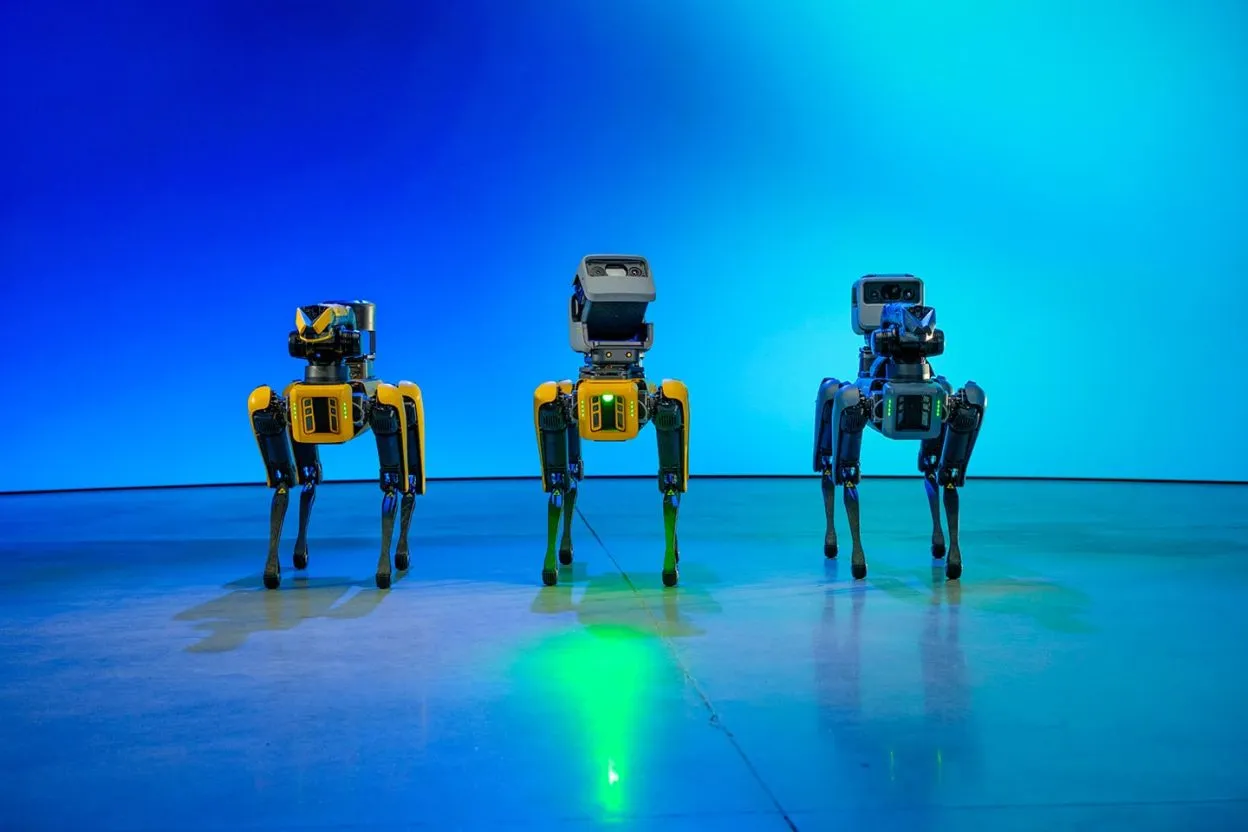
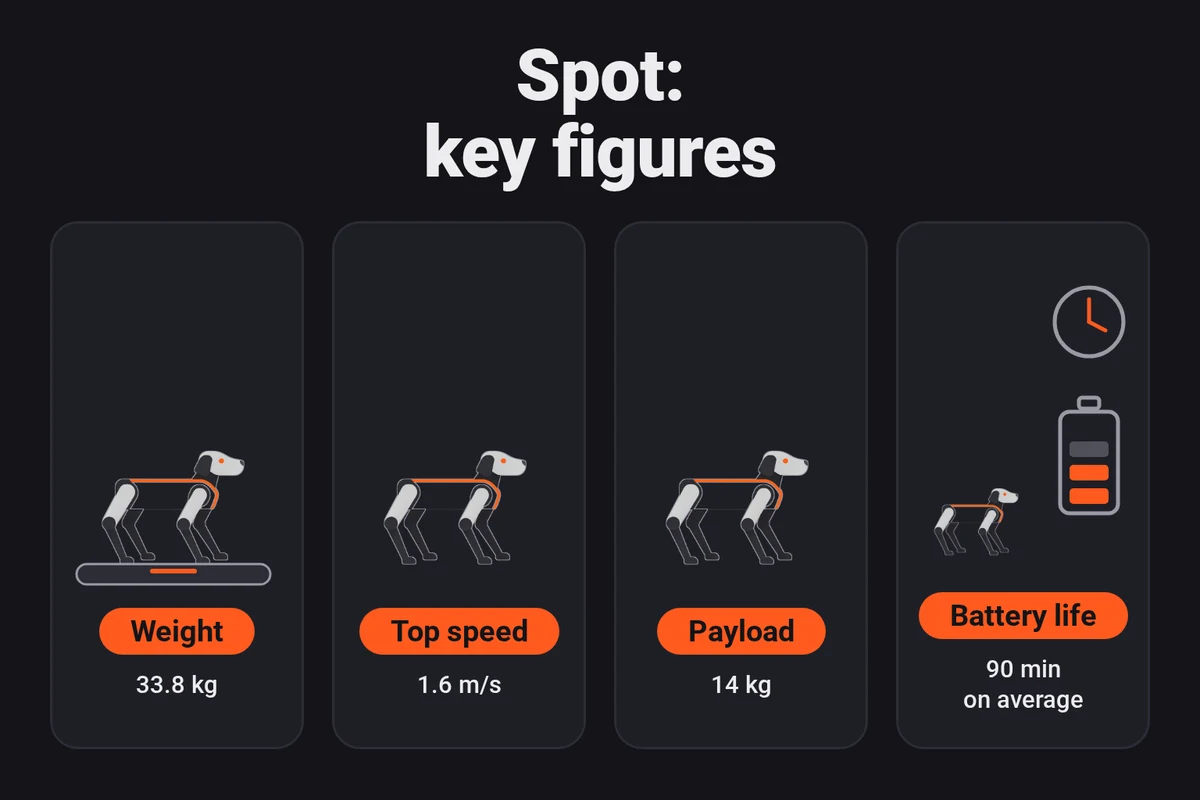
Spot is Boston Dynamics’ quadruped robot, built to move autonomously, carry equipment and perform inspections. It weighs 33.8 kg with its battery, reaches 1.6 m/s and has a stated average runtime of 90 minutes. Its maximum payload is 14 kg. The robot relies on Orbit, the software that manages missions and inspection data, which gained new features with the Spot 5.2 update.
Within the Boston Dynamics lineup, Spot stands out for its four-legged locomotion, its interfaces for onboard equipment and its autonomous navigation. The company says more than 1,500 Spot robots are in customers’ hands. The platform combines movement, perception and data collection with software tools designed to make use of inspection results.
Boston Dynamics Spot specifications
The official Boston Dynamics spec sheet, consulted on 20 October 2026, describes a robot that weighs 33.8 kg with its battery, is 500 mm wide and stands 610 mm tall in its default standing configuration. Its height can range from 520 to 700 mm.
Spot has a top speed of 1.6 m/s, can climb and descend slopes of up to 30° and can step over 300 mm stairs. Its 360° perception supports navigation and obstacle detection.
| Specification | Official Boston Dynamics figure |
|---|---|
| Robot type | Mobile quadruped |
| Weight with battery | 33.8 kg |
| Width | 500 mm |
| Default standing height | 610 mm |
| Height range | 520 to 700 mm |
| Top speed | 1.6 m/s |
| Maximum slope | ±30° |
| Maximum step height | 300 mm |
| Ingress protection rating | IP54 |
| Operating temperature | -20 to +55 °C |
| Perception | 360° |
| Battery capacity | 564 Wh |
| Battery weight | 5.2 kg |
| Average runtime | 90 minutes, depending on load and environment |
| Standby time | 180 minutes |
| Charging time | 60 minutes |
| Maximum payload | 14 kg |
| Equipment mounts | M5 T-slot rails |
| Connectors | 2 DB25 connectors |
| Software interfaces | API available |
| Hardware interface | Interface control document available |
| Manipulation | Optional integrated arm |
| Autonomous functions | Autonomous charging, rerouting around obstacles, self-righting |
Autonomous navigation, stairs, slopes and IP54 rating
Mobility is one of Spot’s core features. Its four legs let it climb stairs and move across sloped surfaces within the limits stated by Boston Dynamics.
The robot also has navigation functions that let it adjust its movement to the obstacles it encounters. The company specifically mentions rerouting around an obstacle and self-righting.
360° perception rounds out these capabilities. It lets Spot take its surroundings into account as it moves, particularly when following an inspection route.
Spot has an IP54 rating and an operating temperature range of -20 to +55 °C. These figures define the environmental conditions in which it is rated to operate.
The IP54 rating means protection against dust that could interfere with operation and against splashing water. It does not mean the robot is waterproof enough to be submerged.
Spot battery life: 564 Wh capacity, runtime and charging time
Spot carries a 564 Wh battery that weighs 5.2 kg. Boston Dynamics quotes an average runtime of 90 minutes, which varies with the equipment carried and environmental conditions.
The company also lists a standby time of 180 minutes and a charging time of 60 minutes.
Autonomous charging is one of Spot’s official features. It allows charging to be built into the robot’s automated operation, alongside navigation and mission execution.
The difference between active operation and standby matters for inspection missions: the 90 minutes refers to the stated average runtime while operating, whereas the 180 minutes applies to standby.
Spot payload: 14 kg capacity, connectors and optional arm
Boston Dynamics gives Spot a maximum payload of 14 kg. This capacity allows additional equipment to be fitted to the mobile platform, particularly for data collection and inspection missions.
The robot has M5 T-slot rails and two DB25 connectors. These hardware interfaces are intended for integrating onboard equipment.
Boston Dynamics also provides a software API and a hardware interface control document. These resources make it possible to build integrations between Spot, its equipment and external software systems.
Spot Arm: optional integrated arm for mobile manipulation
Spot can be fitted with an optional integrated robotic arm. Boston Dynamics presents this as a way to add mobile manipulation capabilities to the robot.
This configuration combines the quadruped’s mobility with the ability to interact physically with its surroundings. The arm is therefore separate equipment from the base mobile platform.
What is Orbit? Spot’s inspection and data management software
Orbit is Boston Dynamics’ software platform for fleet management and inspection data. It organises missions and the information Spot collects around the equipment being monitored.
The software can import asset hierarchies and attach metadata to equipment: location, type, criticality, manufacturer and model. This structure links inspection results to the relevant installations.
Orbit has features in common with several categories of industrial systems:
- CMMS, or computerised maintenance management systems.
- MES, or manufacturing execution systems.
- EAM, or enterprise asset management platforms.
Its open API also allows external data sources to be connected, including programmable logic controllers (PLCs) and security cameras.
This architecture brings the inspections Spot carries out closer to the information already held in industrial systems. The robot gathers observations in the field, while Orbit organises them by the equipment and processes involved.
Spot 5.2 update: visual and video inspections with Gemini
The Spot 5.2 update expands the inspection capabilities of the robot and its Orbit software. One of the main changes is the use of Google Gemini in Orbit AIVI to interpret visual information.
Reading gauges, status lights and equipment
Spot’s AIVI features include visual inspections covering several types of items:
- Gauges and their readings.
- Status lights.
- Pallets.
- Levels.
- 5S boards.
Integrating Gemini into Orbit AIVI is intended to put these visual observations to use in inspection missions.
AIVI-Learning: video sequence analysis
Spot 5.2 also adds video inspections with AIVI-Learning. This feature extends analysis to situations where observing movement or change over time is relevant.
Boston Dynamics gives three examples of situations the system is designed to detect: water leaks, conveyor belt slippage and the state of status lights.
Video analysis thus complements visual inspections of fixed items or equipment readings.
Site Scans: area monitoring and anomaly detection
The Site Scans feature extends inspections to monitoring entire areas. It is designed to identify certain unusual situations in the environment Spot patrols.
The examples given include:
- A spill.
- A person in a restricted area.
- A suspicious bag.
By default, Site Scans covers the entire site. Users can, however, adjust the areas and time slots involved.
This feature introduces a spatial approach to inspection: instead of limiting data collection to specific pieces of equipment, Spot can examine areas according to the parameters set in Orbit.
Gas detection, vibration analysis and partial discharge inspection
The features presented with Spot 5.2 include several types of specialised inspection that combine the robot’s mobility with measurement or analysis devices.
MFE gas detection: more than 20 gas types
The MFE Spot Connected Gas Detection system is described as able to detect more than 20 types of gas.
This integration pairs Spot’s mobility with gas detection equipment, as part of the inspection functions offered around the platform.
Visual vibration analysis
Boston Dynamics also presents a visual vibration analysis feature. It aims to use visual observations to identify vibration on equipment.
This adds another type of observation to Spot’s inspections, alongside gauges, status lights and video sequences.
Partial discharge detection with the Sorama L642
The Sorama L642 device is associated with partial discharge detection. The equipment covered includes high-voltage cables, bushings and transformers.
This feature is part of the electrical installation inspection capabilities presented for Spot.
AI agents and MCP: Spot missions triggered by industrial systems
Orbit’s development includes an architecture designed to support an MCP layer, for Model Context Protocol. The stated goal is to let artificial intelligence agents trigger Spot missions based on business rules and information from industrial systems.
Two families of scenarios are mentioned: equipment reliability and safety.
In this setup, information from an industrial system can be used to determine whether an inspection is needed. Orbit serves as the interface between the available data, the defined rules and the missions Spot carries out.
The planned connections with PLCs, security cameras and equipment management software provide possible sources for these triggers.
These are automation possibilities presented around the MCP architecture, not independently measured deployment results.
Spot deployments: more than 1,500 robots at customer sites
Boston Dynamics says more than 1,500 Spot robots are with its customers. This figure, published on the official product page consulted on 20 October 2026, gives an indication of how widely the platform has spread.
One example of industrial use is reported at Hyundai. In an article published on 17 October 2026, Spot is described as already being used for quality control, including checking that components are present on vehicles.
The same article mentions deployments across hundreds of facilities. These field reports add context to the overall figure provided by Boston Dynamics.
The Spot 5.2 features broaden the range of inspections presented by the company, from reading indicators to video analysis, area monitoring and detecting specific phenomena on equipment.
What we do not know yet
Despite the detail in its official spec sheet, several pieces of information about Spot have not been disclosed.
- Price: Boston Dynamics does not publish a public price for Spot in the available information, nor a separate price for the optional arm.
- Lead times: delivery times are not specified.
- France and Europe: sales and availability terms in these markets have not been established.
- Robotic arm: its detailed specifications, including payload, reach and degrees of freedom, have not been disclosed.
- Spot 5.2 inspection results: no independently measured success rate is available for the visual analysis, video analysis, area monitoring or specialised detection features.
- Deployment of AI agents via MCP: the operational results of this architecture and how much customers actually use it are not documented by independent measurements.
See also: Atlas, Boston Dynamics’ humanoid robot; Can you buy a Boston Dynamics robot?; Spot 5.2: video inspections with Gemini and detection of more than 20 gas types; Orbit moves to Gemini: Spot deploys on alert in factories.
The newsletter
Get the latest on humanoid robots
A selection of announcements, prices and demonstrations, with no advertising. Unsubscribe in one click.