
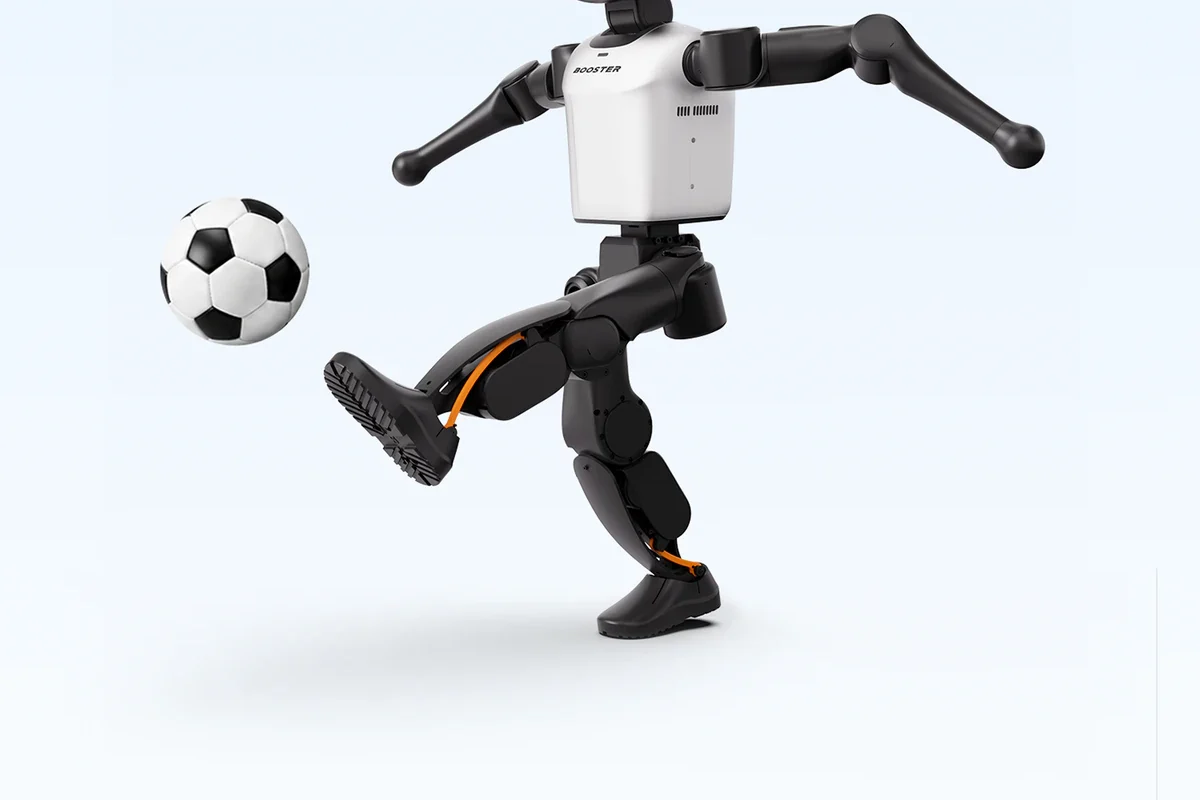
The K1 is the small humanoid robot from Booster Robotics. The manufacturer’s website calls it its “entry-level embodied development platform”. It shares the official product page with the T2, billed as the “flagship platform”. The K1 stands under a metre tall, weighs less than 20 kg and comes in three editions that differ in computing power, battery and warranty. It launched in China in October 2025 and is offered in Europe by several retailers. It is best known from the RoboCup pitches.
Booster K1 specifications
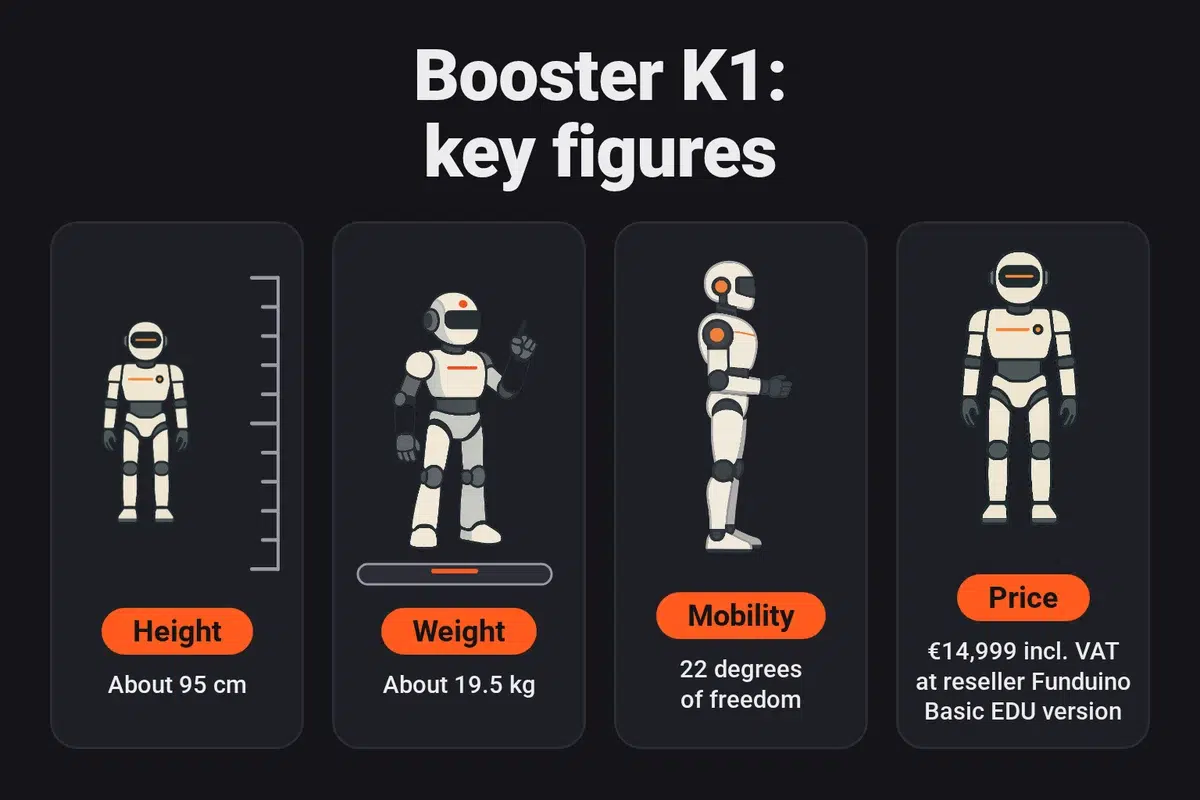
Booster publishes an undated spec sheet on its website. The K1 stands about 95 cm tall and weighs about 19.5 kg. It has 22 degrees of freedom (DoF): 2 in the head, 4 in each arm and 6 in each leg. The manufacturer quotes a walking speed of 2 m/s, a turning speed of 1.5 rad/s and a maximum peak torque of 60 N·m. Each joint has a dual encoder.
For perception, the robot carries a binocular stereo camera, a 9-axis inertial measurement unit (IMU), a microphone array and a speaker. It connects over Wi-Fi 6, Bluetooth 5.2 and Gigabit Ethernet, and a remote control is available as an option. On the software side, Booster provides Python and C++ SDKs, an agent development framework, open-source simulation resources and its Booster Studio environment, and claims support for large models. Safety relies on a software and hardware emergency stop. Charging is through a magnetic port, and charging during use is listed as an option.
| Specification | Official value (Booster) |
|---|---|
| Standing height | About 95 cm |
| Weight | About 19.5 kg |
| Degrees of freedom | 22 (head 2, arms 4 × 2, legs 6 × 2) |
| Walking speed | 2 m/s |
| Turning speed | 1.5 rad/s |
| Maximum peak torque | 60 N·m |
| Encoders | Dual encoder per joint |
| Vision | Binocular / stereo camera |
| Other sensors | 9-axis IMU, microphone array |
| Audio | Speaker |
| Connectivity | Wi-Fi 6, Bluetooth 5.2, Gigabit Ethernet |
| Control | Optional remote control |
| Software | Python and C++ SDKs, agent development framework, open-source simulation, Booster Studio, large model support |
| Safety | Software and hardware emergency stop |
| Charging | Magnetic port (charging during use optional) |
| Computing | 48, 117 or 200 TOPS depending on edition |
A blog post from retailer Génération Robots (26 June 2025) gives the same measurements (95 cm, 19.5 kg, 22 DoF). It also lists tactile sensors, navigation with obstacle avoidance and ROS support alongside Python and C++. It describes the K1 as having “half the joint power of the T1”. Two figures in the post differ from the official spec sheet. It puts computing at “100 to 200 TOPS”, whereas Booster gives 48, 117 or 200 TOPS depending on the edition. It states an active runtime of about 40 minutes, whereas Booster quotes 20 minutes for the Geek edition and 1 h 10 min for the Education and Professional editions.
Booster K1 editions: Geek, Education and Professional compared
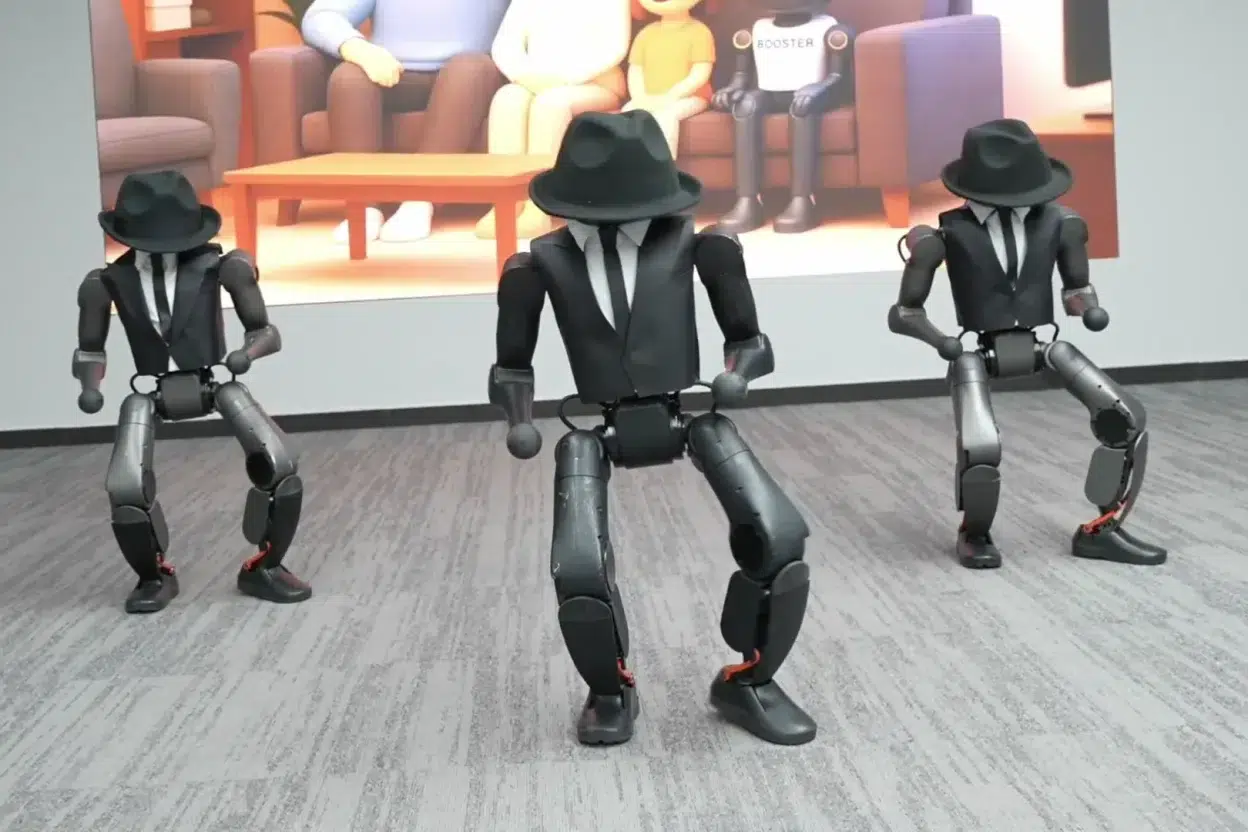
The official spec sheet lists three K1 editions. They share the same mechanics and differ in onboard electronics and warranty. The Geek edition makes do with a 2 Ah battery and a three-month warranty. The Education and Professional editions have the same 5 Ah battery and the same runtime, and differ in computing power.
| Edition | Computing | Battery | Runtime (walking at 1.1 m/s) | Warranty |
|---|---|---|---|---|
| Geek | 48 TOPS (dense) | 2 Ah | 20 min | 3 months |
| Education | 117 TOPS | 5 Ah | 1 h 10 min | 1 year |
| Professional | 200 TOPS | 5 Ah | 1 h 10 min | 1 year |
Booster’s service terms state that the warranty runs from the date the robot is received. Repairs outside warranty are charged. The buyer pays for shipping to after-sales service, and Booster covers return shipping when a quality defect is confirmed. The manufacturer does not publish a general returns policy and directs customers to a Support & Repair portal.
Booster K1 in China: launch price and the K1 Explorer edition
According to Jiemian, Booster launched the K1 on 24 October 2025 from 29,900 yuan, a price presented as time-limited. TMTPost (12 January 2026) reports that the K1 went on sale at launch on Taobao and Tmall and that the first fully paid batch sold out in 20 minutes. The outlet adds that more than 1,000 units had been signed with retailers at that point.
The Chinese version of the official website announced on 17 September 2026 the release of a “K1 Explorer” edition. According to Itiger (21 September 2026), it is offered from 38,999 yuan on the official JD.com store. Itiger repeats the core specifications (95 cm, 19.5 kg, 22 DoF, 60 N·m peak torque) and states a three-month warranty, compared with one year for the Education and Professional editions. The website links this edition to home use, STEM teaching, DIY projects and competitions. The October 2025 price applied to the K1’s first release at a launch price, not to the Explorer edition.
Huxiu (17 April 2026) reports more than 1,000 K1 units in total, in more than 20 countries and for around 400 customers, mostly in education and competitions. These are company statements reported by the press.
Booster K1 price at European retailers
In Germany, Funduino listed two versions of the robot on 22 October 2026. Prices include VAT and exclude shipping, and each product is marked “available to order”.
- K1 Basic EDU (117 TOPS): €14,999.00. The retailer describes it as 90 cm tall, whereas Booster’s official spec sheet gives about 95 cm.
- K1 PRO (200 TOPS): €17,899.99.
- 5 Ah battery (80 minutes according to Funduino): €1,307.81.
- 2 Ah battery: €831.81.
- Chargers: €249.00.
Funduino mentions an education discount of up to 10%, applied on the invoice. The retailer also has a product page for the 48 TOPS Geek version.
OpenELAB lists several K1 accessories. The 5 Ah battery with charger is priced at €2,623.95, on pre-order with stock expected back within two to three weeks. The standard battery is priced at €1,888.95 and the charger at €250.95.
The Génération Robots blog post (26 June 2025) gives no price and quotes delivery in three to four weeks. In it, Génération Robots describes itself as “exclusive distributor in Europe”. Yet Funduino, OpenELAB and reichelt also sell the Booster range, and reichelt calls itself “one of the first distributors” in the German-speaking market.
Booster K1 at RoboCup
The K1 proved itself in competition even before its commercial launch in China. According to reichelt, the HTWK Robots team from Leipzig won the Kid Size category at RoboCup 2025 in Salvador, Brazil, using K1 robots. It beat TH-MOS 11-0 in the final.
At RoboCup 2026 in Incheon (Songdo, South Korea), The Next Web reports that 38 of the 59 teams in the humanoid leagues used Booster machines. The Beijing municipal government gives the same figure of 38 teams. The two sources disagree on the closing date: 6 July for The Next Web, 5 July for Beijing.
The K1 won in two categories. In the middle category, German team B-Human won with K1 robots, beating HTWK Robots 4-0 in the final. The Next Web describes this 11-a-side match as the first between two full teams of humanoid robots on real hardware. In the small category, the Invic team won with a “K1 Air”. The large category went to Hephaestus (Tsinghua University) on T1. Booster’s official website claims 3 gold, 2 silver and 3 bronze medals at this edition. Also according to The Next Web, Booster used the event to launch Booster Studio and its own 3-a-side league.
Other Booster robots: T1 and T2
Booster T1: the previous model
The T1 no longer appears on the product pages, store or documentation of the official website, which feature only the T2 and the K1. Its specifications therefore come from retailers. Génération Robots (blog post of 3 April 2025) describes a robot measuring 118 × 47 × 23 cm and weighing about 30 kg, with 23 DoF (head 2, arms 4 each, torso 1, legs 6 each). It pairs a 14-core Intel i7 processor with a 200 TOPS NVIDIA AGX Orin module. The distributor quotes a maximum knee torque of 130 N·m and an Intel RealSense D455 RGB-D camera.
The T1 comes in three versions: standard, with grippers and with dexterous hands. The DoF count rises from 23 to 31 and then to 41 depending on the version, according to Génération Robots and Funduino. reichelt quotes up to 2 h of walking and 4 h on standby, ROS 2 support and compatibility with the Isaac Sim, MuJoCo and Webots simulators. New and used offers are covered in detail in our article on the demonstration unit offered by Génération Robots.
Booster T2: the new flagship
The T2 was officially launched on 13 July 2026, according to a Booster press release quoted in the press. The official spec sheet offers it in two variants, Education and Professional. It stands about 1.4 m tall and weighs about 42 kg according to Booster, while Futura Sciences gives up to 43 kg depending on configuration. It has 31 DoF.
The Education variant runs on a 375 TOPS ARM processor, the Professional on an NVIDIA Jetson Thor T5000 rated at 2,070 TFLOPS. The 48 V, 10 Ah battery provides about 2 h of continuous walking. The robot optionally accepts standard end effectors, grippers or dexterous hands, and Booster quotes a maximum two-arm payload of 10 kg, varying with posture. In a post on the Open Robotics community on 26 August 2026, Booster presented it as an open platform compatible with ROS 2, with access to high-level and low-level SDKs.
What we do not know yet
Booster publishes no official price for the K1, nor for the T1 or T2. The store on its website shows the K1 without a price, without edition details and without delivery countries. In China, only the starting price of the K1 Explorer edition is known. Prices for the other editions on the Chinese market are not published, and the relationship between the K1 Explorer and the three editions on the official spec sheet is not specified. The “K1 Air” used at RoboCup is not among the editions described by Booster either.
In Europe, OpenELAB’s price for the K1 robot is not known.
Booster has published neither an official list of authorised distributors nor confirmation of a European exclusive. No official page mentions CE compliance. Warranty and after-sales service terms in France for a robot bought from a retailer are not specified. The official K1 spec sheet does not mention ROS, which only retailers advertise.
Actual sales by channel (official website, JD.com, Tmall or Taobao) are not published. The volumes cited by the press come from the company: more than 1,000 units in total according to Huxiu, more than 1,000 units signed with retailers according to TMTPost. Booster has also not explained when or why the T1 disappeared from its product pages.
See also: Booster Robotics, the company and its range · Can you buy a Booster robot? · Educational robots · Humanoid robot price guide · Booster Robotics dominates RoboCup 2026 · A used Booster T1 for €31,200 incl. VAT at Génération Robots
The newsletter
Get the latest on humanoid robots
A selection of announcements, prices and demonstrations, with no advertising. Unsubscribe in one click.