

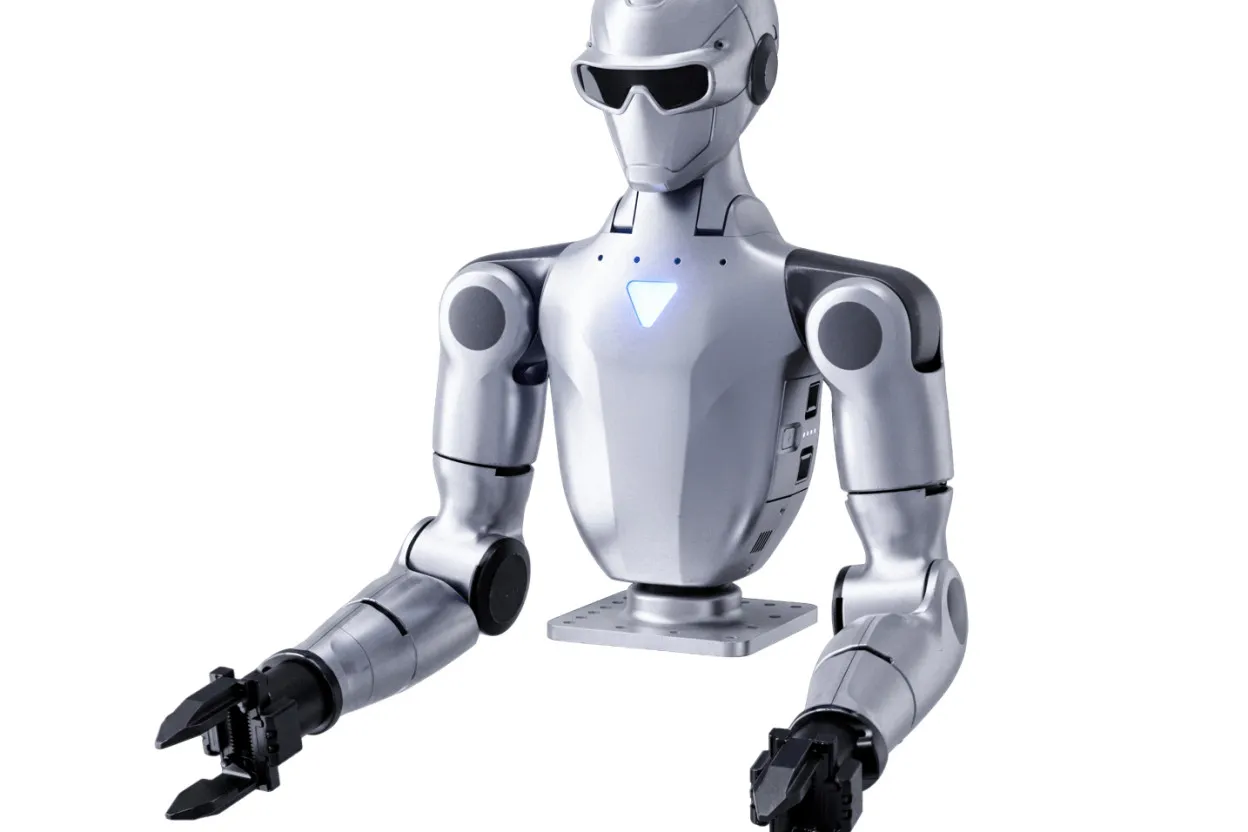
A humanoid robot can now be ordered like a smartphone. For the past few days, the Unitree R1 has been available for pre-order on AliExpress and on the Chinese manufacturer’s official website. According to the official spec sheet, the R1 Air version stands 1.23 metres tall and weighs 27 kilos. Prices start at 4,900 dollars for the R1 Air, around €4,150. Selling a humanoid to the general public is nothing new. The sales channel is. This is probably the first time such a robot has appeared on a marketplace open to everyone.
The standard version costs $5,900, around €5,000. Shipping to France adds €680, bringing the bill to about €5,700 for a unit delivered to your door.
Unitree R1 specs: what the “born for sport” video shows
Unitree presents the R1 as a robot “born for sport”. Its promotional video shows it performing cartwheels, handstands, spinning kicks and mock fights in quick succession. The manufacturer does not say whether these sequences involve autonomous or pre-programmed movements.
Mechanically, the robot has 20 to 26 degrees of freedom depending on the version, with six joints per leg and five per arm. It runs on an octa-core processor paired with a GPU and offers real-time voice and visual recognition through a multimodal artificial intelligence model. It also has a four-microphone array, a speaker, Wi-Fi 6 and Bluetooth 5.2. The lithium battery provides around one hour of operation.
Unitree R1 is a developer platform, not a home robot
One hour of battery life is short. And on the base model, the hands cannot grip, so they cannot handle fine tasks. The R1 can run, perform acrobatics, recognise a voice and answer a question, but it will not do the dishes.
The robot is aimed primarily at developers and laboratories. It is a hardware base on which to build your own algorithms. The control interfaces for the joints and sensors are open and compatible with common simulation platforms. Unitree offers a better-equipped EDU version with an NVIDIA Jetson Orin chip, intended for institutions that want to experiment more seriously.
For the ordinary buyer, the case is harder to make. Limited battery life, non-functional hands on the standard version and a development interface needed to teach it anything at all: the robot is fascinating but, for now, has no clear household use.
Unitree shipped 5,500 humanoid robots in 2025
In 2025, Unitree shipped more than 5,500 humanoid robots. Over the same period, Tesla, Figure AI and Agility Robotics delivered around 150 each. According to TrendForce, Unitree and AgiBot could account for nearly 80% of China’s humanoid production in 2026. Wang Xingxing, Unitree’s founder, is targeting between 10,000 and 20,000 units delivered this year and plans an initial public offering on Shanghai’s STAR Market.
Shipments began in May 2026 from Unitree’s official website, then from 30 June on AliExpress. The comparison with the first iPhone in 2007 is tempting: at launch it did little of practical value, and the uses came later, driven by developers. It remains to be seen whether the same story will play out with a robot that fits in a hallway.
See also: Unitree R1: price, specifications and versions · Unitree: the maker of the affordable humanoid robot