

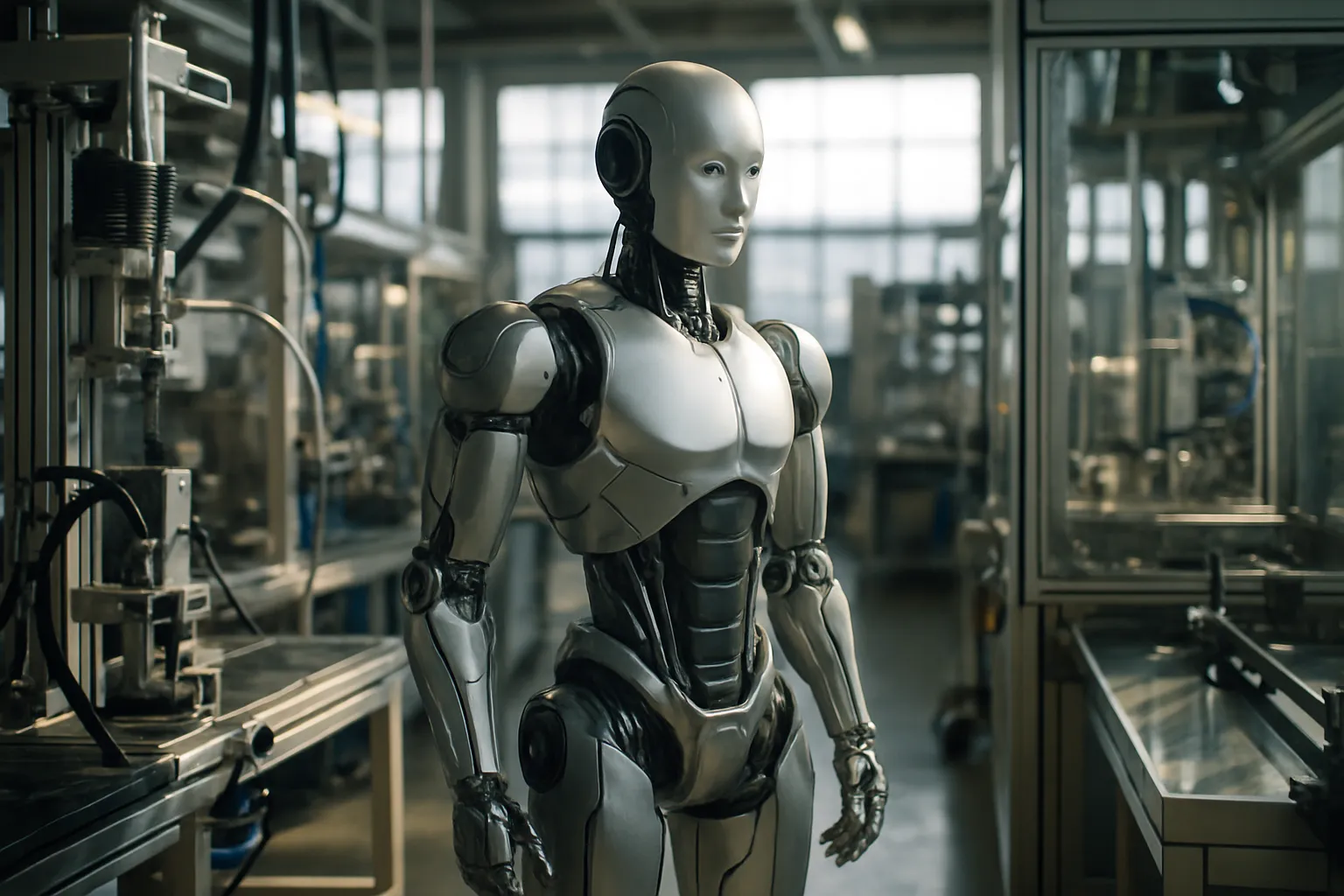
In 2026, the humanoid robot is no longer just a trade-show curiosity. Nicolas Halftermeyer, who headed marketing at Parrot before moving to Aldebaran, puts forward a figure in the Perspectives issue of FrenchWeb: by his estimate, around 13,000 humanoid robots have been produced. He describes them as “real humanoids”, “our size”, “with two hands”. The volume is small next to Asian production lines, but it changes what kind of product this is.
To give a sense of scale, he points to the orders of magnitude elsewhere in the sector. Conventional industrial robotics accounts for “500,000 [robots] installed per year”, he says. Cobotics, the robots taken out of their cages and placed alongside operators, is growing more slowly, at “maybe 50,000 a year”. Humanoids, by contrast, were until recently used as decoration for “stands in Las Vegas or at VivaTech”. His message fits in one sentence: waiting until 2030 to pay attention would be a mistake.
From Pepper to Physical AI: what has changed in humanoid robots
Halftermeyer ties his analysis to his own career. “I had the honour, with my boss Henri Seydoux, of launching drones at CES Las Vegas in 2010,” he says of Parrot. Then came Aldebaran: “I looked after the Nao and Pepper robots.” On set, he handles Pepper’s hand, “a Franco-Japanese robot, designed in Paris, but obviously commissioned by Japan’s SoftBank”. The robot cost “€20,000” and carried 3D sensors, an RGB camera, microphones and speakers, with a hand that was “pretty cool” but “couldn’t really grab much” at the time.
Ten years on, progress is no longer about design but about motor execution and embedded artificial intelligence. That, in his view, is where the next decade will be decided, around what he calls Physical AI.
Chinese humanoid robot makers: 21 of 40 developers at CES
For him, CES shows where marketing and industrial investment is going. His count on site: “Out of 40 developers present, 21 were Chinese.” They were followed by “a dozen” Korean companies, “one from Singapore”, “one German, one British, two French”. On the French side, he cites Miroki from Enchanted Tools and Reachy Mini from Pollen Robotics. The Americans kept a low profile: Tesla and Figure, in particular, were absent.
Safety around people is still handled unevenly across the industry, he says. When a humanoid falls, “that’s 80 kilos of metal landing on your foot”. He argues for robust safeguards, a culture of emergency stops and “responsible” behaviour whenever a robot operates in contact with the public.
Humanoid robots in defense and Europe’s slow scale-up
In defense, Halftermeyer notes that drones have already made the shift and that inspection quadrupeds have concrete uses. Humanoids, “not yet”. Batteries limit autonomy to “one hour, two hours maximum”, on top of terrain constraints and high sensitivity to conditions. He does not rule it out, though: “In 10 years, will we really have combat robots? It’s quite likely.”
His assessment of Europe is less positive. The continent was “very well positioned” with Aldebaran and laboratories such as CEA and CNRS, but scaling up runs into industrial, financial and regulatory obstacles. He criticises the failure to “open the floodgates” on experimentation, in contrast with the United States, where he says robotaxis are already on the roads. Among Europe’s hubs, he names Zurich for ETH and EPFL, as well as Munich, and calls for thinking beyond national borders: “We will need to be with our Italian, Spanish and German friends, and our Swiss friends too.” The word he keeps coming back to is operational cooperation, which he sees as the condition for holding up against China’s Ubtech, Agibot and Unitree.