

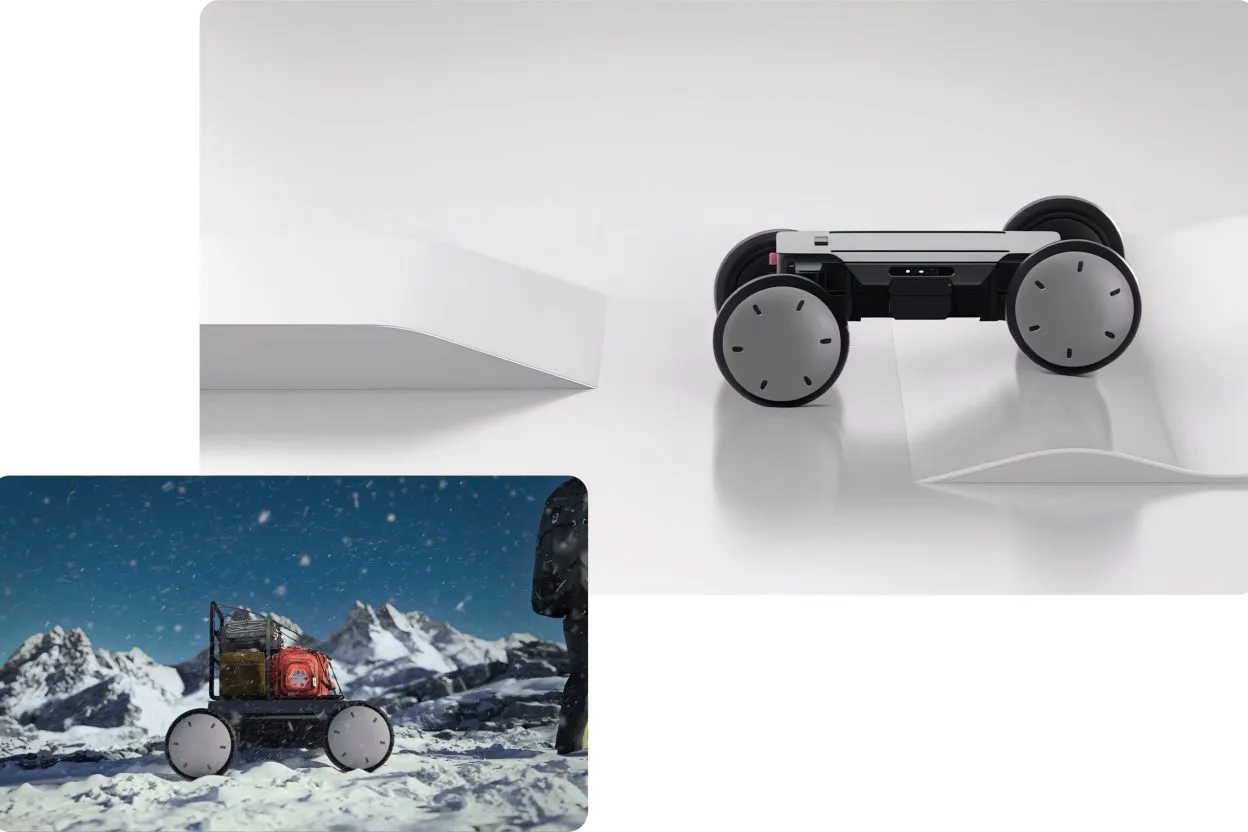
Hyundai Motor Group is opening its MobED mobile platform to three South Korean companies so they can develop specialised robots. At Robot World 2026, the partners gave demonstrations of delivery, collection, patrol and dual-arm manipulation.
On 4 November 2026, at the Robot World show held at KINTEX in Goyang, South Korea, Hyundai Motor Group presented the first applications of its MobED platform developed with Gaon Robotics, WeGo Robotics and ROAS. The carmaker is betting on a shared mobility base to which each company can add its own equipment and software. This cooperation now takes the form of a structure called the MobED Alliance, intended to support the development of robotic solutions for different sectors.
What is MobED? A four-wheel platform with independently driven wheels that keeps its chassis level
Developed by Hyundai Motor Group, MobED is a compact mobile robotic platform designed to carry different modules on its upper section. Its architecture is based on DnL (Drive-and-Lift) technology, which combines propulsion and lifting through eccentric wheels.
According to Hyundai, each of the four wheels has its own motor and can be controlled independently. This setup lets the platform adapt its movements to the terrain and keep the chassis horizontal when travelling over uneven surfaces.
The industrial aim is to separate development of the mobility system from development of the applications. Partner companies can therefore focus their investment on robotic arms, collection systems, delivery equipment or control software, without having to design their own wheeled base from scratch.
Gaon Robotics shows four MobED applications, including a semi-humanoid robot
Gaon Robotics presented four configurations based on MobED, designed for patrol, delivery, sorted waste collection and a semi-humanoid application.

The demonstrations offered to visitors reproduced several service operations. A user could request the transport of everyday essentials or parcels to a set location. Another application handled the collection of recyclable items.
Gaon Robotics built these demonstrations around a complete operating chain, from receiving a request to moving the robot and carrying out the task. The semi-humanoid module also shows that MobED can serve as a mobile base for robots fitted with more complex upper-body equipment.
WeGo Robotics mounts a dual-arm manipulator on MobED
WeGo Robotics opted for a mobile manipulation application. The company installed a dual-arm robotic system on the MobED platform, combining movement with object handling.
During its demonstration, the robot picked up and handled objects while moving. WeGo Robotics showed in particular the independent control of the two arms and their coordination to perform combined movements.
The company also presented an integrated control architecture based on ROS (Robot Operating System), with the option of extending it to AI learning and inference functions.
This configuration shows how a shared wheeled base can carry a dual-arm mobile manipulator, as distinct from a bipedal humanoid.
ROAS demonstrates 360-degree rotation and climbing a 20 cm obstacle
ROAS focused on patrol robots and movement over uneven terrain. Its application makes use of MobED’s manoeuvring capabilities in confined spaces.

The company showed a 360-degree rotation of the chassis, along with lateral and vertical movements used to adjust the platform’s posture.
The most concrete demonstration involved crossing an obstacle with a height difference of 20 cm. ROAS showed its MobED-based robot climbing onto and descending from this obstacle.
The demonstration illustrates the value of the Drive-and-Lift system for patrol missions that are not limited to perfectly flat floors. The height crossed corresponds to the obstacle used during the ROAS presentation.
What the MobED Alliance is for: development and commercialisation of applications
By creating the MobED Alliance, Hyundai Motor Group aims to organise technical and commercial cooperation around its platform. The carmaker supplies the mobility technology, while the partners develop modules and services tailored to their customers’ needs.
Hyundai plans to extend this collaboration to designing customised solutions for different industrial sectors, then to deploying them in operation and commercialising them.
The robots shown at Robot World 2026 are applications exhibited and demonstrated in public. Commercialisation and deployment at customer sites are the next steps planned within the alliance.
For the partner companies, this arrangement is meant to cut the cost and time involved in developing proprietary mobility technology. For Hyundai, it opens up more uses for MobED and builds a cooperation network with South Korean robotics specialists.
The platform’s commercial development will depend in particular on whether other companies adopt MobED, and on whether the delivery, patrol and manipulation applications can operate reliably over time in their future customers’ environments.