

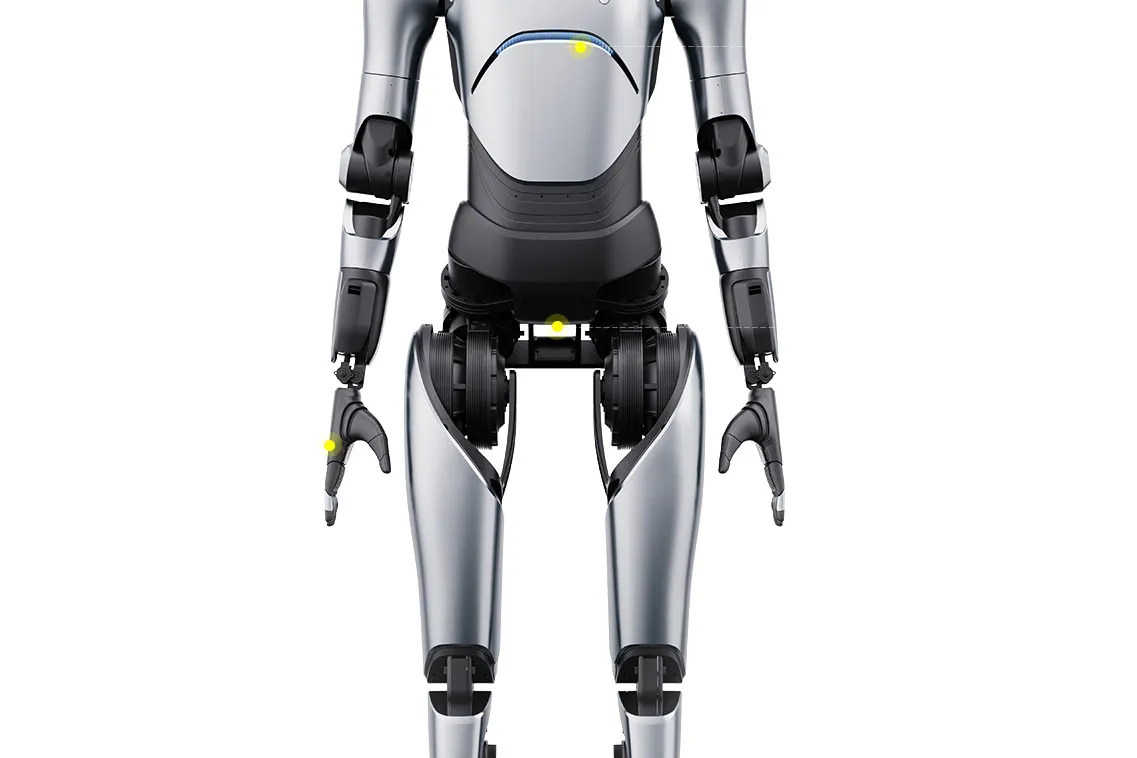
In China, AgiBot, Tsinghua University and INFINIGENCE have tested a method that lets robots learn from the successes of other robots. Trialled on 96 physical robots, it improved their performance on several household and industrial tasks.
The approach, called Collective Experience Learning (CEL), is based on robots sharing their experience. Instead of relying only on human demonstrations to learn a manipulation task, the machines also draw on solutions found by other robots that faced similar difficulties. The three partners presented the results of a group experiment designed to evaluate the method.
How Collective Experience Learning works: robots learning from other robots
CEL works by pooling successful experiences across a group of robots. When a machine runs into a difficulty during a task, it can benefit from solutions that other members of the group have already acquired.
The method aims to reduce dependence on human demonstrations and to let performance improve gradually through the experience the robots build up themselves.
The researchers present the approach as a possible route towards the autonomous evolution of robot capabilities and their large-scale deployment. The experiment concerns collective learning, not the commercial launch of a new robot model.
The five household and industrial tasks used to test the robots
The teams from AgiBot, Tsinghua University and INFINIGENCE evaluated CEL in household and industrial settings. The robots were given five different tasks:
- Making a flower arrangement.
- Folding clothes.
- Charging mobile phones.
- Assembling chairs.
- Packing smartphones.
These tasks make it possible to assess how well shared learning works on operations that involve different movements and interactions with different objects.
In an evaluation covering 600 trials carried out by two untrained robots, the teams report only 15 failures, a success rate of 97.5%. On each of the five tasks, the robots outperformed the average success rate of six human operators used as a benchmark in the experiment.
Smartphone packing success rate rises from 79.2% to 98.3%
One of the largest improvements was in smartphone packing. According to the results presented by the research teams, the robots’ success rate rose from 79.2% before collective learning to 98.3% after it was applied.
In this evaluation, the robots recorded only two failures in 120 consecutive trials. The gain shows the value of sharing experience for a repetitive handling and packing task.
Scaling from 16 to 96 robots improves learning results
The researchers also looked at how the number of robots taking part in collective training affects results. Their findings show the success rate rising as more machines contribute to the shared experience.
With 16 participating robots, the measured success rate reached 86.7%. When the group grew to 96 robots, the rate reached 98.3%, according to the experiment’s results.
The teams attribute this progress to the accumulation of a larger pool of usable experience. Each additional robot can add to the solutions available to the other members of the group.
The experiment by AgiBot, Tsinghua University and INFINIGENCE thus validates CEL on a group of 96 physical robots, with results measured on household and industrial manipulation tasks.