

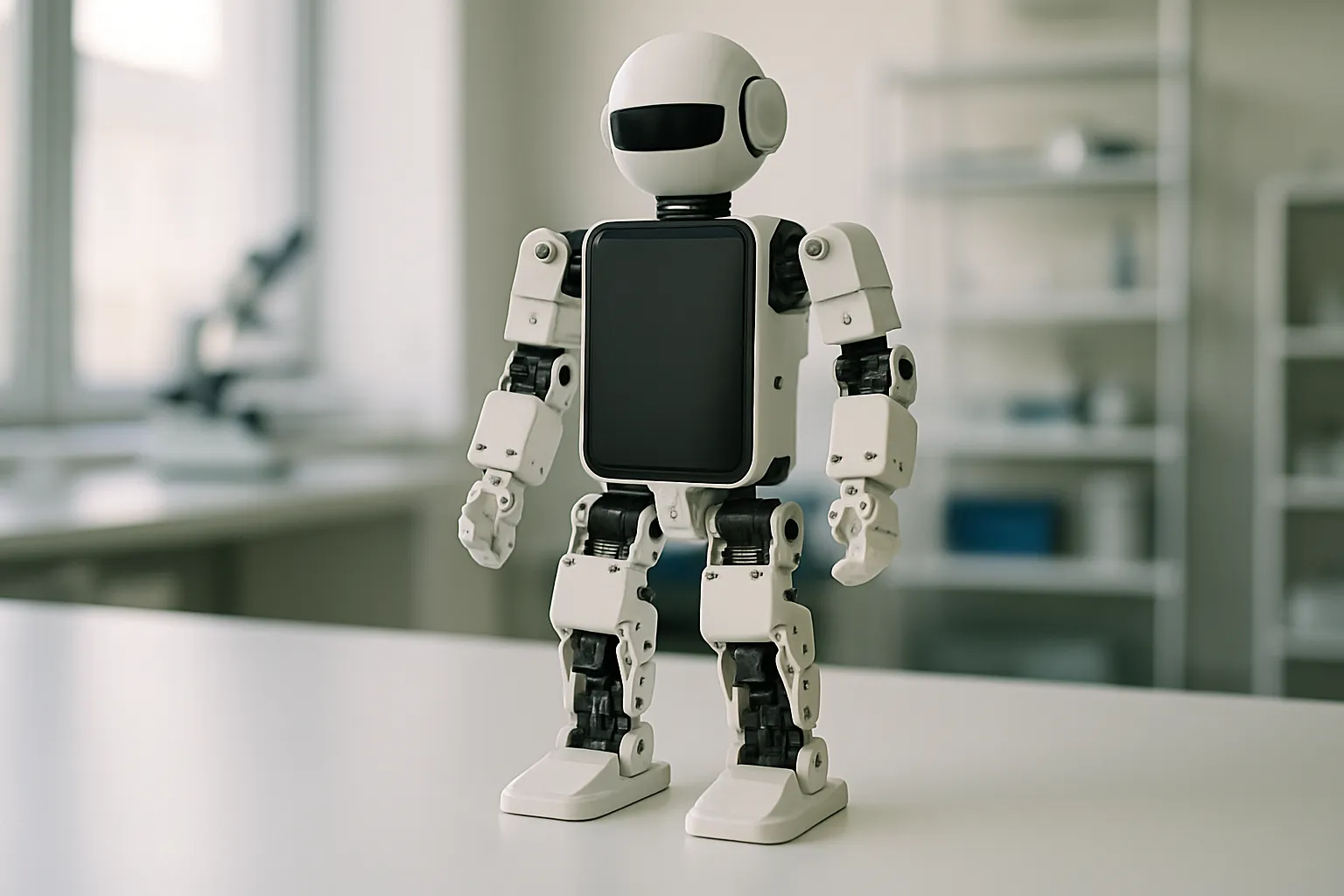
A smartphone gathering dust in a drawer becomes the brain of a humanoid robot. That is the idea behind PhoneBot, developed by a team at the University of California Los Angeles (UCLA) and described in a preprint posted on arXiv under the title “PhoneBot: A Low-Cost Open Humanoid Robot Platform Reusing Smartphones”. The machine stands 48 cm tall and weighs 1.8 kg. What sets it apart is that it needs no dedicated sensors.
The Android phone housed in the torso does everything: it supplies the computing power to drive the motors, the motion sensors for positioning in space, the cameras, GPS and Wi-Fi for remote control. According to the researchers, the idea is to reuse a device that already has all this hardware rather than stacking up separate components.
Which phones work with PhoneBot: four models tested, including one from 2017
The team is not aiming for high-end hardware. It tested four devices: a 2017 Honor 9, a 2025 Moto G, a Samsung Galaxy A16 5G and a 2024 Moto G. All of them handled the robot’s core functions: motion control, sensor data processing and image processing. A recent smartphone is therefore not required.
The researchers do flag one caveat: on the Honor 9, the lack of Google services prevented use of the mapping function. To make full use of the robot’s capabilities, the hardware and software of the chosen device need to be checked beforehand.
PhoneBot motors and walking: 13 motors, no arms, flat ground only
PhoneBot currently has 13 motors: six per leg and one for torso rotation. This pivoting torso, where the phone is mounted, lets the robot redirect the camera without repositioning itself with its legs. It has no arms yet; the researchers say these will come at a later stage.
Locomotion was first learned in simulation, taking into account the physical limits of the hardware, including motors and joints, to keep the system from collapsing during certain movements. Despite the robot’s symmetrical structure, the resulting gait was uneven. Rather than rerun a full training cycle, the team simply mirrored the training sequences, which balanced the gait and reduced the workload.
Once this data was transferred to the machine, PhoneBot could walk, follow a person and get back up on its own after a fall, according to the researchers. For now, walking only works on flat ground. The next steps announced are moving over uneven terrain, adding simple arms to handle objects, and shifting voice control, currently handled by an external computer, onto the smartphone itself.
How much does PhoneBot cost? An open-source project with about $400 in parts
PhoneBot is designed as an open-source project. The stated goal of the UCLA researchers is to give students an affordable humanoid platform to experiment with. The robot’s components cost about $400, phone not included.
Chinese humanoid robot runs 100 metres in 9.39 seconds at the World Humanoid Robot Games in Beijing
At this stage, it is a research platform described in a preprint, not a product on sale. Nothing in the paper addresses commercial availability or distribution in France.