

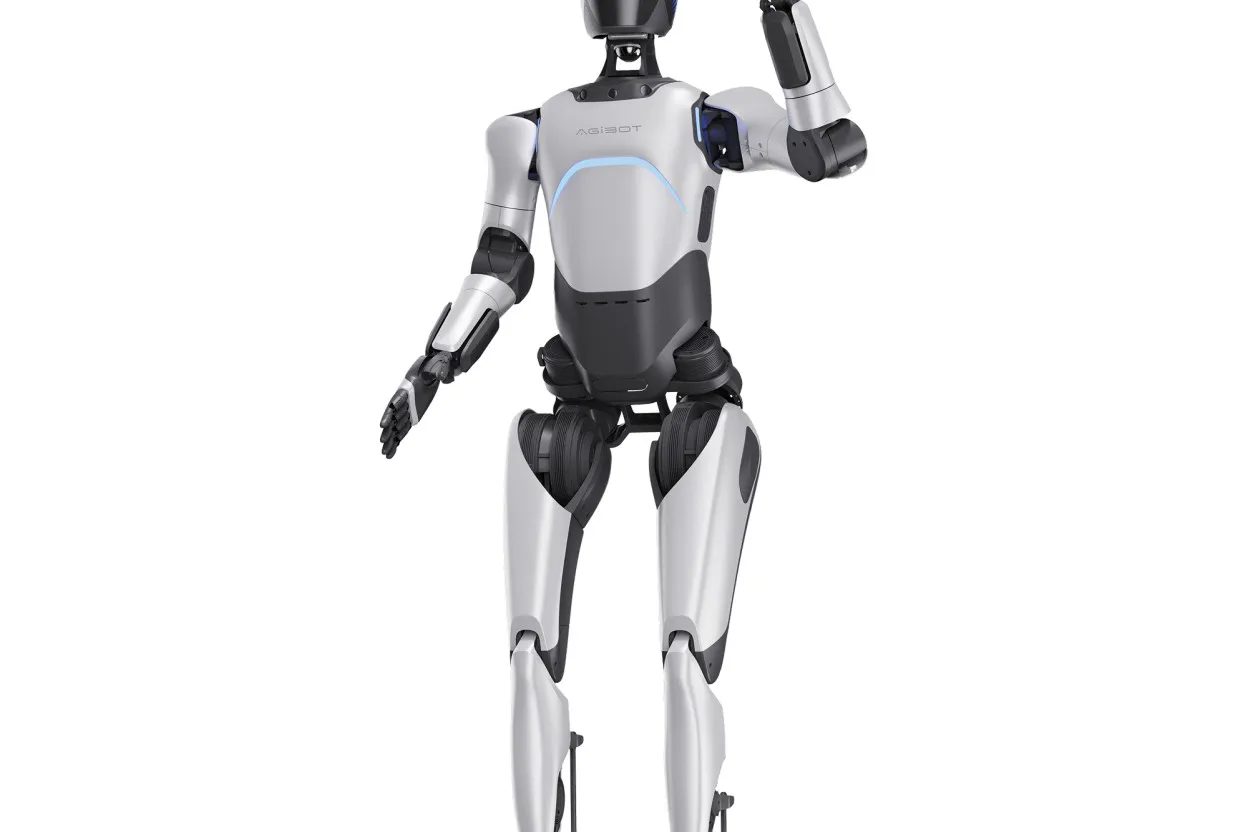
On 22 October 2026, AGIBOT announced Physical Reasoning, the fourth release of its AGIBOT WORLD 2026 dataset. The new data collection aims to train robots to choose their actions based on the objects in front of them, any obstacles and how far a task has progressed.
With this release, AGIBOT shifts the focus from executing complex movements to the reasoning needed to complete a job. The goal is to teach robotic systems to identify the right object, work out the order of operations and check that the requested outcome has actually been achieved.
Tasks that require robots to adapt their actions
AGIBOT illustrates its approach with the restocking of a hotel minibar. The instruction is to leave exactly three full bottles. The robot must tell empty bottles from full ones, count those that remain and decide which items to remove or add.
A predefined sequence of movements is not enough: the actions required change depending on what the minibar contains at the start.
Former OpenAI science chief Kevin Weil’s Warp Sciences raises $215 million to automate labs
The company also presents several scenarios designed to train different types of reasoning:
- Finding objects: locating toiletries in drawers while keeping track of the ones already checked.
- Handling obstacles: moving a box that blocks access to a key before picking the key up.
- Planning: checking the weather forecast before choosing sunscreen or an umbrella for an outing.
These examples illustrate the skills the dataset targets. They are not measured performance figures from a commercially available robot.
Nine reasoning categories and three difficulty levels
AGIBOT organises Physical Reasoning around nine reasoning categories. They cover object selection, whether a manipulation is feasible, the preconditions for an action, search, task-state tracking, planning, memory and the organisation of subtasks, among others.
The scenarios vary several parameters: the number of objects, the presence of obstacles, the space available and the progress of the task.
According to AGIBOT, the exercises are split into three difficulty levels, ranging from single decisions to tasks that combine several goals and constraints.
Agile Robots introduces Agile ONE SN, a 1.4 m research humanoid robot due in early 2027
This structure is intended to train models on situations where the same image may call for different actions depending on what has already been done.
How the annotations link decisions to movements
The dataset links each high-level instruction to subtasks and individual actions. The annotations describe the object to be handled, where the action takes place, how the work is divided between the two arms, the state of the grippers and the expected result.
Spatial information ties these descriptions to object positions and to the trajectories visible in the images.
AGIBOT also includes examples of both successes and errors. The annotations indicate, for example, whether the correct object was selected, whether it was placed correctly and whether quantity constraints were met.
The data is intended for research into systems that can detect an error and then adjust their next actions, rather than always carrying on with a predefined sequence.
Dataset already used for AGIBOT’s upcoming models
AGIBOT says it has already used this fourth release to develop its upcoming agent framework and to train its next-generation foundation model.
The announcement concerns training data and software development work. It is not the commercial launch of a new humanoid robot.
The release aims to bring the reasoning capabilities of AI models closer to the physical execution of robotic tasks.
Is AGIBOT WORLD 2026 open source? License and commercial use
AGIBOT presents Physical Reasoning as an open-source release, available through the AGIBOT WORLD 2026 repository on Hugging Face.
The repository lists a CC BY-NC-SA 4.0 license. This license restricts commercial use, which matters for companies considering using the data in their own robotics development.