

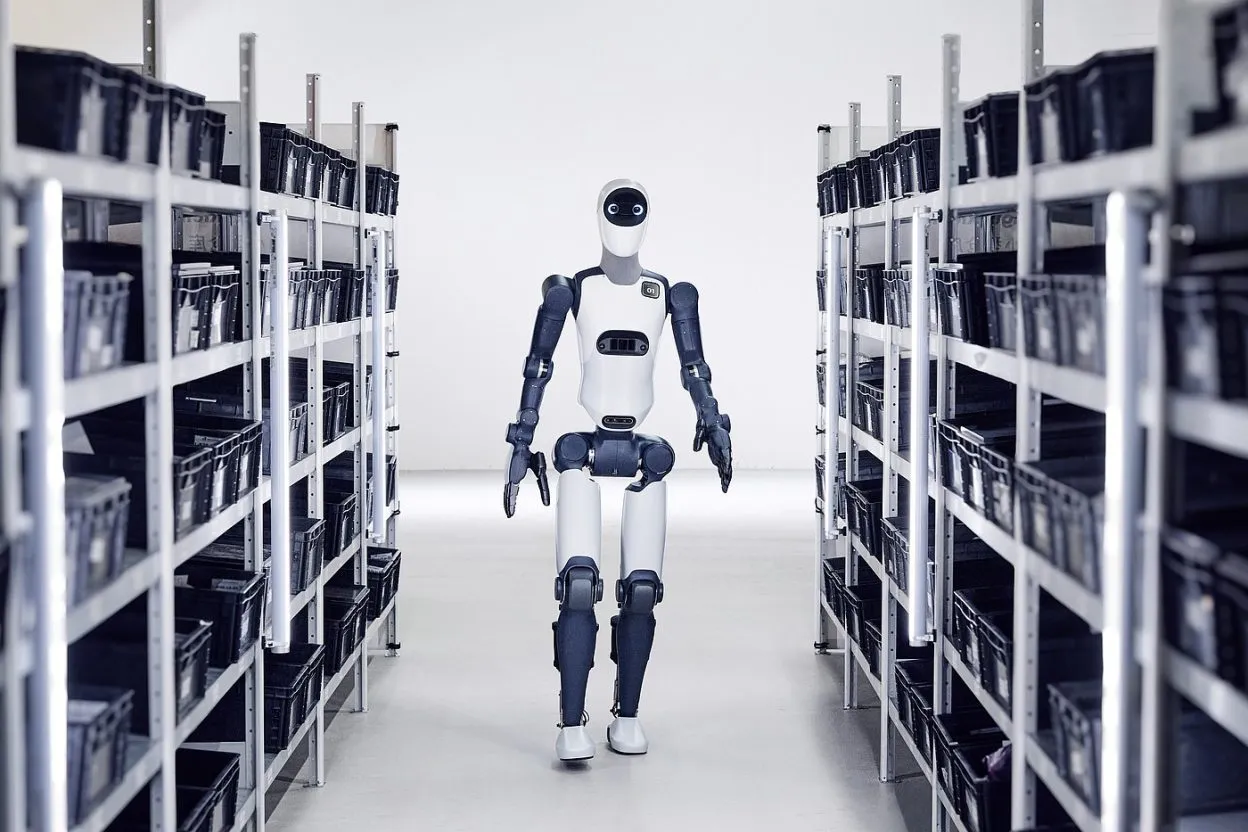
Agile Robots presented the Agile ONE SN, a compact 1.4 m humanoid robot for research labs, at GTC Berlin on 21 October. It relies on NVIDIA onboard computing and robotics software. According to Humanoids Daily, it is due to become available in early 2027.
Agile ONE SN specs: an Agile ONE S body and two tactile hands
According to Agile Robots’ announcement, the platform combines an Agile ONE S body with two Wuji tactile hands. The body has 31 degrees of freedom, meaning 31 independent axes of movement. Each hand has 20, for a total of 71. The stated payload is 3 kg per arm. The two announcements give different weights: 43 kg in Agile Robots’ press release and 40 kg in NVIDIA’s.
The product page lists several sensors:
- cameras in the head and at the wrists;
- additional depth cameras;
- a waist-mounted lidar, a laser sensor that measures distances.
Onboard AI processing runs on an NVIDIA Jetson Thor module. An Intel base compute module supplements it.
Industrial robotics: CRM and ERP software draw 6.7 times more searches than invoicing tools
Agile ONE SN software: a preconfigured stack for research labs
The robot ships with NVIDIA’s GR00T 1.7 model and whole-body control, which coordinates all the joints, both already configured. It also comes with its description files for the Isaac Sim and Isaac Lab simulators. The described workflow starts from recorded demonstrations or simulated data. It then moves through training and virtual evaluation, and ends with tests on the physical robot. Researchers can choose to use only some software components rather than the full stack.

According to Humanoids Daily, the aim is to reduce the integration work labs have to do before starting their experiments. The launch is part of a broader NVIDIA announcement around Isaac, which includes a new runtime environment, learning tools and datasets.
What remains to be proven
Agile Robots says that skills and data developed on the SN can be transferred to the Agile ONE, its full-size industrial humanoid. Humanoids Daily notes that this transfer between two different bodies still has to be demonstrated task by task.
Integration of Halos, NVIDIA’s safety platform, is planned but still in development. According to Humanoids Daily, the announcements do not show that the robot already integrates the full platform or that it has obtained safety certification.
