

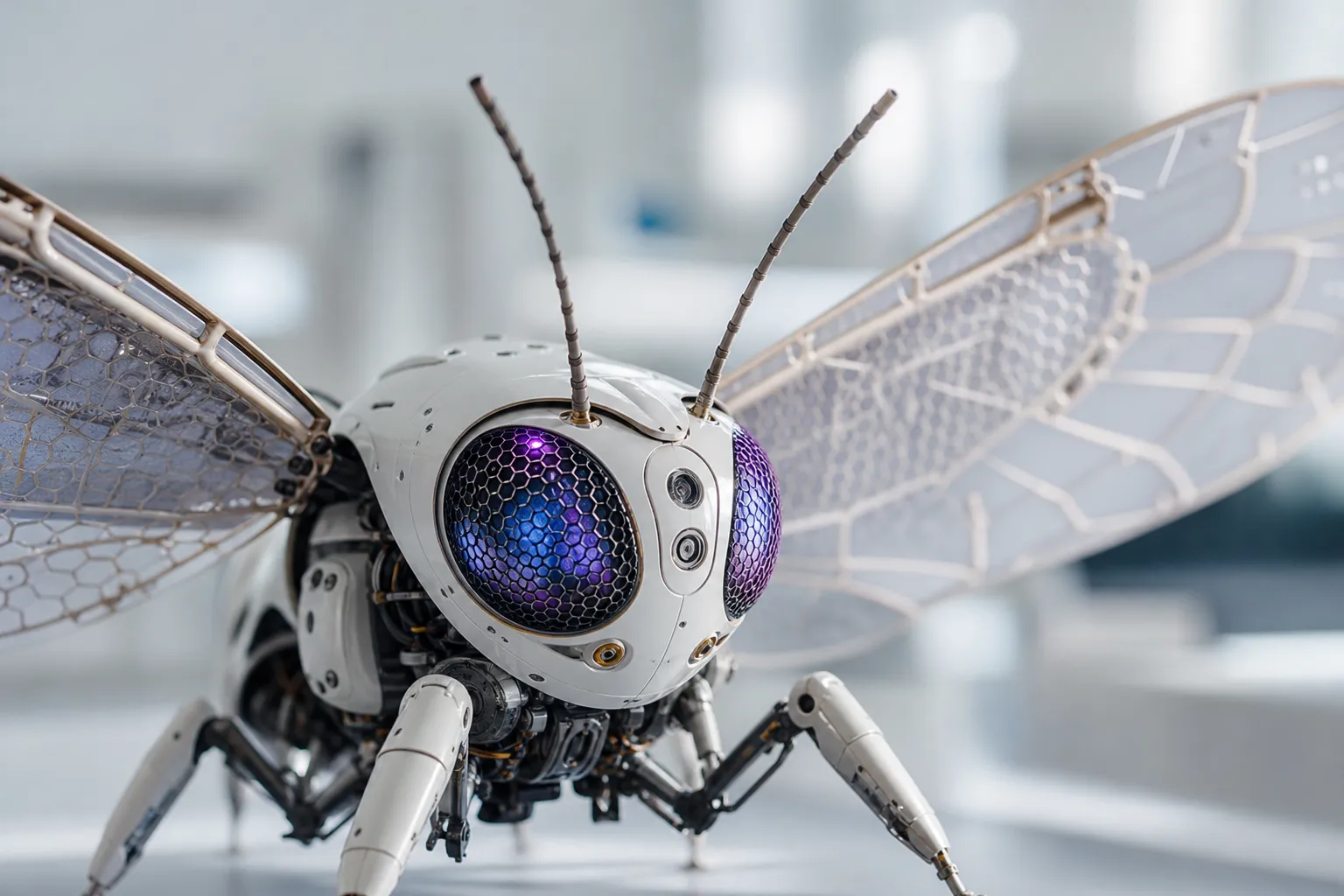
Researchers in Estonia and Italy have shown that a moth-shaped robot can make a light sensor directly inside its body. An artificial circulatory fluid carries the required chemical components, which are activated locally by UV light.
The experiment, led by the University of Tartu in Estonia and the Italian Institute of Technology, is described in a study titled “Receptogenesis in a Vascularized Robotic Embodiment”, published on 23 October in the journal Advanced Science. The team developed an experimental prototype whose structure can produce a new electronic component when exposed to ultraviolet light, without that component being installed in advance.
How moths inspired the robot’s artificial circulatory system
To design their robot, the researchers took inspiration from the moth Catocala fraxini, known in English as the “blue underwing” and one of the largest moths in Estonia. Specimens were supplied by colleagues at the University of Tartu’s Institute of Ecology and Earth Sciences.
These insects have an open circulatory system: a vessel pumps hemolymph, the equivalent of blood, which flows through a few channels and bathes the organs directly. This arrangement makes it simpler to distribute substances throughout the body.
The wings are also a useful model. Because they are almost flat, the fluid flows mainly in a single plane, which reduces the complexity of the artificial circulation network.
“I am working on giving robots a circulatory system so that they can transport molecular components throughout their bodies and create the hardware they need, on site, when they need it,” says Kadri-Ann Pankratov, lead author of the study.
3D-printed wings with a network of microchannels
The prototype’s body is 3D-printed in a transparent plastic, PETG. According to the researchers, each wing has a surface area of 86 cm² and contains a circulation network organised on two scales.
Millimetre-wide veins distribute the fluid through the wings. Between the printed lines, a dense network of microchannels allows the fluid to penetrate about 10 micrometres into the plastic.
A single pump, controlled in open loop, fills the whole body with about 3 millilitres of fluid. The system thus borrows the principle of biological circulation to carry chemicals to different regions of the structure.
How the conductive sensor forms after about a minute of UV exposure
To produce the sensor, the team circulates an artificial hemolymph made of pyrrole, a light-activated initiator and a cellulose-based additive.
When an area of the robot is exposed to ultraviolet light for about one minute, the pyrrole in the plastic turns into polypyrrole, an electrically conductive polymer.
The formation of the material can also be seen: the initially translucent area turns black, while regions that receive no UV light stay unchanged.
The researchers also used a stencil to control which areas were exposed to light. This method makes it possible to confine the production of the conductive material to specific parts of the prototype’s body.
Making components inside the robot’s body: what the experiment shows
The research explores a different approach to robotic adaptation. Sensors are usually installed before deployment, while algorithms adjust the robot’s behaviour to the information it receives.
The prototype developed in Tartu and at the Italian Institute of Technology demonstrates another possibility: delivering chemical precursors through a robotic structure and producing a functional material locally when an external stimulus activates it.
This is an experimental laboratory demonstration, not a commercial robot. The experiment concerns the formation of a light sensor within an artificially vascularised structure, with localised activation by ultraviolet light.