

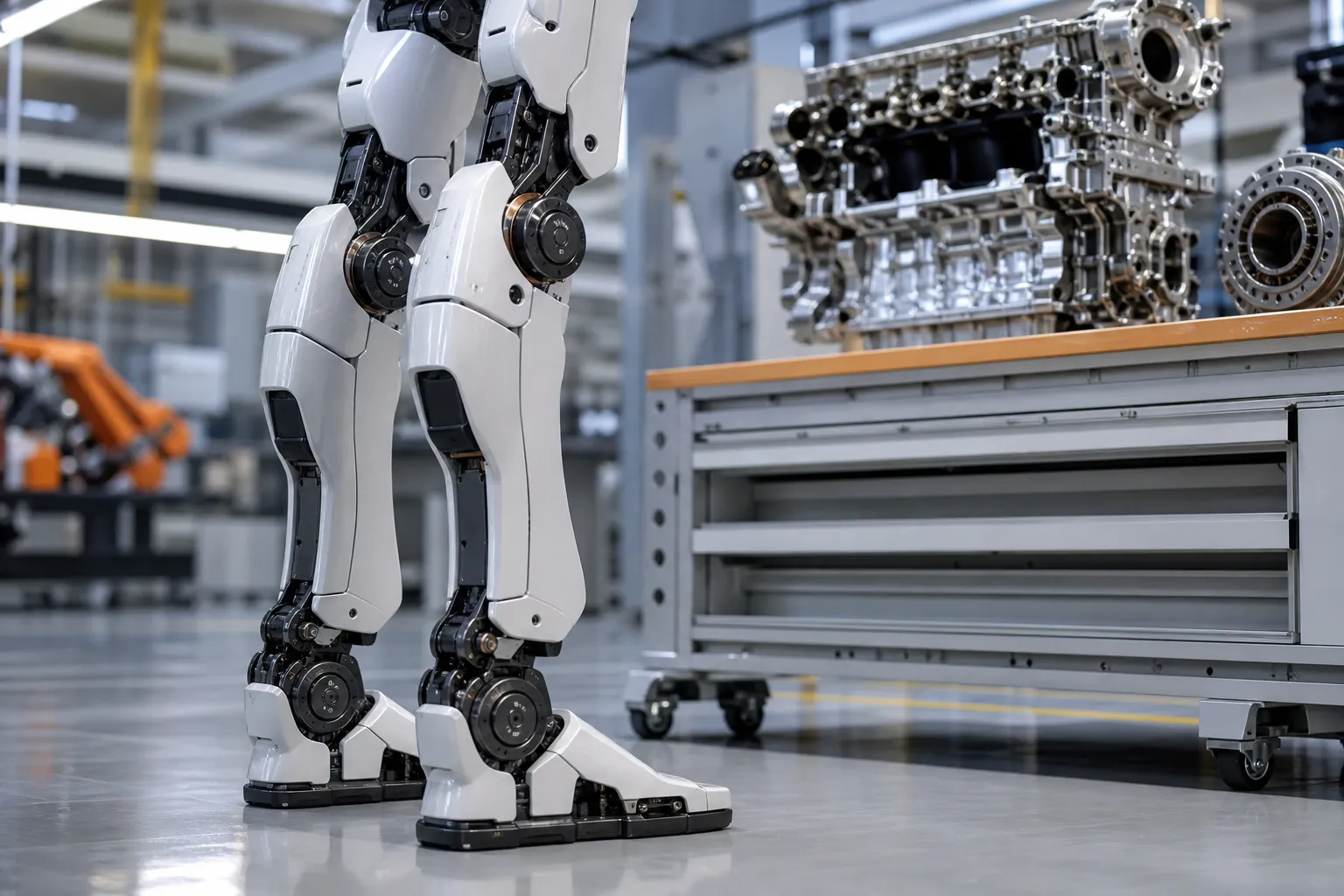
In South Korea, 71% of the auto parts suppliers surveyed are considering a move into robotics within three years. At a seminar in Seoul, experts advised them to target components, industrial customers and orders rather than complete robots.
About 100 professionals from the auto parts sector gathered at El Tower in Seoul’s Yangjaedong district for a seminar on strategies for entering the robotics industry. The event was co-organised by the Korea Auto Industries Cooperative and the Korea Association of AI and Robotics, with support from DN Solutions. Topics included the opportunities linked to humanoid robots and the shifting Chinese and American supply chains.
Survey: how many Korean auto parts suppliers plan to enter robotics
Park Seung-wook, a centre director at the Korea Automotive Technology Institute, presented interim results from a survey of 31 auto parts companies and 23 robotics companies.
According to the survey, 71% of the auto parts suppliers that responded plan to develop robotics activities within the next three years. Their main motivation is the search for new sources of growth.
The shift to robotics faces commercial and financial hurdles, however. Companies in particular struggle to identify customers and secure sales outlets.
The obstacles also vary with company size. According to Park Seung-wook, companies with revenue of at least 50 billion won mainly point to a lack of specialised staff. Those below that threshold are more likely to cite the burden of the initial investment.
Why experts say suppliers should start with robot components and orders
Park Seung-wook believes auto parts suppliers should focus on supplying parts rather than building complete robots. He also recommends finding customers and orders before investing heavily in new equipment.
This approach builds on industrial skills that automotive suppliers already have. Precision machining, assembly, forging and heat treatment can all be used to make robot components.
Park Seung-wook identifies three ways into the industry:
- Supplying components to robot manufacturers.
- Contract manufacturing of parts designed by robotics companies.
- Secondary sourcing, alongside established suppliers.
He recommends starting with prototypes made on existing machines or shared equipment. Further investment would come after customer evaluations and once orders have been secured.
Faced with Chinese price competition, he advises targeting industrial applications where component reliability is a decisive criterion, particularly in factories. Buyers looking for suppliers based outside China are another commercial target.
US humanoid robot makers look for Korean suppliers
Lee Tae-yeop, a principal researcher at Hyundai Motor Group’s HMG Management Research Institute, discussed how China’s industrial rise is affecting robotics supply chains.
According to his analysis, US humanoid robot manufacturers have started looking for component suppliers in South Korea, against a backdrop of US restrictions targeting China.
To illustrate China’s industrial progress, Lee Tae-yeop also cited the change in Chinese carmakers’ global market share, which reportedly rose from 16% in 2016 to 29% in the most recent period covered in his presentation.
This trend could benefit Korean suppliers able to meet the manufacturing needs of US robotics companies, especially for components that require precision industrial production.
China builds its own robot software and production chains
Ko Tae-bong, managing director at iM Securities, focused his talk on developments in China’s physical AI and humanoid robot industry.
In his view, Chinese manufacturers have gradually brought their manufacturing capabilities and artificial intelligence technologies closer together. This goes hand in hand with factory automation using industrial and collaborative robots equipped with AI-based vision systems.
Ko Tae-bong also described several trends among Chinese robot makers:
- Simplified designs to make commercialisation easier.
- Development of robotic hands and their mechanisms.
- Integration of in-house software and AI models rather than systematic reliance on Nvidia platforms.
- Integrated supply chains that allow customised production.
The iM Securities executive also stressed the need to turn the practical skills of skilled workers into training data for robots.
DN Solutions on machining humanoid robot joint parts
Manufacturing technology also featured on the seminar programme. Jang Hyun-sik, a manager at DN Solutions, presented machining solutions suited to the precision components used in humanoid robots.
His talk focused in particular on harmonic reducers, transmission mechanisms used in robot joints. These components are a potential application for the machining skills of auto parts suppliers.
Lee Taek-sung, chairman of the Korea Auto Industries Cooperative, also spoke about his visit in February to a Chinese humanoid robot company and an electric vehicle production site. He highlighted how quickly Chinese technological developments turn into industrial businesses.
Finally, Bae Seok-tae, standing vice-president of the Korea Association of AI and Robotics, underlined the central role of component suppliers in building a complete robotics supply chain.