

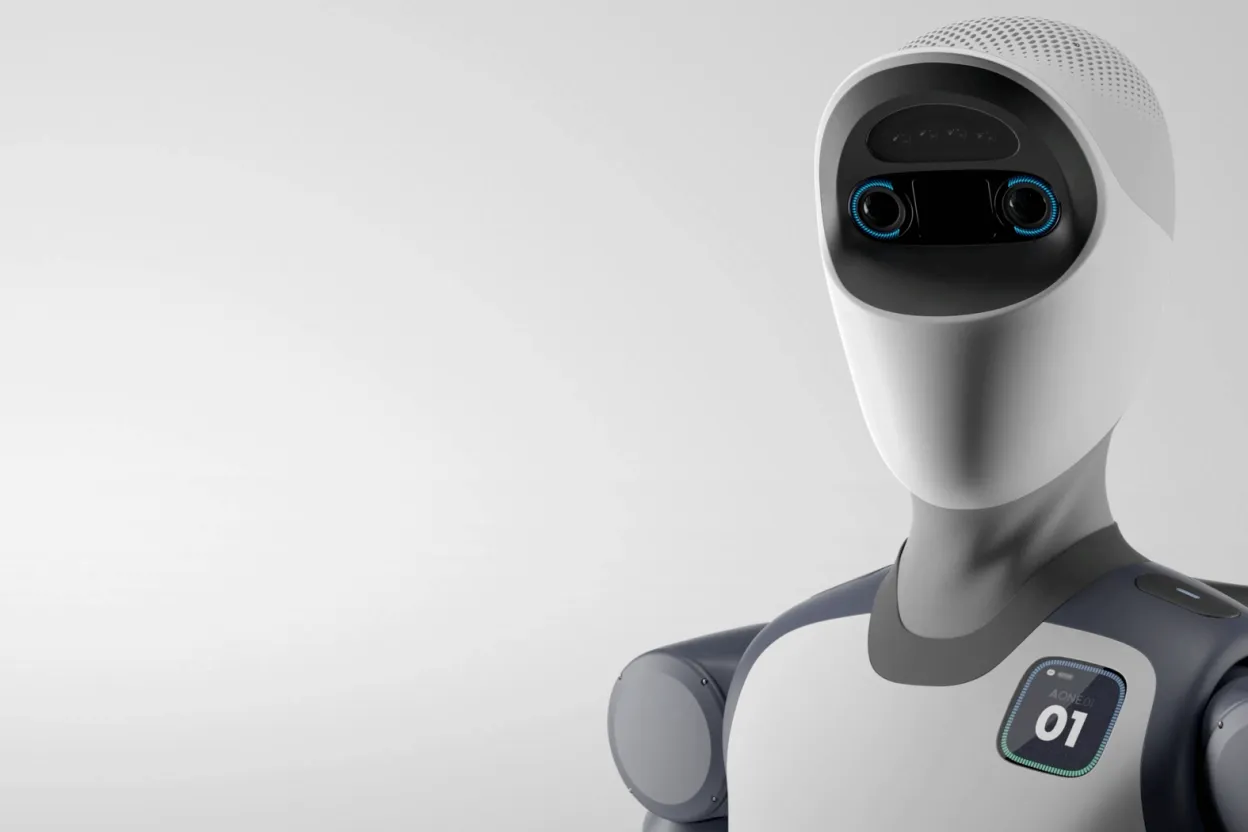
Agile Robots plans to deliver 10,000 units of its Agile 1 humanoid robot by the end of 2027. The AI-powered robot is already used for logistics tasks at several industrial companies and is on display at the ExSamples26 exhibition in Darmstadt.
Developed by Munich-based Agile Robots AG, Agile 1 is a human-sized humanoid robot designed to work in professional environments. Its design was produced with input from Fabian Wappler, the company’s co-founder and head of design, who graduated from Hochschule Darmstadt in Germany.
Where Agile 1 is used: humanoid robot already working in industrial warehouses
Agile 1 is already deployed at several industrial companies as a logistics or warehouse assistant. These professional deployments are the robot’s first concrete application in the industrial sector.
The robot also has built-in artificial intelligence that lets people hold a conversation with it. It has a visual communication system based in part on its eyes, which can blink.
These dialogue and visual expression capabilities support its use in workplaces, where interaction between humans and machines is one of the design challenges.
Agile Robots production target: 10,000 Agile 1 deliveries by end of 2027
Agile Robots AG aims to deliver 10,000 units of Agile 1 by the end of 2027. This is a target announced by the company, not the number of robots already delivered.
The industrial goal comes as the company develops products that combine robotics and artificial intelligence. Fabian Wappler describes Agile Robots as a company growing particularly fast in these fields.
Why Agile 1 has a rounded design: making a humanoid robot less intimidating
Agile 1’s design is not based solely on its industrial functions. Fabian Wappler says he applied design principles he learned during his studies at Hochschule Darmstadt to the robot.
The team chose rounded shapes and a friendly appearance to reduce the sense of threat that a human-sized humanoid robot can create.
According to Fabian Wappler, an appearance closer to childlike proportions helps make the robot look less intimidating. This aesthetic approach complements the interaction offered by its eyes and conversational functions.
Agile 1 on display at ExSamples26 in Darmstadt among 39 Hochschule Darmstadt designs
The robot is on show at the ExSamples26 exhibition on the Mathildenhöhe in Darmstadt. It occupies one of five greenhouses used as display cases for work by former and current industrial design students.
The exhibition brings together 39 objects and projects that illustrate what has come out of the programme over the past 25 years. They include the Brazuca ball used at the 2014 FIFA World Cup and a bicycle associated with the Tour de France.
Professors Tom Philipps and Tino Melzer, who curated the exhibition, chose DIY-store greenhouses set on structures built from planks and vegetable crates. The staging evokes the gradual development of design ideas until they become industrial products.
The exhibition also features graduation projects completed from 2020 onwards during the coronavirus pandemic, which had not yet been shown to the public.