

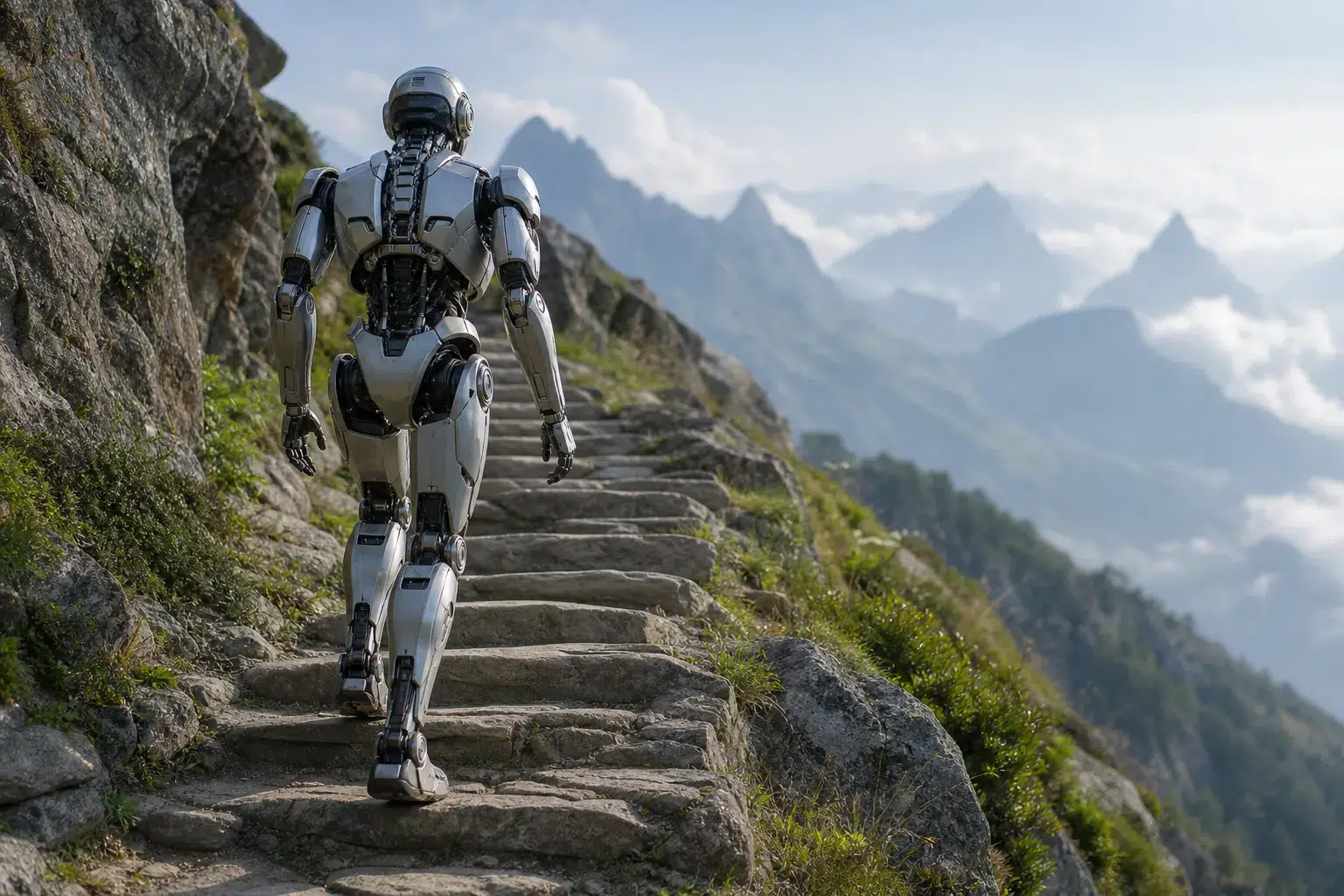
The first CMG world climbing robot competition at Mount Tai brings together bipedal and quadruped machines on a real mountain course. Teams are testing their navigation, perception and balance technologies on irregular stairs.
Held in Tai’an, in China’s Shandong province, the competition follows the old paved path linking Hongmen to Zhongtianmen. According to CMG, the course includes 3,100 steps and 600 metres of elevation gain. Competitors must climb stairs of varying heights and widths, as well as stretches covered in cobblestones. The aim is to test different robotic solutions in real mountain conditions rather than in a laboratory setting.
How robot dogs use lidar to map the Mount Tai course
Before the climb, teams survey the path to identify steps, slopes and obstacles. This mapping is an important stage for quadruped robots and humanoids alike.
A navigation engineer from one of the participating teams explains that their robot dog uses infrared laser-beam lidar to analyse the terrain. The system identifies stairs, rocks, trees and obstacles along the sides of the path.
The measurements are used to build a three-dimensional point cloud, which is then fed into the robot’s navigation system. The robot can then plan its route before starting the climb.
Their four-legged layout gives robot dogs a stable base of support and a gait suited to changes in the terrain. Once their path is set, they can move quickly over the passable sections.
Why some humanoids move their cameras to the chest to see the steps
Humanoid robots face an additional challenge due to their bipedal build. Their higher centre of gravity requires precise posture control during the climb, especially when step height changes.
On some of the models entered in the competition, teams chose to mount the camera on the chest rather than the head. This places the perception system closer to the ground and reduces blind spots in front of the feet.
A test engineer from one participating team describes how this approach works: when a step is detected, the robot lifts its foot using the captured images and a control algorithm. According to this engineer, the camera then gives a clear view of an area roughly 45 degrees ahead of the tip of the foot, which is used to guide the movement.
This solution prioritises close-range perception of obstacles over a view directed mainly at the course ahead.
A bipedal robot that adjusts its steps without vision
Another participating team is trying a different method: its robot climbs the steps without using vision. Its movement relies on mechanical information gathered while walking.
When a foot touches the ground, the system uses the forces acting on the joints and the robot’s posture to adjust the length of the next step. Corrections are made continuously and in real time to maintain balance.
This approach therefore relies on reacting to contact with the terrain, unlike systems that visually analyse the steps before placing a foot on them. The two methods show distinct technical strategies for tackling the same irregular course.
How qualifying changed refereeing at the Mount Tai contest
The first qualifying rounds also led to a change in the rules. According to the competition’s chief referee, some robots were moving too fast for referees to follow them on foot for the whole climb.
The organising committee therefore replaced continuous tracking of the machines with fixed-post refereeing. Each referee now monitors a set section of the course and records any infringements as competitors pass.
According to the chief referee, each post usually covers a distance of about 50 to 60 metres. The spacing can be increased on straight sections with good visibility. On bends where the view is blocked, referees must stay within sight of one another.
The organisers say they observed relatively few infringements during the trials. The system also allows for robot batteries to be swapped so the machines can continue the climb, while referees stay assigned to their checkpoints.