

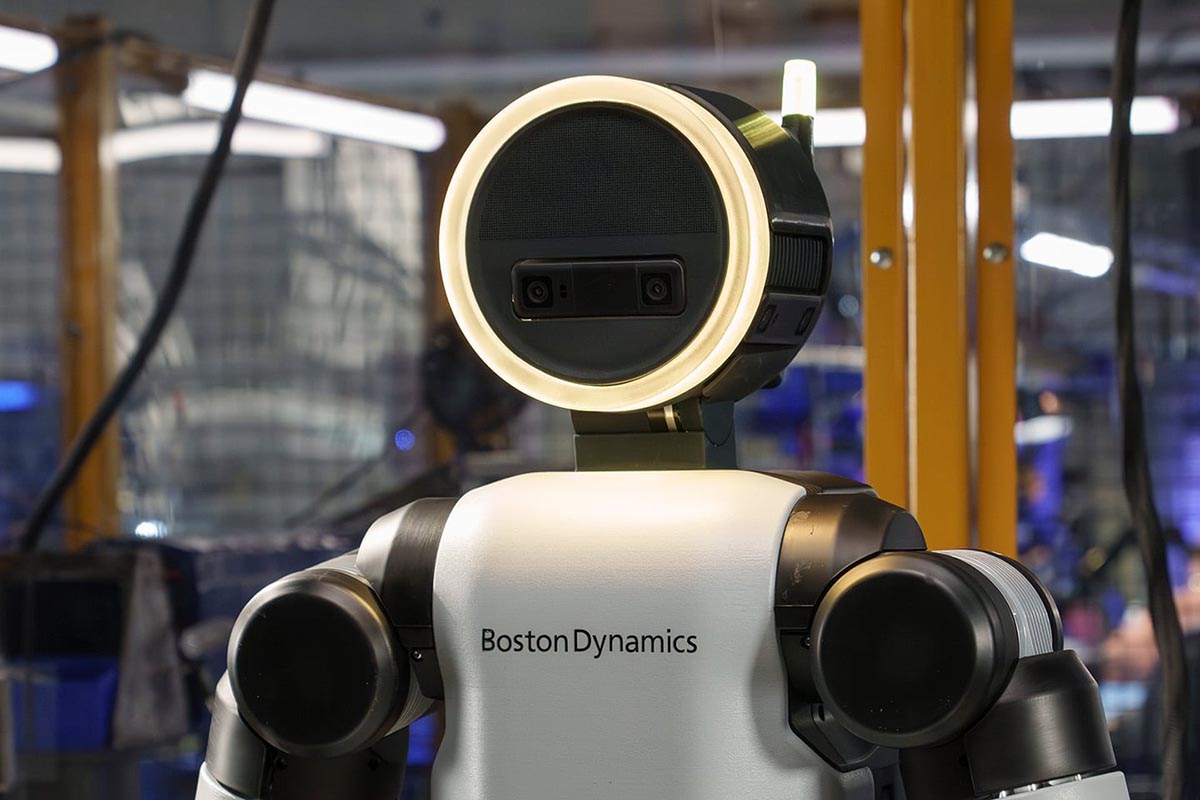
Boston Dynamics’ Atlas humanoid robot is sorting automotive parts at Hyundai. Using artificial intelligence, teleoperation and simulation, it learns from human movements so it can carry out certain tasks without direct intervention.
As of 17 October 2026, progress in industrial humanoid robots highlights a significant shift: machines are now learning complex movements from human demonstrations. At Boston Dynamics, Atlas illustrates this approach. The American company, majority-owned by Hyundai, is developing a humanoid designed to work in industrial environments alongside human operators.
What Atlas does at Hyundai: sorting car parts autonomously
At a Hyundai car plant, Atlas helps sort roof rack components bound for an assembly line. The operation is described as autonomous: the robot performs the task without an operator directly controlling each of its movements.
The robot stands 1.9 m tall and weighs 90 kg, according to Boston Dynamics’ official specifications. Its fully electric design replaces the hydraulic architecture used in earlier generations.
NEURA Robotics prices 4NE1 Mini humanoid robot from €19,999, with a refundable €100 reservation
In 2021, Atlas demonstrations mainly showcased running and jumping. The new generation relies more heavily on machine learning and NVIDIA processors to handle the information it needs to move around and manipulate objects.
According to the figures reported, the Hyundai plant in question uses more than 1,000 industrial robots alongside nearly 1,500 people. These machines handle tasks such as lifting, stamping and welding.
Atlas is still in a phase of development and gradual industrial deployment. Its permanent integration into Hyundai’s production teams could take several years.
How Atlas is trained: teleoperation and motion capture
Development of Atlas is led in part by Zach Jackowski, a mechanical engineer who graduated from the Massachusetts Institute of Technology (MIT).
Used Booster T1 humanoid robot on sale in France for €31,200 incl. VAT at Génération Robots
To train the robot, Boston Dynamics teams use demonstrations performed by humans. Kevin Bergerman, a machine learning specialist who worked on Atlas before joining Google DeepMind, used a virtual reality headset to control the humanoid’s arm and hand movements.
The principle is to record an operator’s movements, then use that data to train the robot’s artificial intelligence models. Atlas can then reproduce certain actions without constant teleoperation.
Another method relies on capturing human body movements. Sensors record the movements, gestures and postures of a person wearing a dedicated suit. Engineers then map these movements onto the robot’s body.
This approach makes it possible to teach behaviours that are difficult to program by hand, while keeping humans involved in preparing the training.

Simulation training: more than 4,000 virtual Atlas robots in six hours
Simulation is another key stage of development. According to information presented on Boston Dynamics’ work, more than 4,000 digital copies of Atlas were trained for six hours in a virtual environment.
The simulations introduce various physical challenges: slippery floors, stiff joints or constraints on movement. They make it possible to multiply training scenarios without tying up as many physical robots.
The learned behaviours can then be transferred to the real robot. This method was used in particular to develop movements such as crawling on all fours and cartwheels.
These demonstrations show off Atlas’s locomotion capabilities, but they do not amount to full versatility in everyday activities. Tasks such as getting dressed, or making and carrying a cup of coffee, remain particularly complex for this type of robot.
What Boston Dynamics learned from deploying Spot
Atlas’s development also benefits from the experience Boston Dynamics has gained with Spot, its quadruped robot already in use at industrial sites.
Spot is equipped with cameras as well as thermal and acoustic sensors to gather information about its surroundings. It is used for inspection, safety checks and equipment monitoring.
At Hyundai’s facilities, Spot contributes to quality control, in particular by checking that components are present on vehicles.
Unlike Atlas, which is still in industrial development, Spot is a commercial platform deployed at hundreds of sites around the world, according to the information presented on its use.
This experience gives Boston Dynamics know-how in integrating mobile robots into professional environments, supervising them and maintaining them.
Google DeepMind: robots that understand natural language instructions
Atlas’s progress is part of a broader trend in artificial intelligence applied to robotics. At Google DeepMind, research focuses in particular on machines’ ability to understand their environment and carry out instructions given in natural language.
Researchers Alex Lee and Julia Vassallo presented a demonstration in which a robot interprets an instruction involving a colour association. Given an instruction mentioning a mix of yellow and blue, the system identifies green and picks up the matching objects.
The demonstration shows reasoning applied to a manipulation task. It differs from pre-programmed movements, since the system has to interpret the instruction before acting.
Demis Hassabis, co-founder and CEO of Google DeepMind, nonetheless stresses the importance of keeping artificial intelligence systems under control as their capabilities grow. He points in particular to the risk of malicious use and the need to keep machine behaviour within limits set by humans.
Can humanoid robots replace factory workers? Training and supervision still required
Progress in humanoid robots raises questions about their place in factories and their impact on jobs. Manufacturers are considering handing machines certain repetitive, strenuous or dangerous tasks.
The Atlas demonstrations show that a humanoid can perform a specific industrial task autonomously after training. This operational autonomy does not mean it can carry out all of an employee’s activities without preparation or supervision.
Designing, training, maintaining and integrating robots remain human activities. Operators also help define tasks and oversee how the robots are used.
This distinction is essential for companies considering humanoids: an operation demonstrated in one industrial environment does not necessarily translate into a capability that can be immediately transferred to every production site.
Hyundai’s stake in Boston Dynamics and the humanoid robot race
According to the information presented, Hyundai owns 88% of Boston Dynamics. This investment puts the carmaker at the centre of Atlas’s industrial development.
Competitors include Tesla and several Chinese companies, while players backed by NVIDIA or Amazon are also developing robotics technologies.
For Hyundai, the long-term goal is to deploy robots that can work alongside humans and take on tasks suited to their physical and software capabilities.
The next industrial step for Atlas is to move from demonstrations and targeted operations to regular use within manufacturing processes, with skills acquired through training and supervision suited to the tasks performed.
Further reading: Boston Dynamics Atlas: profile and Hyundai pilot · Boston Dynamics: Atlas, Spot, Stretch and Hyundai