

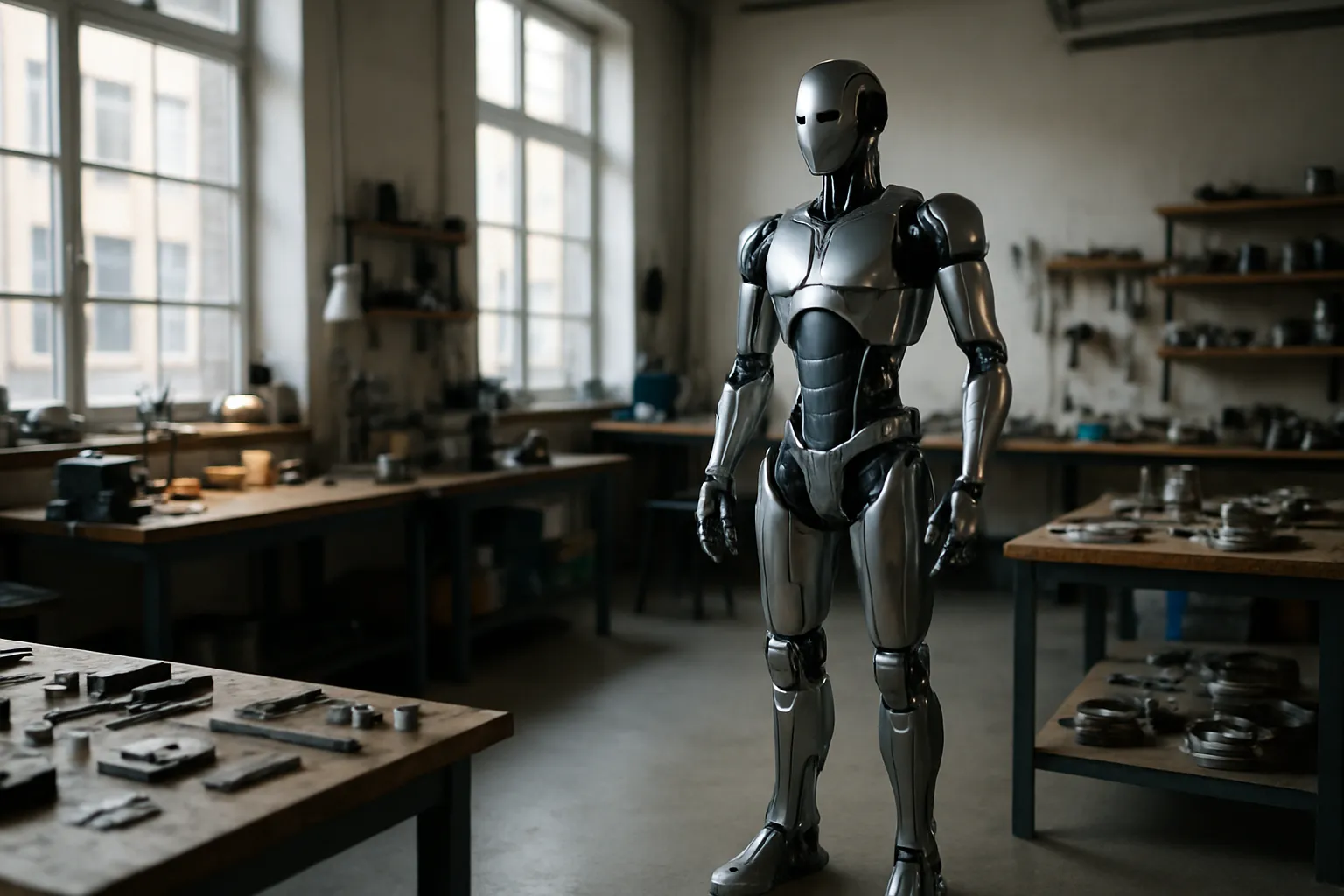
Agility Robotics has introduced Digit 5, a new generation of its industrial humanoid robot. According to the manufacturer, it can lift 23 kg totes, and it features redesigned legs, fast charging and a safety system intended for work in close proximity to people.
With Digit 5, US manufacturer Agility Robotics is adapting its humanoid to the demands of warehouses and factories. Jonathan Hurst, the company’s co-founder and head of robotics, describes a heavier machine than previous generations, whose design now puts material handling, endurance and safety ahead of speed or agility.
Digit 5 payload: new leg design to lift 23 kg totes
The most visible change is in the legs. Earlier Digit generations used a bird-inspired design with backward-facing joints. Digit 5 has legs whose configuration is closer to that of a human.
The change addresses a problem encountered during handling tasks: with the old design, the ankle could touch the ground when the robot crouched. The new layout allows the knee and hip motors to work together to straighten the robot up after it picks a load off the floor.
NEURA Robotics prices 4NE1 Mini humanoid robot from €19,999, with a refundable €100 reservation
According to Jonathan Hurst, Digit 5 weighs more than 120 kg and was designed to repeatedly lift 23 kg totes, including placing them on shelves up to 1.75 m high. These design targets are based on the US National Institute for Occupational Safety and Health guidelines for manual handling by humans.
The motors must deliver high torque to lift loads while precisely controlling the forces applied when the robot comes into contact with its surroundings. This requires a bulkier structure and more powerful actuators.
The trade-off is that Digit 5 gives up some of the dynamic capabilities of its predecessors: according to Hurst, this generation can no longer run or jump as earlier ones could.
Digit 5 battery life and charging: 9-minute recharge, 20-hour daily target
Agility Robotics has also reworked the power system to meet the constraints of industrial teams. The manufacturer claims 90 minutes of operating time, followed by a full recharge in 9 minutes.

The planned charging station is designed to deliver 240 A at 48 V. The robot is intended to reach the station on its own so it can recharge its battery during breaks in work.
Used Booster T1 humanoid robot on sale in France for €31,200 incl. VAT at Génération Robots
According to Jonathan Hurst, the battery and cooling system take up about 75% of the torso’s volume. Fans move air through internal ducts to limit heat build-up during fast charging.
Agility Robotics is aiming for operation of up to 20 hours a day, with regular charging breaks. This is a stated target for Digit 5, not a continuous-operation result presented as already proven in the field.
Digit 5 safety: the robot stops and cuts motor power when a person approaches
Safety is the other major change. Previous commercial deployments of Digit 4 required physical barriers separating the robots from workers, in particular to meet regulatory and insurance requirements.
For Digit 5, Agility Robotics spent two years developing an architecture intended to allow the robot to work near people.
The planned system relies on safety sensors, physical guarding and computers dedicated to protective functions. When a person approaches, the robot is programmed to follow a set sequence:
- Stop the task in progress.
- Put down the load it is carrying.
- Lower itself to the ground.
- Cut power to its motors before the person can touch it.
The aim of this approach is to reduce the risk of contact with a heavy, motorised machine. It also means the robot has to stop working whenever someone enters its safety zone.
Jonathan Hurst presents this architecture as a first step towards humanoid robots and operators sharing the same workspace. The design takes into account European CE conformity requirements, UL electrical safety certifications in North America and the electromagnetic emission limits set by the US Federal Communications Commission. These references are requirements considered during development, not certifications already obtained for Digit 5.
From Digit 4 commercial deployments to Digit 5
Digit 5 builds on several years of industrial trials. In 2019, Agility Robotics and Ford presented a demonstration of Digit 1 carrying parcels from an autonomous vehicle to a house.

Later generations were gradually geared towards logistics. Agility Robotics worked in particular on moving and sorting boxes, while Amazon tested Digit 4 for carrying and stacking totes.
Digit 4 was also deployed commercially at logistics company GXO. That experience helped the manufacturer identify the maintenance, availability and operating constraints that come with real industrial use.
Digit 5 marks a new stage in this industrialisation. Agility Robotics describes it as its first humanoid platform designed from the outset around customers’ operational requirements. Its launch has been announced, while extended operation and working alongside operators remain the technical goals of this generation.
Digit 5 modular design: which industrial tasks are planned next
Tote handling remains the first target application. But Agility Robotics wants to gradually extend Digit 5 to other tasks in warehouses and production sites.
The roadmap outlined by Jonathan Hurst includes picking individual items, machine tending, preparing parts for assembly and shipping, and then assembly work.
To support this, Digit 5 has a modular architecture and interfaces that allow its tools to be swapped. Agility Robotics plans to upgrade some subsystems without rebuilding the entire platform.
The manufacturer also has RoboFab, its production facility in Salem, Oregon. According to Agility Robotics, the 70,000-square-foot plant has the capacity to build more than 10,000 Digit 5 robots a year. This stated production capacity does not reflect the number of robots actually built or delivered.
Future versions of Digit are expected to benefit from data gathered during industrial operations to improve their behaviour and develop new manipulation skills.