

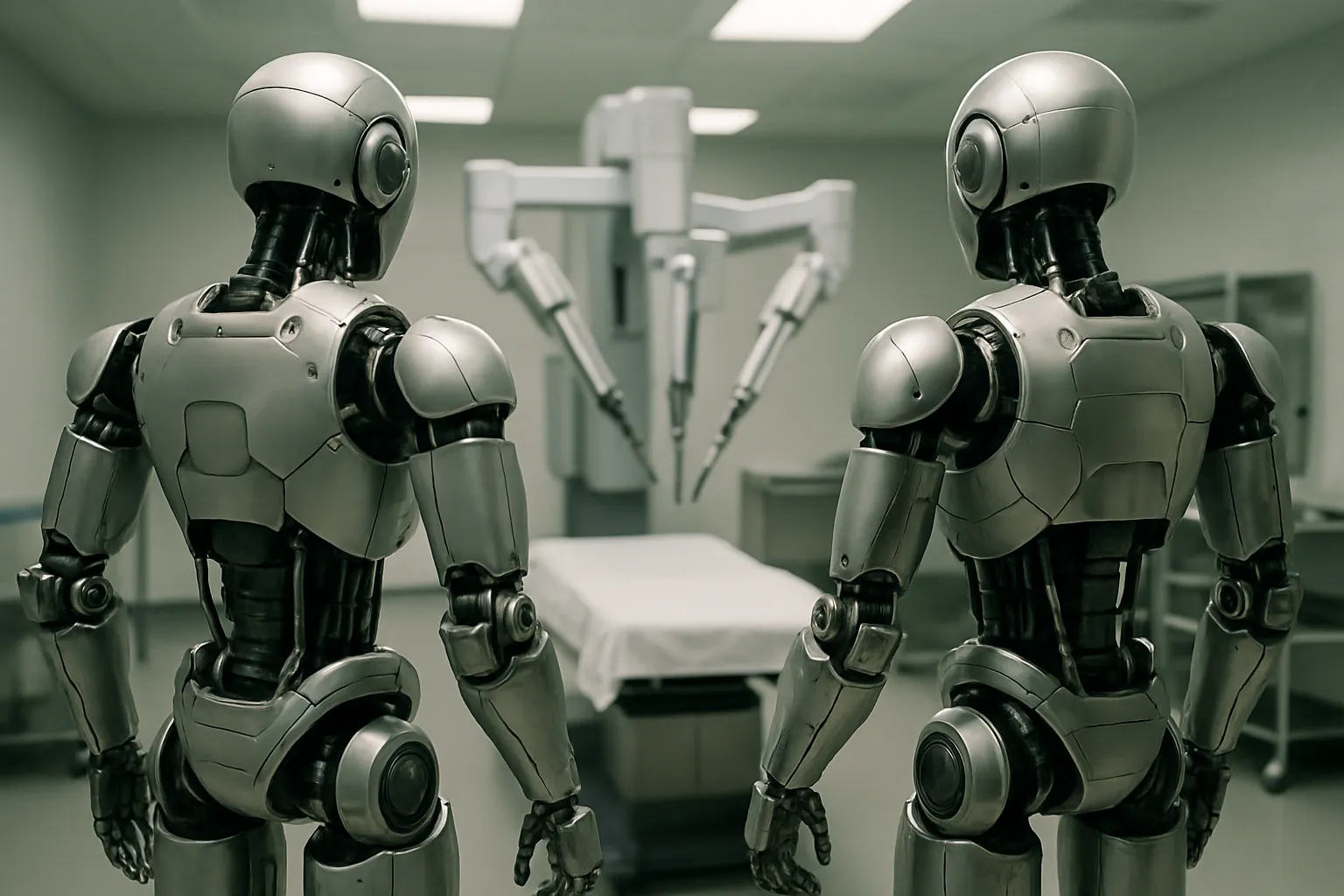
Two humanoid robots have performed two operations on large non-primate mammals, including the removal of a gallbladder. The machines did not operate on their own: they were controlled remotely by surgeons at the University of California San Diego (UC San Diego). The feasibility study, carried out jointly by surgeons and engineers, was published in the journal Nature under the title In vivo feasibility study of humanoid robots in surgery.
The robots are called Surgie and are made by Arclab. They stand 1.5 m tall and weigh 27 kg. Their compact size is the study’s central argument: they can work in cramped operating rooms, including makeshift theatres in rural areas or in regions short of medical staff. The researchers contrast this form factor with specialised three- or four-arm surgical robots, which weigh around 800 kg and require larger rooms as well as dedicated infrastructure.
Standard surgical instruments, custom adapters
To let the two humanoids handle conventional surgical instruments, the teams had to develop adapters that make the instruments easier for the robots to hold. Experienced UC San Diego surgeons then controlled the machines through a teleoperation system.
Specialised robots run on proprietary software and dedicated instruments, which limits them to a narrow range of procedures. The researchers present humanoids as more flexible. This is the study’s working hypothesis, not a result measured across a large number of operations.
Latency and recalibration: why the operations took longer
Both operations ran into practical limits. Data transmission introduced latency: the robots reproduced the surgeons’ movements only after a delay. The teams also had to recalibrate the machines several times during the procedures. As a result, the operations took longer than planned.
The researchers expect these problems to fade as the technology improves. By way of comparison, they point to the first laparoscopic operation performed with a specialised surgical robot, which took about six hours, against around 30 minutes today for the same type of procedure. According to them, the humanoids’ movements were highly precise, close to the level of specialised surgical robots.
What the researchers envision, and what remains to be proven
Michael Yip, who teaches at UC San Diego’s Institute of Electrical Engineering and Computer Science, sees teleoperated and autonomous humanoid robots as a way to widen access to life-saving operations, including for patients who would otherwise go without. He views them as one possible response to the shortage of surgeons, which lengthens waiting times for procedures and deepens inequalities in access to care, in the United States and elsewhere.
Beyond surgery itself, the authors imagine these humanoids supporting surgeons: handing over instruments during an operation, tidying the operating room afterwards and relieving understaffed teams. The study covers only two procedures, performed by teleoperation on animals. The move to autonomous movements, like the reduction of latency, has yet to be demonstrated.
UCLA’s PhoneBot: a 48 cm humanoid robot built around an old Android phone for about $400 in parts