

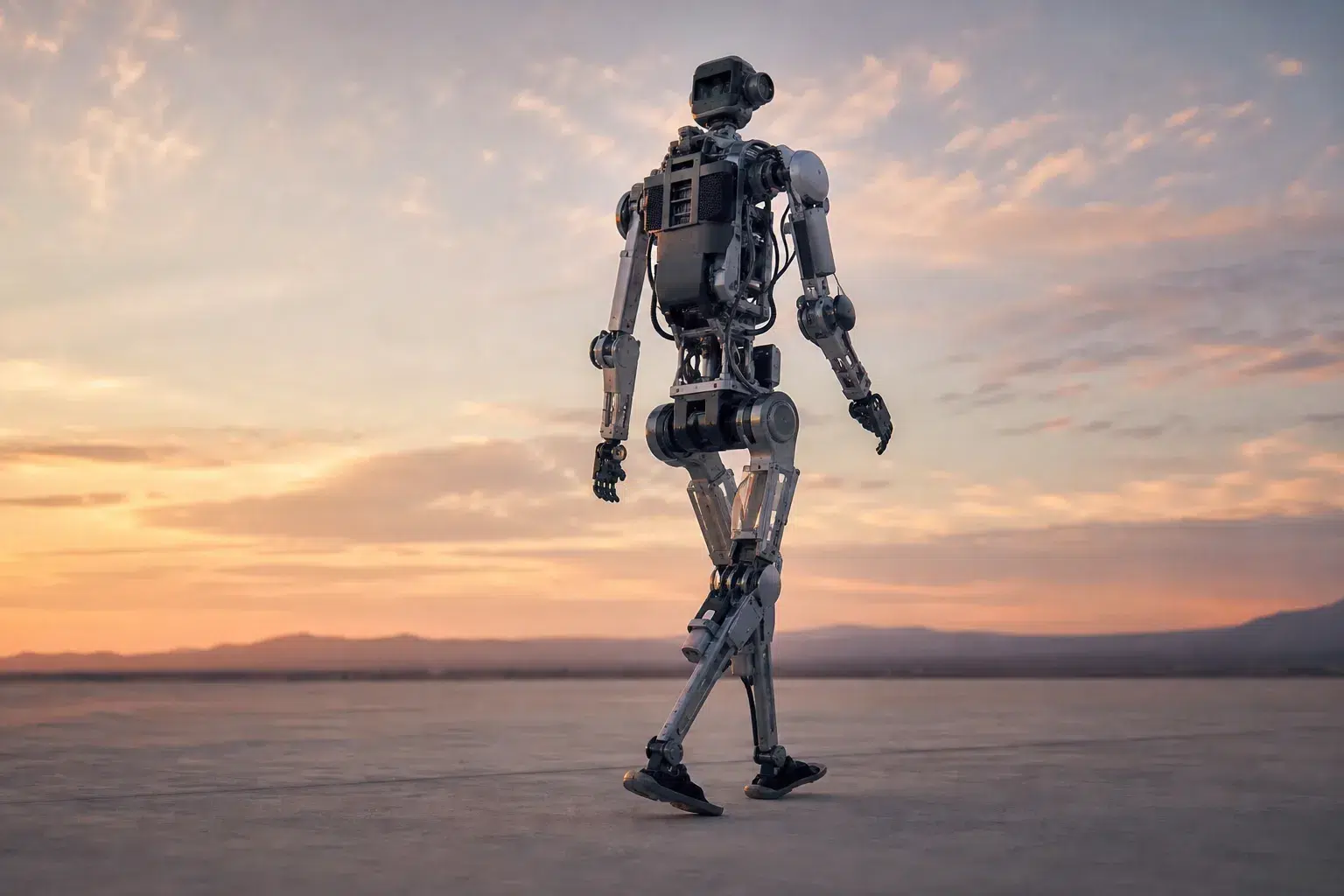
Why do advances in artificial intelligence struggle to carry over to humanoid robots? On 31 October 2026, Professor Meng Qinghu identified two obstacles and proposed focusing on models specialised in specific tasks.
Meng Qinghu is a professor at the Southern University of Science and Technology and head of its Department of Electronic Engineering. He spoke at the Guangdong-Hong Kong-Macao Greater Bay Area Embodied Intelligence Industrial Ecosystem Innovation Forum, held as part of the 2026 Greater Bay Area Science Forum, where he presented his analysis of the difficulties in combining artificial intelligence with humanoid robotics. In his view, the problem lies in particular in the nature of the data used to train the models and in their ability to represent the physical world.
Why AI models fall short for humanoid robots: two mismatches
The first obstacle Meng Qinghu identified concerns the training data of large language models. These systems are mainly trained on digitised text. According to the researcher, this training produces a text-centred intelligence that does not directly match the needs of robots operating in a physical environment.
The second difficulty concerns the representation of the world in three dimensions. Meng Qinghu believes that artificial intelligence lacks a capacity for thinking in three-dimensional images comparable to that of humans.
In his analysis, these two mismatches explain part of the difficulty in transferring the capabilities of AI models to humanoid robots.
Specialised AI models instead of a universal artificial intelligence
To overcome these obstacles, Meng Qinghu recommends focusing AI training on vertical application scenarios, meaning specific tasks in particular fields.
This approach runs counter to the pursuit of ever larger, more universal models. According to the professor, trying to reproduce the full range of human intellectual abilities from a large language model amounts to trying to match intelligence spaces of different dimensions.
He therefore advocates developing an intelligence suited to each application, one that can handle a limited share of the problems encountered rather than trying to reproduce every human faculty in a single system.
Capsule endoscopy robot: an example of specialised AI
To illustrate this strategy, Meng Qinghu cited the capsule endoscopy robot, a medical device that is swallowed to examine the digestive tract.
In the example the researcher presented, this robot has no general capabilities such as reading text or recognising faces. It uses a specialised intelligence to detect abnormal areas in the digestive system.
Meng Qinghu points out that a small model can carry out a complex task when it is trained for a well-defined application. He argues for applying the same logic of specialisation to develop AI capabilities suited to the practical needs of robotics.