

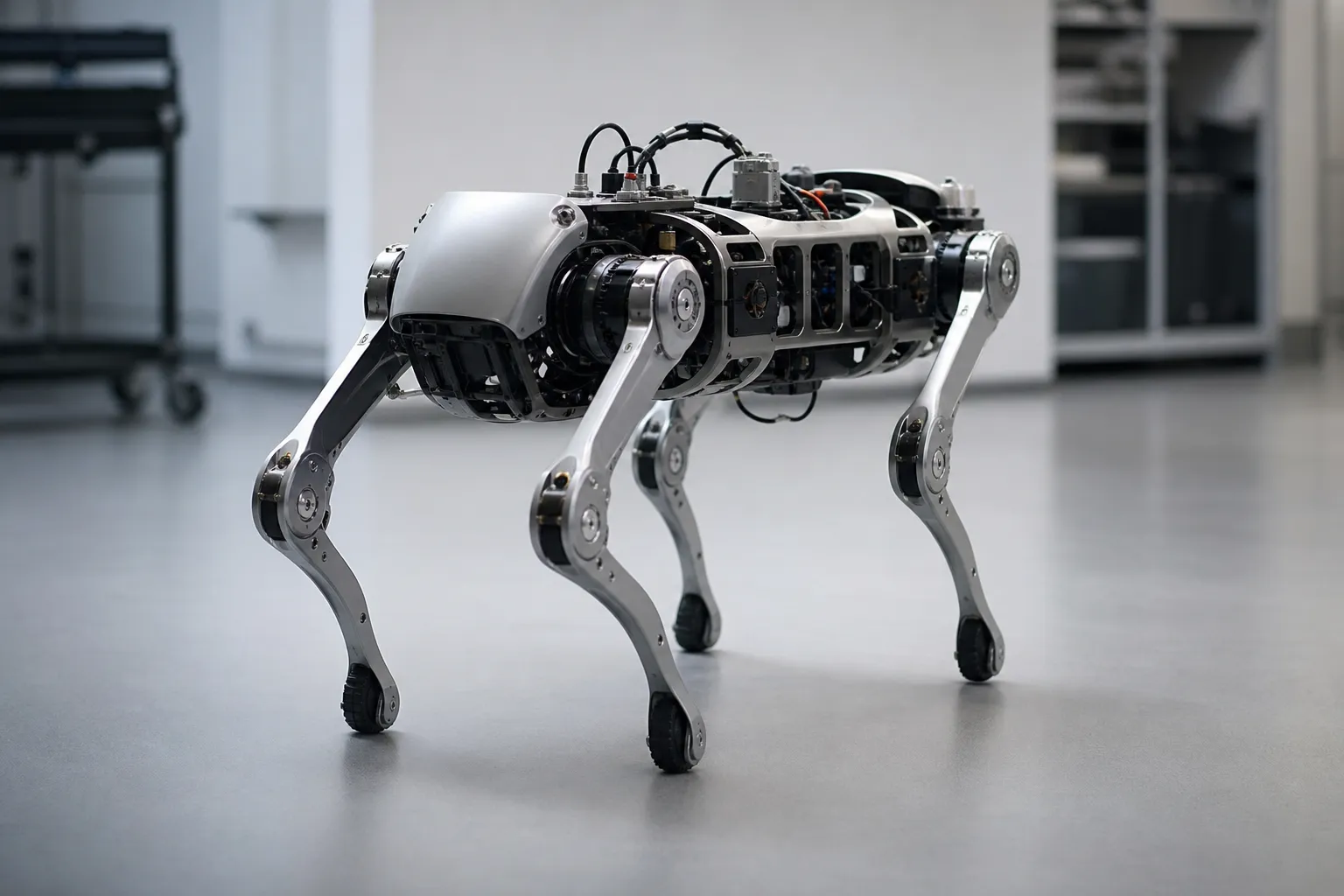
Australian company Cortical Labs and Honda Research Institute Europe have controlled the movements of a robot dog using living neurons grown on a chip. Their demonstration points to a possible route toward biological control of robots.
The experiment, presented at the NeurIPS 2026 conference, marks a new step in research on biological computing. Cortical Labs previously used nerve cells to run the video games PONG and DOOM. It is now applying the technology to a physical robot. The work is available as a preprint on arXiv and is awaiting peer review.
How living neurons guided a robot dog to a target
The system relies on living neurons grown directly on a chip fitted with electrodes that can exchange electrical signals in both directions. The researchers stimulate the nerve cells, record their activity and convert their electrical responses into movement commands.
In the demonstration, the robot dog manages to move toward a target point on a simple grid map. The signals sent to the neurons, and the information fed back after the robot moves, are used to adjust how the biological system responds.
The experiment shows that a small number of nerve cells can take part in controlling the movements of a physical machine. It involves a basic navigation task carried out in an experimental setting.
More than 4,000 hours of interactions to test biological control
To develop the system, Cortical Labs and Honda Research Institute Europe ran more than 4,000 hours of interactions between the neural chip and the robotic agent. According to the research team, these trials made it possible to evaluate around 1,300 combinations of electrical signals.
Among other things, the researchers varied the characteristics of the stimulation sent to the cells and used feedback from the robot’s movements to steer the cells’ responses. The aim was to identify communication and training methods that produce consistent behaviour.
Johnson Zhou, a research software engineer at Cortical Labs, says the main difficulty lies in communicating stably with biological systems and training them reliably, rather than simply in growing neurons on silicon.
Cortical Labs and Honda explore an alternative to conventional computing
The collaboration aims to study the use of living cells as a computing substrate for robotic systems. The approach draws on the biological brain’s ability to process information with low energy consumption and to adapt to new situations.
According to Brett Kagan, co-founder and chief executive of Cortical Labs, today’s robots already have advanced locomotion capabilities, but the high-level control needed to learn quickly and adapt their actions to their environment remains a challenge.
The company is therefore seeking another way to decide which movements a robot should make in a given situation, beyond simply executing motor commands.
Daniel Tanneberg, principal scientist at Honda Research Institute Europe, names energy efficiency, robustness and adaptability among the potential advantages of the approach. These properties are research goals, not performance measured during the robot dog demonstration.
Next steps: larger neural chips for more complex tasks
The next step the researchers are considering is to increase the size of the neural chips so they can handle more complex tasks in less time. The work will also address the system’s processing speed and efficiency.
Another line of research concerns how neural networks grown on a chip retain information. In particular, Cortical Labs wants to investigate whether mechanisms comparable to memory exist.
In the longer term, the company is considering applications in robots working in remote or hazardous locations, as well as in assistive systems able to adapt their actions to their environment.
To move from grid navigation to these uses, the teams will need, among other things, to make electrical exchanges with the neurons more reliable and to develop training methods suited to more complex physical situations.