

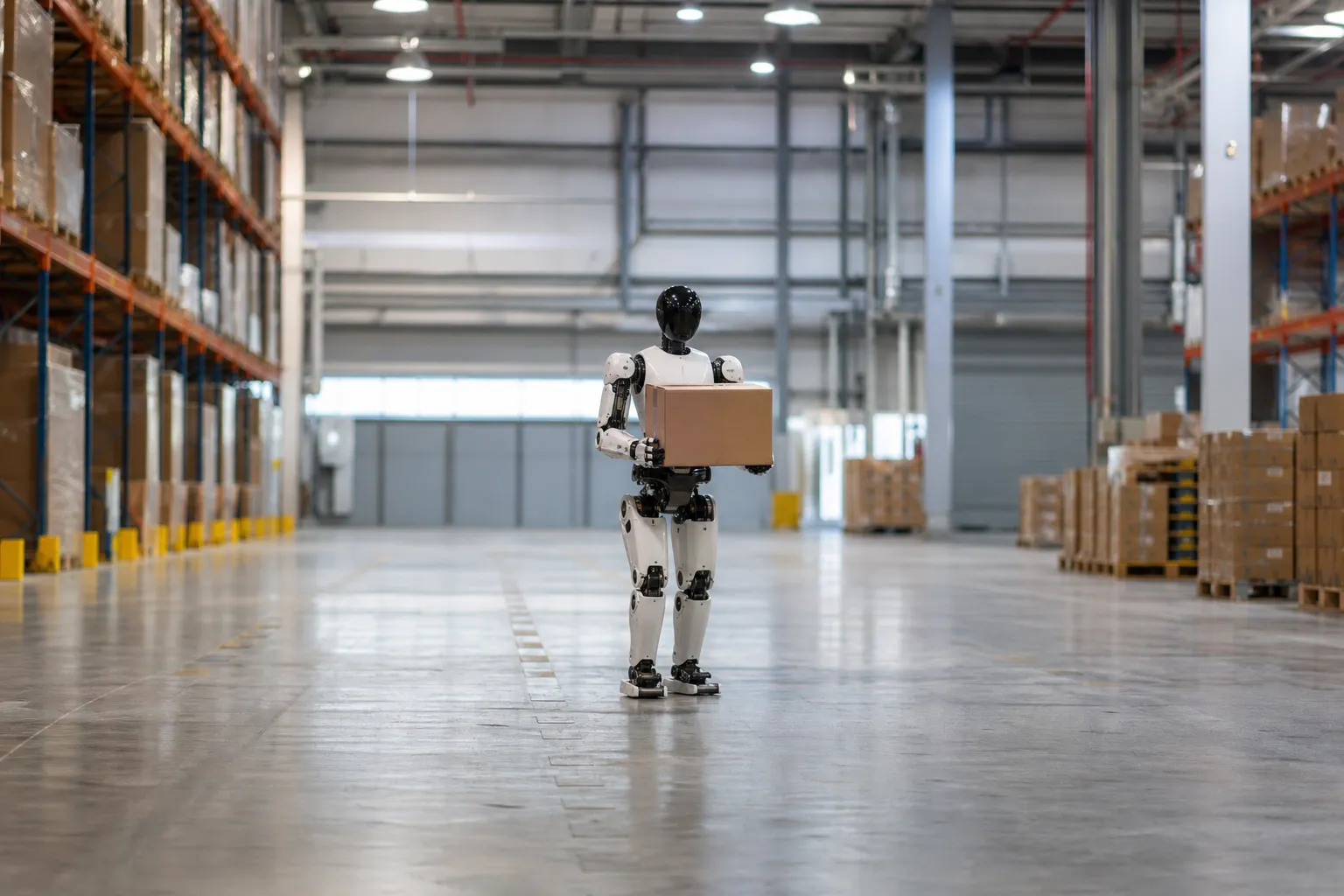
Audi is launching a trial with a mobile humanoid robot from Agile Robots at its plant in Ingolstadt, Germany. Working with Dassault Systèmes and Nvidia, the carmaker wants to automate the picking and preparation of parts for vehicle assembly.
The German manufacturer is running a proof of concept (PoC) in its Production Lab, a space dedicated to future industrial technologies. The aim is to find out whether a mobile humanoid robot can handle repetitive and complex logistics operations directly within an existing production environment.
How the two-armed robot picks and sorts car parts
The robot supplied by Agile Robots removes car parts from their storage bins, then places them on transport carts in the order required for final vehicle assembly.
This is a significant industrial challenge. According to Audi, around 1 million parts-picking tasks are carried out every day at its logistics site to supply the production shops. The variety of components, their shapes and the way they are stored makes automated handling difficult.
The Agile Robots mobile humanoid pairs an upper body fitted with two manipulator arms with a mobile platform. This design combines the handling capabilities of a humanoid with the stability of a wheeled base.
According to Agile Robots, the design allows the robot to work at a height comparable to that of a human operator and to fit into industrial facilities without major changes to their layout.
With its two arms and AI-based recognition functions, the robot is designed to handle different categories of components, including bulky or flexible parts and parts stored in varied configurations.
Audi tests the robot’s capabilities in its Production Lab
The collaboration takes the form of an industrial proof of concept, not a large-scale rollout across Audi’s production shops.
Audi’s supply chain specialists define the tasks to be performed and the operational constraints the robot must meet. They then assess its ability to work within the existing logistics and production facilities.
The trial is intended to establish whether robotic handling can meet the requirements of parts preparation, in particular selecting parts and arranging them in a precise sequence.
Audi aims to automate certain repetitive manual operations while allowing employees to spend more time on higher-value work.
How Dassault Systèmes and Nvidia use a digital twin to plan the robot’s work
The demonstration does not rely solely on the robot’s physical capabilities. Dassault Systèmes and Nvidia are contributing simulation tools to prepare and assess its integration into the plant.
Using Dassault Systèmes’ DELMIA application, the partners are building a digital twin that reproduces the working conditions. The 3DEXPERIENCE platform is used to assess several parameters:
- The feasibility of the operations assigned to the robot.
- The time needed to carry them out.
- The ergonomic conditions at the workstations.
- The safety of operations in the industrial environment.
The simulation draws in particular on Dassault Systèmes’ industrial world model and Nvidia’s Omniverse libraries.
These technologies are meant to prepare the robot’s tasks before they are carried out physically, taking into account the real constraints of Audi’s facilities.
Audi aims to cut industrial planning from months to days
Beyond parts handling, Audi also wants to speed up the preparation of automation projects.
The carmaker believes that combining the digital twin with AI tools could reduce planning processes that previously took several months to a few days. This is a goal stated by Audi, not a time saving already measured during this trial.
Dassault Systèmes also plans to eventually integrate LEO, its AI-based virtual companion, to assist engineers in their work.
The partnership brings together Audi’s expertise in car production, Agile Robots’ expertise in mobile robotics and Dassault Systèmes’ and Nvidia’s expertise in industrial simulation.
For Audi, the next operational step is to confirm, within the Ingolstadt Production Lab, that the robot can prepare parts in the order required by the assembly line, before considering any extension of this automation.