

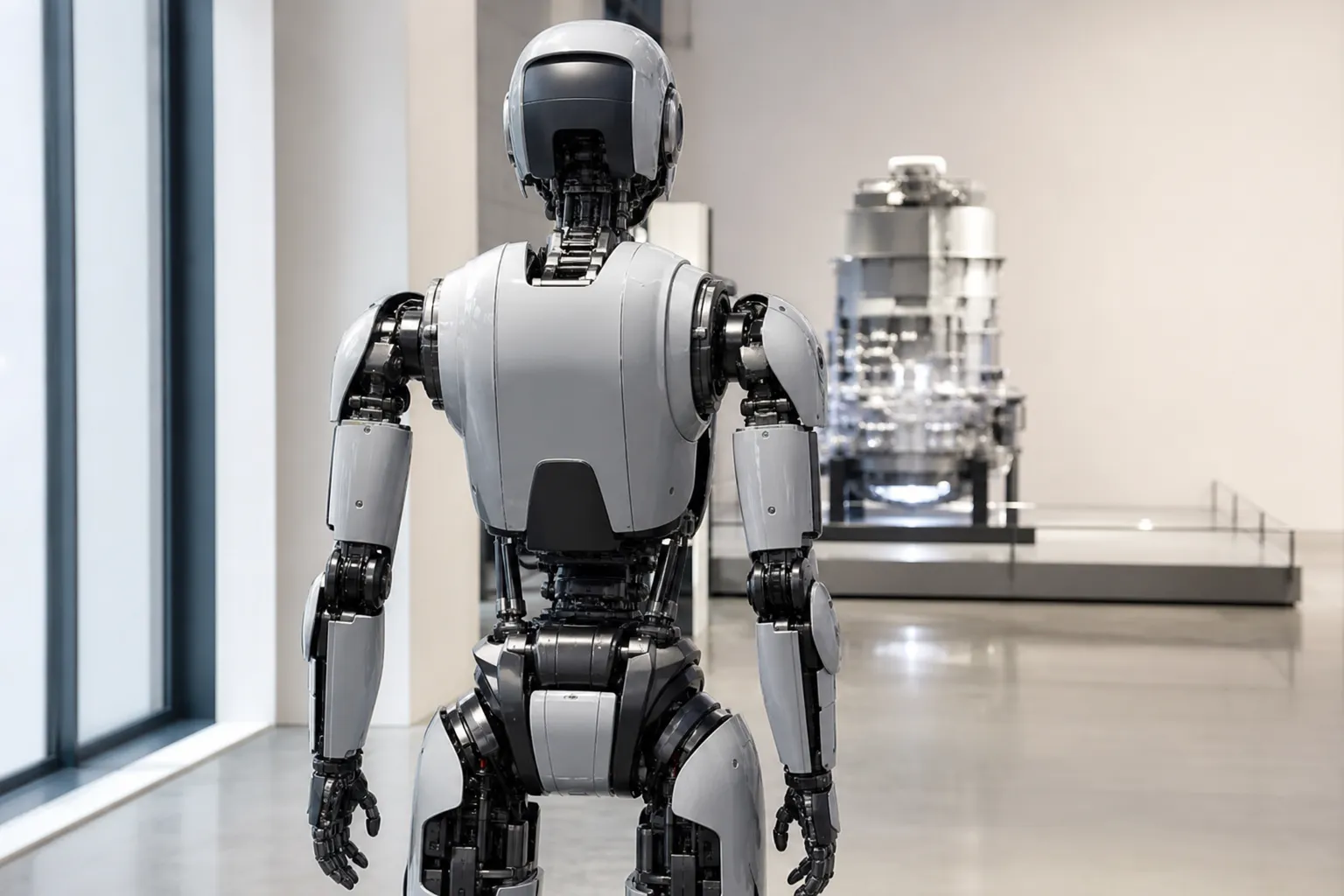
On 26 October, AGIBOT presented the Genie G2 Max, a two-armed industrial handling robot designed to move heavy loads with precision. It targets existing factories and warehouses, and its power system is designed for continuous operation.
Presented as part of the AI WAVE initiative, the Genie G2 Max is aimed at three main applications: depalletizing, material transfer and feeding production lines. AGIBOT is betting on a machine that can pick up, carry and set down a range of industrial parts while fitting into facilities already in place. The manufacturer also presents real-world applications in logistics and robot assembly.
G2 Max payload and precision: up to 50 kg across two arms
The Genie G2 Max combines heavy-duty handling with a manipulation system based on vision and force control. According to the specifications announced by AGIBOT, each arm can carry a payload of 20 kg. The combined rated load reaches 40 kg, while the maximum load across both arms can reach 50 kg.
The manufacturer also states an arm repeatability of ±0.5 mm or better. This figure describes the ability to return to the same position during repeated movements, an important parameter when placing components on an assembly line.
Each arm has seven degrees of freedom and force control. The system combines visual guidance with force adjustment to handle cardboard boxes, European-standard transport totes and irregularly shaped parts. AGIBOT says this architecture reduces retraining and recalibration when materials change.
The manufacturer estimates that the G2 Max’s handling capabilities match the requirements of more than 95% of industrial material totes and spare parts on the market. This is a manufacturer estimate of application coverage, not the result of independent testing.
Working envelope suited to warehouses and older factories
Integration into existing facilities is central to the G2 Max’s design. According to AGIBOT, the robot has a vertical working range of 0.1 to 2.5 metres and a horizontal reach of 1.2 metres.

A pitch joint at the waist lets it tilt its chassis forward to reach loads. Among other things, this configuration allows depalletizing from a single side of the pallet.
Pallets can therefore be placed against a wall, without setting aside the 1.5 metres of rear clearance usually needed in the configuration the manufacturer refers to. The aim is to keep more floor space available for storage and other production equipment.
Up to 80 totes depalletized per hour in a logistics application
AGIBOT presents an application of the G2 Max in an e-commerce warehouse. The robot works within a goods-to-person logistics setup, in coordination with the robotic systems already on site.
In this scenario, the G2 Max depalletizes full totes, transfers them to storage and palletizes empty totes for return.
The throughput figures given for this application reach 80 totes depalletized per hour and 75 empty totes palletized per hour. AGIBOT reports these figures for the scenario presented, and they are not a throughput guarantee for every installation.
The manufacturer highlights the possibility of automating these operations while keeping the warehouse’s physical layout unchanged.
G2 Max on the Qiyuan T1 robot assembly line
The Genie G2 Max is also used on the production line for the Qiyuan T1 robot, where it transports mechanical components.

Its job is to move machined shoulder joint housings, hip joint assemblies and other joint components from storage areas to final assembly stations.
This application shows the robot being used for tasks that require both load capacity and precise positioning, particularly when handling components used to build other robots.
Dual hot-swappable batteries for 24/7 operation
For industrial applications running multiple shifts, AGIBOT announces a power architecture combining two hot-swappable batteries and autonomous charging.
The manufacturer presents this setup as enabling continuous operation, 24 hours a day, 7 days a week, including night shifts. This continuity depends on power management and battery replacement.
The G2 Max also includes several safety features intended for industrial environments. Its sensor coverage spans 360 degrees and combines 2D and 3D lidar, ultrasonic sensors, a safety edge on the chassis and a physical emergency stop button.
AGIBOT presents this package as an architecture designed to industrial safety requirements, intended to detect obstacles and secure the robot’s movements in work areas.
Genie Studio 2.0 software for programming and supervising the G2 Max
The G2 Max is natively compatible with Genie Studio 2.0, AGIBOT’s software platform for embodied robotics applications.
The platform lets operators prepare task sequences, check that they work through simulation and manage maintenance for several robots within the same facility.
AGIBOT also says on-site adaptation can be completed within about a day using the platform’s tools. The aim is to shorten the time needed to integrate the robot into existing material-handling flows and industrial equipment.