

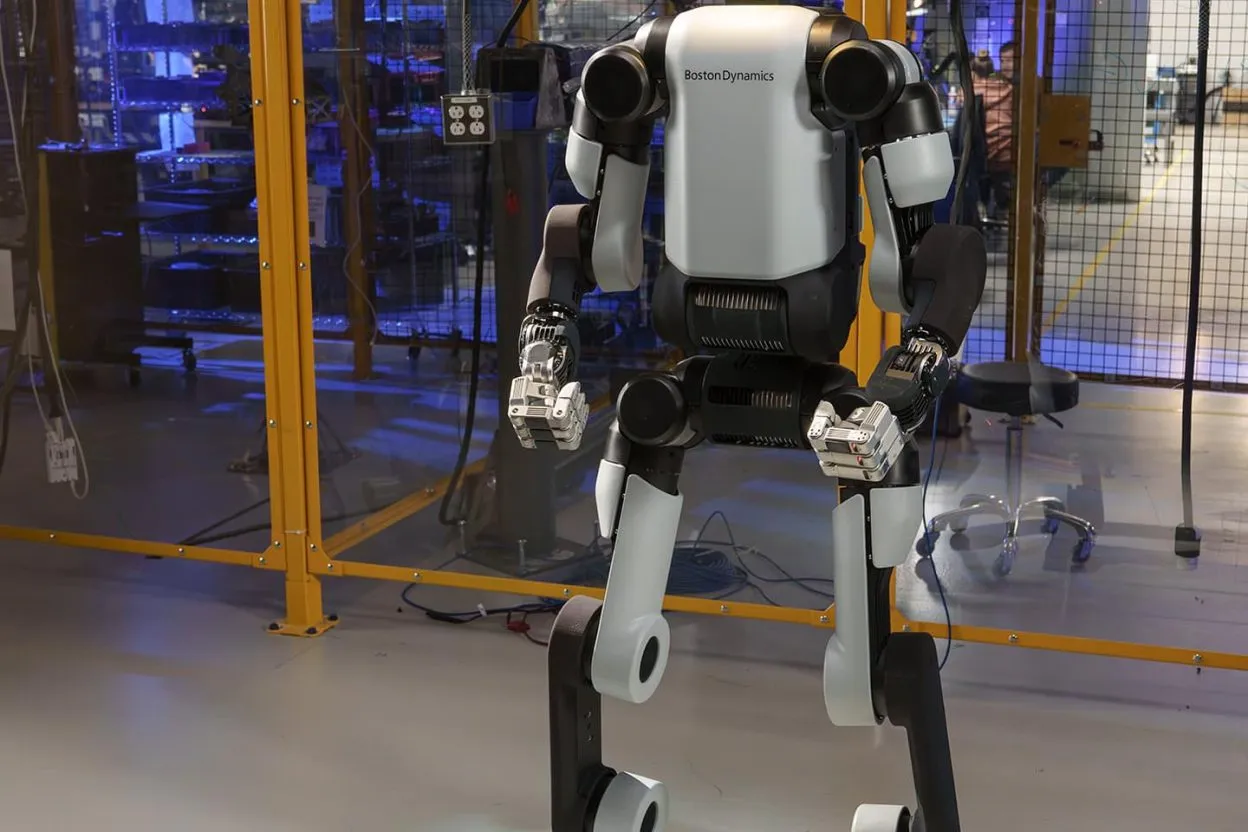
In January 2026, Boston Dynamics unveiled a new version of its Atlas humanoid robot, with 56 degrees of freedom and the ability to lift up to 49.9 kg according to the announced specifications. The update reflects the hardware progress being made in humanoid robotics.
The new Atlas arrives during a period of rapid development for humanoid robots. Manufacturers are trying to reproduce certain human abilities, including object manipulation, perception of the environment and mobility. But adding more joints and control systems raises questions about mechanical complexity, energy consumption and industrial profitability.
Atlas specs: 2.28 m reach and full-rotation joints
The version of Atlas that Boston Dynamics presented in January 2026 has several key technical features:
- 56 degrees of freedom (DoF), used to control the movements of its various joints.
- Joints capable of full rotation, to extend its range of movement.
- A reach of up to 2.28 m, according to the announced specifications.
- A maximum lift capacity of 49.9 kg, according to the announced specifications.
These specifications show the level of mechanical sophistication Boston Dynamics is aiming for. They describe the robot’s announced capabilities and do not, on their own, measure how it performs in sustained industrial operations.
Why a humanoid shape helps in human workspaces
Part of the appeal of a humanoid robot lies in its potential ability to operate in environments originally designed for people. Articulated arms can reach equipment, while legs can make it easier to move across uneven surfaces.

This design also comes with significant constraints. Keeping balance on two legs requires coordinating many actuators, motors and joints. The control systems must also manage shifts in the centre of gravity and the dynamic loads placed on the structure.
Every additional component adds mass, energy requirements and maintenance complexity. For a company, the economic case for a humanoid therefore depends on the tasks it can actually carry out and the return on investment that comes with them.
How physical AI and VLA models help robots adapt to different tasks
Beyond the mechanics, the development of general-purpose robots depends on progress in physical artificial intelligence. This approach combines perception of the environment, motion control and learning mechanisms.
Vision-language-action models, also known as VLA, are one of the technologies being explored. They use visual observations and instructions given in natural language to produce action representations or commands for the robot.
Their appeal lies in the possibility of adapting a single software architecture to several tasks and robot platforms. How robust they are across different environments is still debated, however, especially when the situations a robot encounters differ from the data used during training.
Researchers are also developing synthetic data to complement experiments carried out in real-world conditions. The aim is to improve how robotic systems respond to a wide range of situations.
Robot hands and perception: the remaining technical challenges
Manipulation is another challenge for humanoid robots such as Atlas. Advances in actuators, motors and vision systems allow more precise control of movements and the recognition of different objects.

Improvements in proprioception, which lets a robot know the position of its own limbs in space, also help with the coordination of movements.
Designing a robot hand that can handle large packages as effectively as small, delicate objects is particularly difficult, however. One alternative is to use interchangeable end effectors, matched to the objects and the operations to be performed.
Cameras can also be mounted near the wrists or manipulation tools rather than on a robotic head. Likewise, an extendable mechanism can reach high shelves without requiring a large humanoid structure.
Wheeled robots vs humanoids for industrial applications
Bipedal locomotion, a defining feature of humanoids, makes it possible to move over uneven terrain. It does, however, require a more complex mechanical and electronic architecture than a wheeled system.
A wheeled robot benefits from a relatively simple drive mechanism that bears its weight directly. Robotic legs, by contrast, involve several joints, actuators, bearings, cables and additional control systems.
This complexity adds to the demands on wiring, thermal management and power supply. The extra mass can also increase the energy needed to move around.
For many industrial applications, wheeled platforms are therefore an alternative to bipedal locomotion. The choice between a full humanoid design and a modular robot depends mainly on the working environment and on the manipulation or mobility capabilities required.