

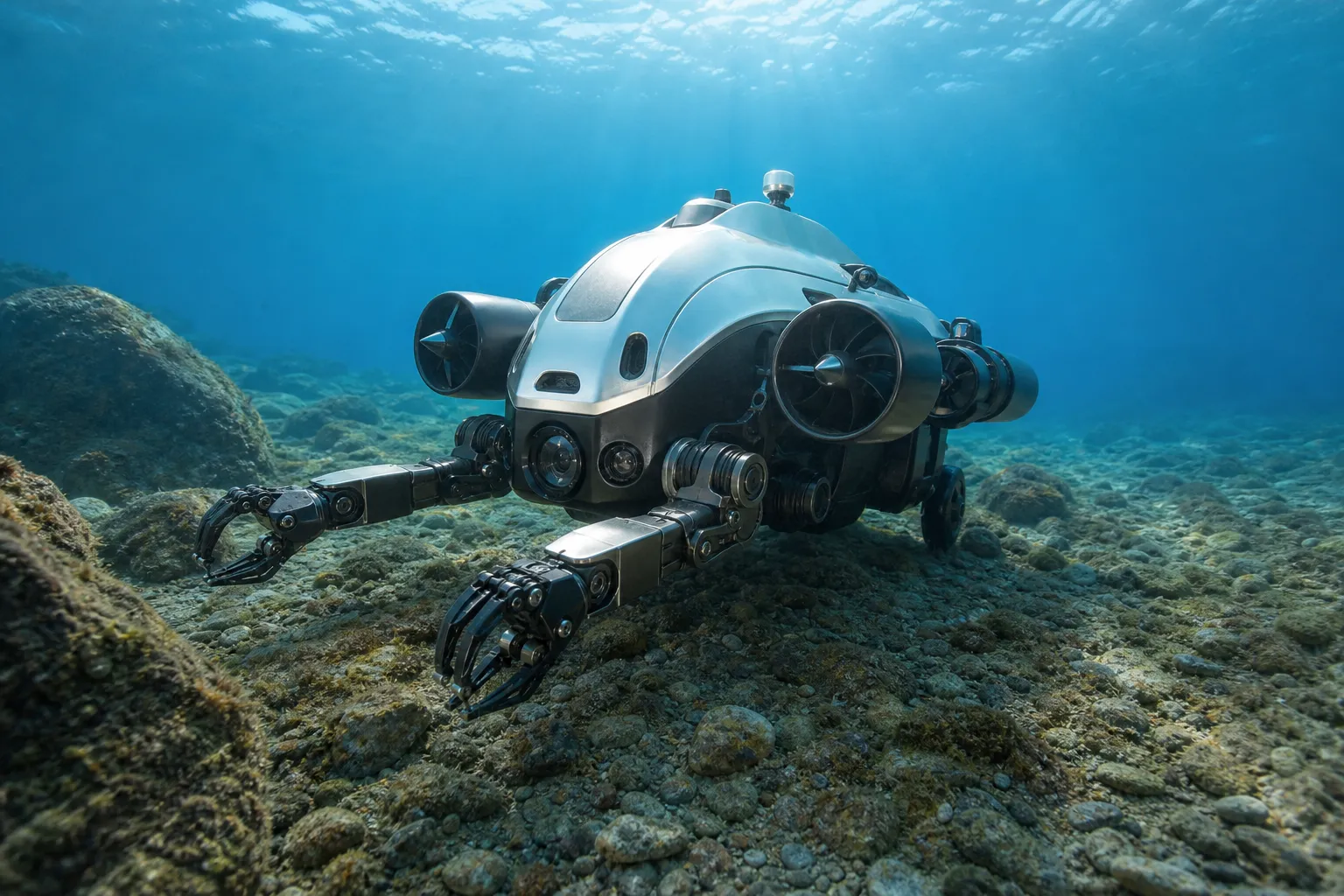
On 21 October 2026, the first Global Ocean Robotics Day brought together 10 international partner hubs, including Constructor University. The event focused on research into autonomous underwater robots, marine artificial intelligence and robotic fleets.
Held as a hybrid international symposium, the Global Ocean Robotics Day gathered researchers and academics from more than a dozen countries across Europe, Asia, North America and Australia. This first edition was free to attend online or at the partner hubs. Its aim was to strengthen scientific exchange and give more visibility to institutions from regions that are under-represented in marine robotics research.
Constructor University’s role in ocean robotics research
Constructor University was one of the partner institutions hosting the event. Its Marine Systems and Robotics research group, led among others by Professor Francesco Maurelli, works on autonomous systems for exploring and observing marine environments.
Francesco Maurelli, who also organised the symposium, described this first edition as “an important milestone and the beginning of a new chapter” for the international ocean robotics community.
The university intends to support collaboration between researchers specialising in artificial intelligence and robotics. Frazer Cairns, provost of Constructor University, stressed the importance of these international exchanges to the university’s scientific mission.
Low-cost fleets, robot swarms and multi-robot systems: the research topics
The talks covered several lines of development that could shape future robotic systems used at sea:
- Low-cost robotic fleets: developing groups of robots for deployment in real ocean environments.
- Underwater swarms: research on groups of robots able to operate in the same environment.
- Reliable multi-robot systems: work on the reliability of architectures involving several machines.
- Digital twins: simulating autonomous docking manoeuvres before applying them to physical systems.
- Current mapping: using the trajectories of marine vehicles to study how water moves.
- Bio-inspired robotics: exploring robot designs inspired by living organisms.
This work shows the range of approaches being studied by laboratories, from the navigation of a single vehicle to the coordinated use of several underwater vehicles.
How autonomous underwater robots navigate: sonar, vision and onboard intelligence
In his talk on advanced perception and navigation, Francesco Maurelli presented the technologies that allow autonomous underwater robots to operate in uncertain environments.
The research discussed combines sonar, vision, fault-tolerant systems and onboard intelligence. The goal is to enable the machines to perceive their surroundings, navigate and make decisions during their missions.
This work involves researchers from Constructor University’s Marine Systems and Robotics group, including PhD student Muhammad Waqar Mughal, who specialises in developing autonomous systems and deep learning methods.
Marine robots built at Constructor University shown on site
The symposium also included in-person demonstrations. Muhammad Waqar Mughal and several members of his team presented autonomous marine robots designed, developed and built at Constructor University.
The machines on display included a robot on which the PhD student is developing autonomy and deep learning systems as part of his thesis.
Muhammad Waqar Mughal joined Constructor University in 2023 to begin his PhD under Francesco Maurelli, whom he had met in Pakistan in 2021.
The team’s work relies on the robotics group’s facilities, the Ocean Lab and the local marine environments of Bremen. These resources allow the researchers to design, build and test their robots, from the earliest stages of development through to real-world trials.