

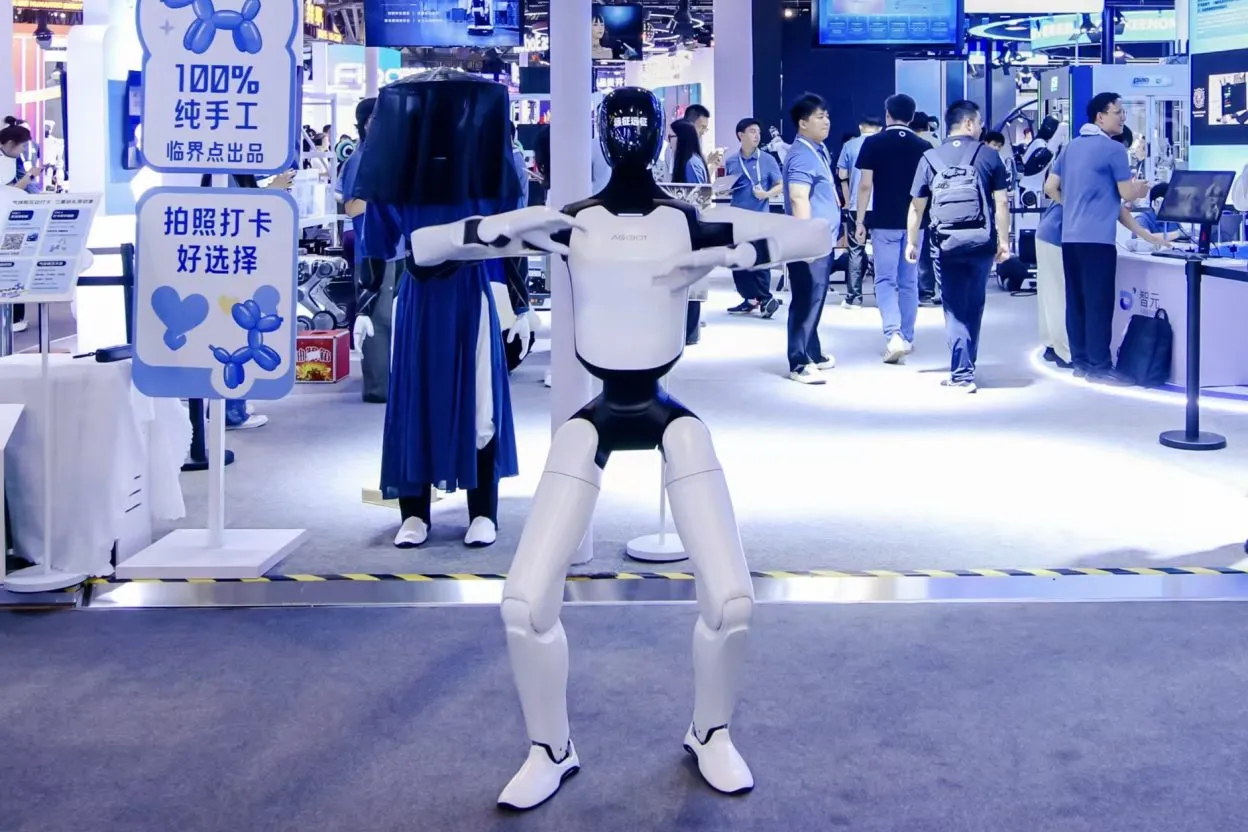
At AGIBOT Innovation Day 2026 in Shanghai, the Chinese manufacturer presented Worken, a metric designed to measure the work robots actually get done. It also introduced the G2 Max industrial robot and several artificial intelligence technologies.
AGIBOT wants to change how the industry evaluates the performance of robots deployed in the field. Presented by Peng Zhihui, the company’s co-founder, president and chief technology officer, Worken combines the notions of work and token. The proposed measurement framework is meant to assess how well machines perform useful tasks autonomously and consistently, rather than relying only on production or delivery volumes.
How Worken measures robot productivity: three factors
AGIBOT defines Worken as a measure of effective intelligent working hours. The manufacturer proposes a formula based on three variables:
Worken = Number of active robots × Autonomous working hours × Production efficiency rate
- Number of active robots: machines actually carrying out tasks in real-world environments, excluding units that have merely been built or are held in stock.
- Autonomous working hours: the time during which robots work autonomously, not their total powered-on operating time.
- Production efficiency rate: the third component included in the Worken calculation.
The approach seeks to tell apart two deployments with a similar number of robots but different results. AGIBOT stresses in particular the importance of the level of autonomy, how often humans have to intervene and the amount of acceptable work completed.
“We want to go beyond the number of robots built or delivered and start measuring their ability to do useful work, autonomously and consistently, in the real world,” says Peng Zhihui.
AGIBOT G2 Max industrial robot, AHA3 and GO-3 Preview announced
AGIBOT Innovation Day 2026 was also a showcase for several announcements covering the manufacturer’s hardware, artificial intelligence models and software.

AGIBOT launched the G2 Max, an industrial robot, and presented AHA3, an integrated hardware platform that the company describes as bringing three forms of intelligence together in a single architecture.
The manufacturer also introduced GO-3 Preview, presented as the next generation of its embodied AI foundation model. It highlighted WITA-Omni 1.0, its omnimodal interaction model, as well as Link-U OS 1.0.
The announcements also covered AGILE, the motion intelligence framework developed by AGIBOT. Among other things, the company presented a new self-evolving agent capability.
AGIBOT robot applications in industry and commercial services
Beyond the technology announcements, AGIBOT presented concrete applications in industrial manufacturing and commercial services. These demonstrations reflect its strategy of developing robots intended to carry out tasks in operational environments.
The manufacturer builds this approach around robot hardware, locomotion, task execution intelligence, interaction, operations and an ecosystem intended to support large-scale deployments.
Founded in 2023 as Zhiyuan Xinchuang Technology Co., the Shanghai-based company develops humanoid robots, quadrupeds, dexterous manipulation systems and commercial cleaning solutions, among other products.
AGIBOT announced that its 20,000th robot had rolled off its production line. According to IDC, the manufacturer also ranked first worldwide for humanoid robot shipments in the first half of 2026.
With Worken, AGIBOT now proposes to supplement these industrial indicators with a measure of the work done after machines are deployed, taking into account their autonomous activity and operational efficiency.