
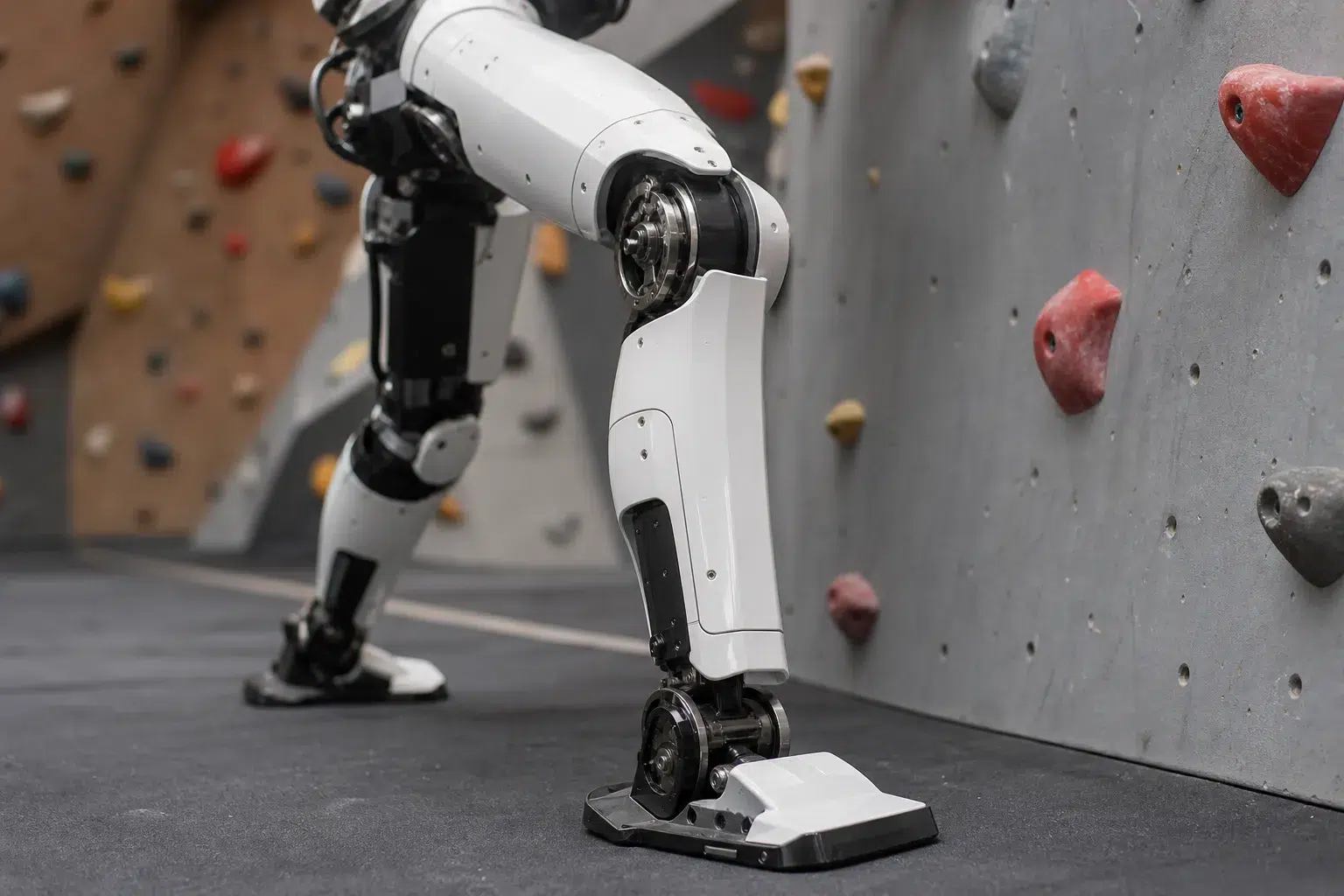
Researchers at ETH Zurich have shown that a Unitree G1 humanoid robot can climb ladders, clear obstacles and get back up after a fall using a single learned locomotion policy. Their ACP method plans where the robot makes contact based on the terrain.


The Attention-based Contact Planning (ACP) approach was developed by ETH Zurich’s Robotic Systems Lab and its collaborators. It is described in a scientific paper titled “Humanoid Mobility via Attention-based Contacts”, submitted to arXiv on 22 October and listed as under review. Partners on the project include ETH Zurich, Apple, the ETH AI Center and NVIDIA. The work concerns an experimental control method applied to the Unitree G1. It is not the announcement of a new commercial model.
How ACP teaches the Unitree G1 where to make contact
What sets ACP apart is how the robot prepares its movements. Instead of generating a full sequence of postures in advance, the system identifies the places where different parts of the body need to touch the environment.
The system learns which contacts are useful from human motion data. Reinforcement learning is then used to work out how to move the rest of the body between those contact points.
At runtime, a planner uses a terrain map built from LiDAR data, the robot’s measured state and a target position. It predicts the contacts required for nine body parts: the hands, elbows, knees, feet and pelvis.
According to the researchers, this planning looks up to 1.5 seconds ahead. A second neural network converts the contact points into commands for 23 joints. Both networks run directly on board the robot at 50 Hz, without replaying a reference motion sequence.
Unitree G1 demos: ladders, stairs and combined obstacle courses
The researchers presented several physical demonstrations of the Unitree G1 using this method. Among other things, the robot can:

- Climb a ladder and step up onto platforms.
- Negotiate stairs and stepping stones.
- Move along a balance beam.
- Vault over an obstacle and jump down onto a lower surface.
- Sit down, stand up and recover a usable posture after a fall.
The demonstrations also include sequences that chain several challenges together. The G1 can, for example, combine a ladder climb with a jump down, or clear one obstacle before climbing onto another.
The value of this approach lies in the continuity of movement: a single locomotion policy lets the robot chain different actions without being given a complete body trajectory for each obstacle.
The team also shows situations where the robot struggles, including during a ladder climb, after a failed jump and in a fall caused by mapping errors. Some sequences show how it regains a usable posture.
How the LiDAR map is updated while the robot moves
To adapt its footholds and handholds to the terrain, the system uses a LiDAR mounted on the robot’s head and neural mapping that runs on the CPU of the onboard Jetson Orin NX module.
According to the research team, the map is updated in under 30 milliseconds for each LiDAR scan, which runs at 10 Hz, on a grid with a resolution of 3 centimetres.
This information lets the planner adapt contact points to the obstacles it observes, while the control network computes the corresponding joint movements.
ACP reaches 92.5% success on eight simulated courses
The researchers also evaluated their method in simulation on eight courses combining several obstacles. Under these conditions, ACP achieves an average success rate of 92.5%, compared with 58.8% for MGMT, an approach based on generating and tracking motions.

For this comparison, the researchers disabled sensor noise, physics randomisation and action delays to isolate terrain-related performance. These results therefore come from a simulation-based evaluation, separate from the demonstrations carried out with the physical robot.
Limitations: local locomotion toward predefined targets
The work covers the robot’s local mobility toward target positions. On some unstructured routes, the researchers supply intermediate waypoints by hand. Global navigation is not part of this study.
The authors also identify limitations for contacts located above the robot, movements involving hanging and object manipulation. The sequence of contacts alone also cannot distinguish between certain acrobatic movements, such as a vertical jump and a backflip.
The ACP method is therefore a research demonstration on the Unitree G1. It combines examples of human motion with terrain-aware control, with the aim of selecting the necessary contact points before computing the body’s movements.