

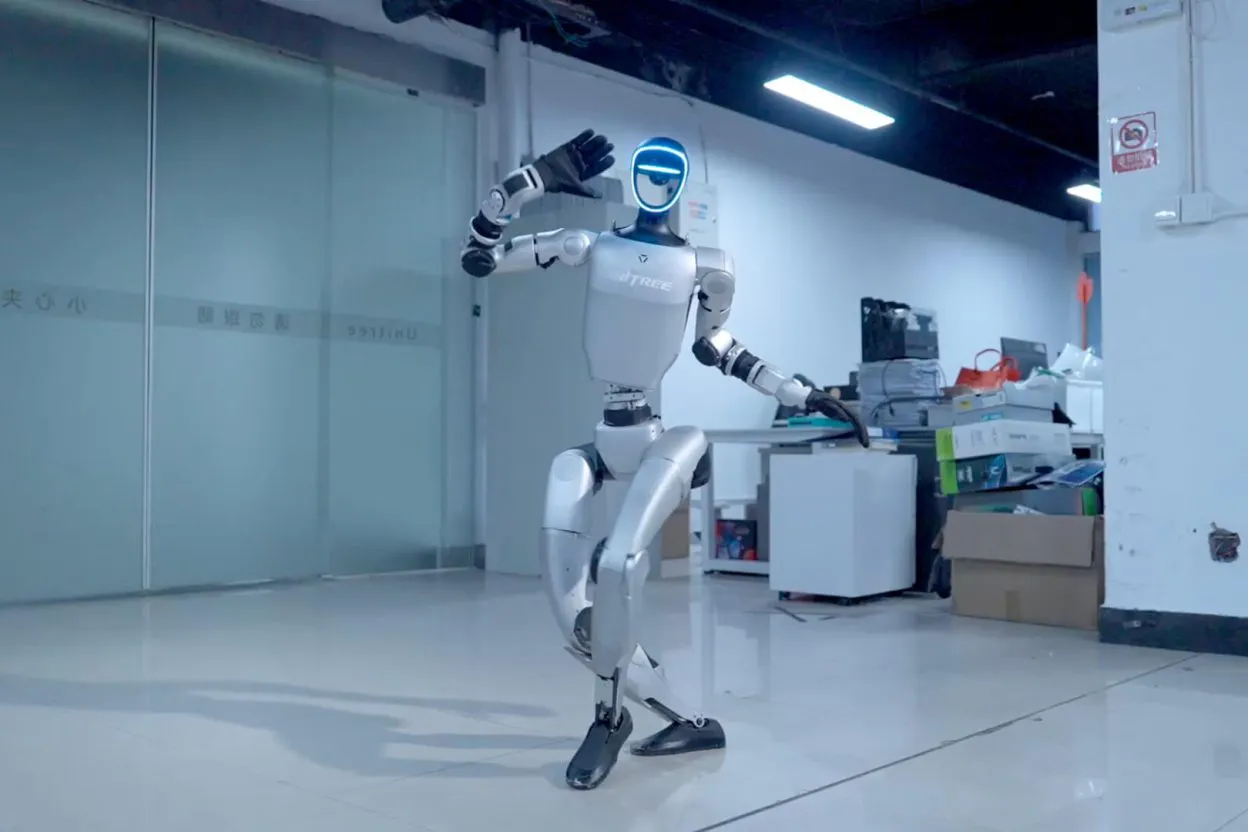
The Unitree G1 serves as the base for several US humanoid robot projects. Lightberry uses it for Lumi and Tuesday Labs for Voxel, while Dynamic Creatures may have chosen a modified version for Hugo. The three projects take different approaches to interacting with people.
Rather than developing all of their own mechanics, some US startups are building on an existing robot platform so they can focus on the software, sensors and behaviour of their machines. The Unitree G1, designed by Chinese manufacturer Unitree, features in this strategy through three projects with distinct uses: commercial entertainment, home assistance and entertainment.
Lightberry Lumi: a conversational robot built on the Unitree G1
San Francisco-based startup Lightberry is using a version of the Unitree G1 with 29 degrees of freedom to develop Lumi, a yellow interactive robot aimed mainly at commercial entertainment, marketing and developers.
Lightberry does more than change the robot’s appearance. The company replaces its onboard computer and adds several components to improve its interaction capabilities:
- A Jetson Thor T4000 compute module.
- An array of eight microphones.
- Stereo cameras.
- A movable neck.
- Grippers for handling objects.
These modifications are intended to let Lumi converse with the people around it, perceive its environment and adjust the pace of its interactions.
ETH Zurich develops living muscle actuators for robots that can jump and move
Lightberry has announced a Founder Edition priced at $39,990, intended for commercial applications and development. This is the announced price for this edition, not a price set for the French market.
Tuesday Labs Voxel: a home robot prototype with reversed legs
With Voxel, Tuesday Labs is exploring another use of the Unitree platform. Its yellow prototype has an upright body that also serves as a face, glowing eyes placed very low, and legs whose joints bend in the opposite direction to human knees.

This unusual silhouette appears to result from reorienting the G1’s mechanics. Benjamin Bolte, an angel investor in Tuesday Labs, explicitly describes Voxel as a shell built around the Unitree G1.
In a video about building the robot, Paul Vizzio, head of hardware at Tuesday Labs, explains that he wants to quickly test the concept of a home assistant with a personality. His approach is to use proven robotics technology and then develop the character around that base.
Voxel is still presented as a prototype. Tuesday Labs aims to explore how a home robot and its users can interact, with considerable weight given to the robot’s appearance and character.
Dynamic Creatures Hugo: an expressive robot character, possibly G1-based
The third project, Hugo, is being developed by Dynamic Creatures. This robotic character is covered in purple fur and has horns and oversized hands. Unlike Lumi and Voxel, its use of the Unitree G1 remains a hypothesis.
In a video presenting Hugo, a developer’s screen briefly shows a mechanical model whose proportions and joint layout resemble those of a modified G1. This observation, however, does not amount to confirmation from Dynamic Creatures.
The company describes Hugo as a platform with 43 actuators. It is also developing a Vision-Language-Expression model, designed to link the character’s visual perception, language and expressive movements.
This architecture aims to match the robot’s movements to its interactions with its environment and the people around it.
Dynamic Creatures also has a partnership with Boston Dynamics in entertainment and hospitality. This relationship does not make it possible to identify the hardware inside Hugo.
One Unitree G1 base for commercial and home robots
These projects show different ways of developing a robot from existing mechanics. Lightberry prioritises conversation and perception, Tuesday Labs is working on a character for the home, and Dynamic Creatures is focusing on body expression.

The three machines are at different stages: Lumi has an announced commercial edition, Voxel is presented as a prototype, and Hugo’s development is focused in particular on its expressive movements.
What they mainly have in common is the emphasis on user experience. By reusing an existing mechanical architecture when it suits their project, the teams can put more work into the interaction, software and visual identity of their robots.