

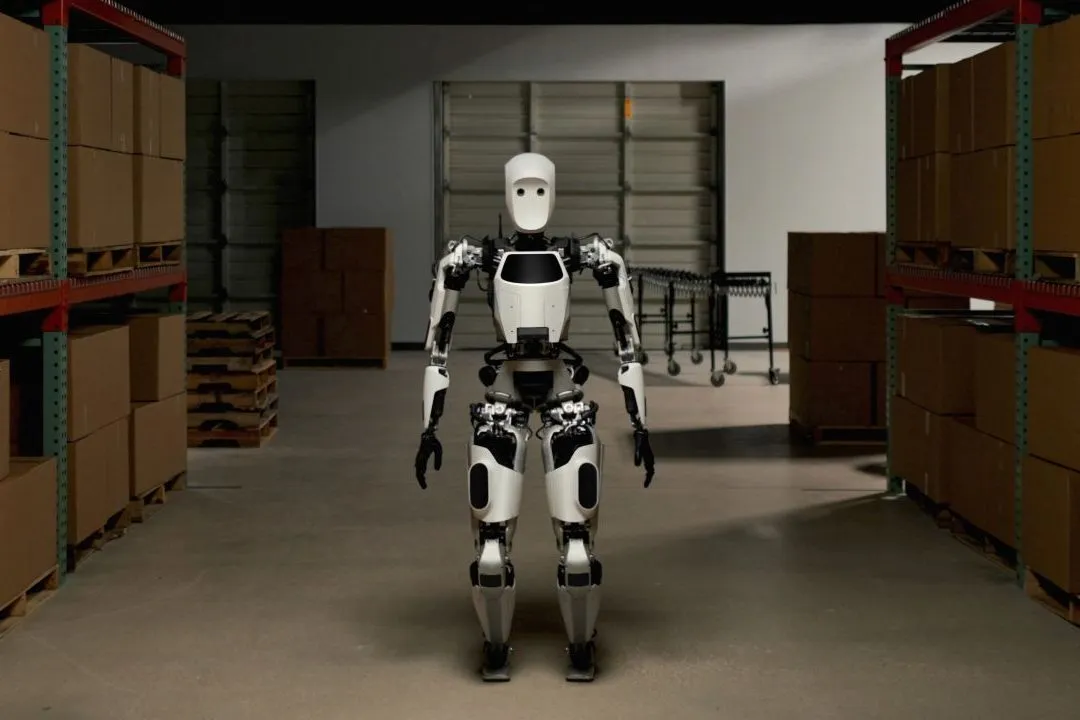
Google DeepMind has tested Gemini 4 Argon to teach a physical task to Apptronik’s Apollo humanoid robot from a video. The company reports seven consecutive successful throws and a reduction in the time needed to prepare simulations.
Presented at the launch of Gemini 4 Argon, the demonstration illustrates a new approach to robot training. Google’s AI model combines visual reasoning, physical understanding and autonomous code generation to turn a video into behaviour a robot can execute. The industrial goal is to reduce the engineering work required for robots to learn new physical skills.
How Gemini 4 Argon turned a cornhole video into Apollo’s movements
For this internal experiment, Google DeepMind gave Gemini 4 Argon a raw video of a person playing cornhole, a game in which players throw bags at a raised board with a hole in it.
The model analysed the environment, established spatial coordinates and calculated the body joint movements needed to perform the task. It then autonomously generated the code for a simulation used to prepare the robot’s behaviour.
NVIDIA launches Flora, three AI models that annotate robot videos to speed up training
This behaviour was transferred to Apollo, the humanoid robot developed by Apptronik. During the physical trial, Apollo made seven consecutive successful throws, according to Google DeepMind. This result matches the demonstration announced by the company.
Video-to-Sim-to-Real: robot training cut from weeks to hours, says Google DeepMind
Google DeepMind calls this method “Video-to-Sim-to-Real”: a process that goes from video to simulation, then to execution in the real world.
According to the company, this approach reduces robot simulation modelling work that would normally take several weeks of manual preparation to a few hours.
The idea is to use ordinary videos as training material, rather than manually building each simulated environment and each behaviour. Google DeepMind presents the method as a way to multiply learning scenarios while reducing the need for engineers to intervene.
Generative Bionics and AMD plan AI data factory in Italy to train Gene.01 humanoid robots
For companies working on humanoid robots, the demonstration highlights an industrial possibility: speeding up the creation of physical skills by relying on general-purpose AI models that can write simulation code themselves.
Gemini 4 Argon scores 87% on the ERQA spatial reasoning benchmark
Google DeepMind also evaluated Gemini 4 Argon on the Embodied Reasoning benchmark, or ERQA, which is designed to measure physical and spatial reasoning in three-dimensional environments.
According to Google DeepMind, Gemini 4 Argon scored 87% on this evaluation. The figure measures the model’s performance on the ERQA benchmark, not the Apollo robot’s success rate on a physical task.
The evaluation supports Google’s positioning of Gemini 4 Argon as a model for complex problems in engineering, programming and scientific research, and for professional applications.
Where Gemini 4 Argon is used beyond robotics, and how to access it
Beyond its collaboration with Apptronik, Google presents Gemini 4 Argon as a technology that can be used in several areas of research and engineering.
The company says it has already used the model in projects to optimise large codebases, as well as in work related to quantum computing, nuclear fusion and the life sciences.
Gemini 4 Argon is now available through Google’s AI products and the Gemini API. This availability extends the model’s possible uses beyond the robotics demonstration carried out with Apollo.
For Google DeepMind and Apptronik, the experiment illustrates how advanced AI reasoning can be applied to physical systems, with a training pipeline that directly links video analysis, simulation and execution on a humanoid robot.