

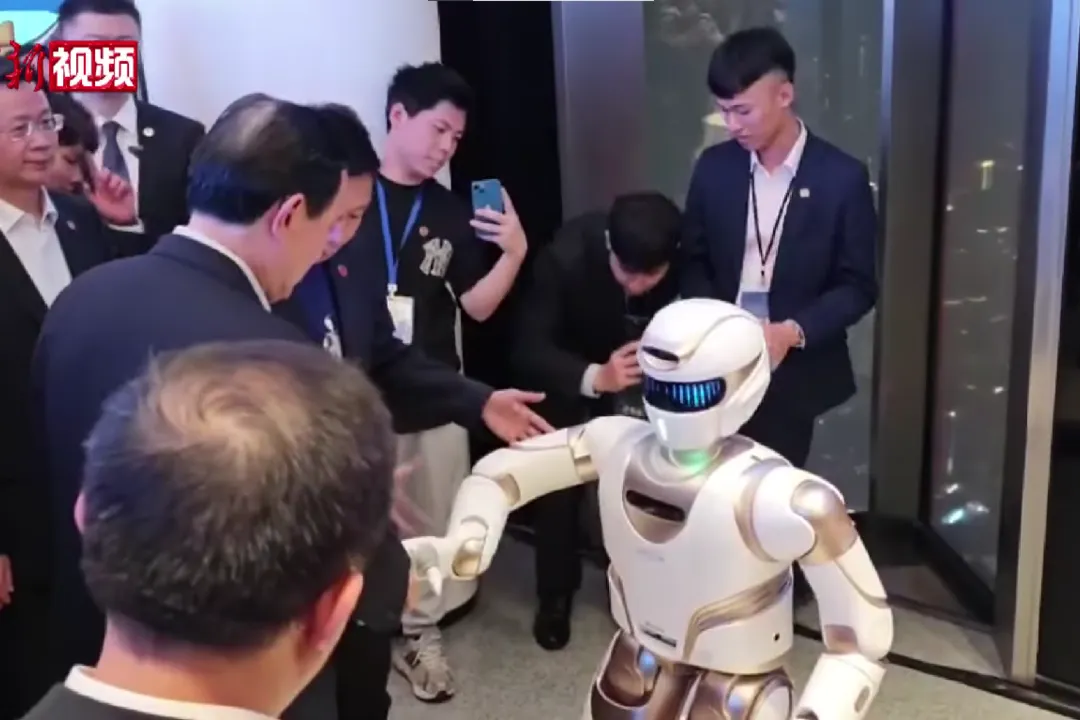
UBTech has presented three realistic-looking humanoid robots under the series name Uworld U1. The Chinese manufacturer is announcing mass production and describes the machines as everyday companions, powered by large language models it calls “emotional”. Prices start at RMB 119,800, according to UBTech, and rise, again according to the manufacturer, to the price of a mid-range car.
The range comes in three versions. The U1 Lite is limited to a humanoid upper body. The U1 Pro is a full-body robot. The U1 Ultra, presented as the most dynamic model, completes the series. Each is available in a so-called “female” version, 168 cm tall, and a “male” version, 183 cm tall, according to AI Weekly (1 July 2026). The robots’ weight is not given in the sources consulted.
Silicone skin and 88 degrees of freedom: UBTech U1 specifications
The robots are covered in a silicone skin intended to replicate the feel of human skin. UBTech says their appearance can be adjusted to some extent, for example hair colour and make-up. The manufacturer cites 88 degrees of freedom, hands included, and a biomimetic cervical spine with a double joint for natural movement. UBTech claims this allows the robots to reproduce 90% of basic human movements, a figure that should be read as a manufacturer’s promise rather than an independent measurement.
On the artificial intelligence side, UBTech says it draws on principles from cognitive neuroscience, without specifying what this involves. The manufacturer announces a response time of under 500 ms and advanced reasoning capabilities. Interaction is by voice: according to UBTech, the robot continuously analyses the context of the conversation, which would make a wake word unnecessary and allow context-appropriate responses. Lip synchronisation reportedly has a latency of under 20 ms, according to the manufacturer.
Emotion recognition and companionship for people living alone
UBTech highlights an emotional dimension. The large language models powering the U1 robots can, according to the manufacturer, recognise more than 20 human emotional states with an accuracy above 90%. The manufacturer lists a wide range of uses: daily companionship, emotional and psychological support, social assistance and elderly care, as well as tourism, exhibitions, reception and hospitality.
The company places particular emphasis on companionship for people living alone. It cites around 90 million adults living alone in China, 10 to 20% of whom are psychologically vulnerable, according to its own figures. UBTech has launched an annual donation initiative for vulnerable groups. Before the end of 2026, the manufacturer plans to give 100 customised U1 humanoid robots to isolated elderly people and to children separated from one or both parents or from disadvantaged backgrounds.
A sensitive point: UBTech says the robots can be modelled on real people, in both appearance and voice. The manufacturer mentions long-term memory systems and emotion-driven interaction models, which would be used to provide psychological support. What such a promise means in practice has yet to be demonstrated in real-world conditions.
UBTech U1 pre-orders: 13,361 claimed
UBTech says it had recorded 13,361 orders for U1 robots as of 30 June 2026, after pre-orders opened on 2 June. The manufacturer did not specify how autonomous the machines were during the presentation, nor the delivery terms.