

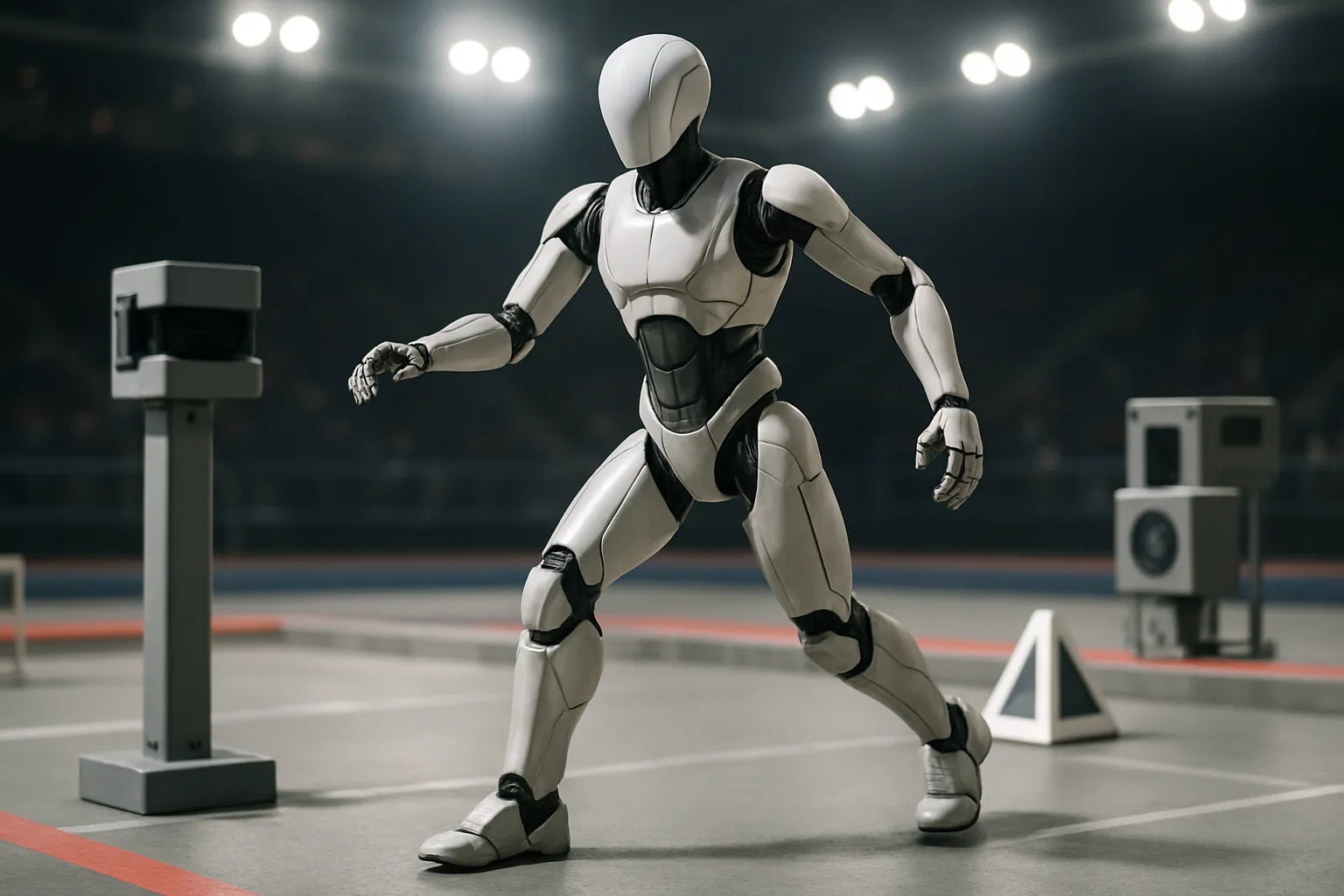
RoboCup was held in Songdo, Incheon, South Korea, from 30 June to 6 July 2026. Teams from several dozen countries competed against each other on a football pitch. When it was over, every winner in the humanoid categories had the same supplier behind it: Beijing-based Booster Robotics.
Of the 59 teams entered in the humanoid leagues, 38 competed with Booster machines. They took gold and silver and filled most of the podium places in all three divisions: Small, Middle and Large.
Tsinghua, B-Human and Invic: who won the RoboCup 2026 humanoid divisions
Tsinghua University’s Hephaestus team won the Large division on the Booster T1 robot. Germany’s B-Human took the Middle division on the K1 model. A team called Invic won the Small division on the K1 Air.
These results reflect a shift in where the competition is played. For years, every team built its own robot from scratch. Most of the work went into mechanics, hardware and simply teaching the machine to walk. Most of the leading teams now buy the robot body off the shelf and focus their efforts on software: perception, fast decision-making and coordination between several robots. Booster supplies the hardware and keeps working on the hard parts, such as running, sudden stops and getting up after a fall.
First 11-a-side humanoid robot match ends 4-0
RoboCup 2026 was the first time two complete teams of humanoid robots played each other 11-a-side on real hardware. The score was modest: B-Human won 4-0 against another German team, HTWK Robots. These players are still small and unsteady, far from a top-level footballer. Ten years ago, walking without falling was already a challenge.
The stated goal is not new. It is RoboCup’s founding mission, set in 1997: by 2050, a team of autonomous humanoid robots should beat the reigning world champion team under standard FIFA rules. “Our team’s ultimate goal is to beat the FIFA champion in 2050,” one participant told Reuters in Incheon. The gap with a human national team remains enormous, and the event does not hide it.
Booster Studio and a 3v3 league: Booster’s developer platform strategy
Booster’s win is also a commercial move. The company does not just sell robots. It wants to control the platform they run on. It recently launched Booster Studio, which it presents as the first complete development environment for embodied intelligence, a robot’s ability to see, balance and react in the real world. Engineers use it to program, simulate and deploy a robot’s behaviour before touching the hardware. One of the youngest teams in Incheon came from a secondary school in Macau: its students trained their code in the simulator before loading it onto real robots. Booster has also launched its own 3v3 football league to attract more developers.
The context goes beyond football. According to The Next Web, China shipped around 90% of the world’s humanoid robots in 2025, driven by names such as Unitree. The sector is crowded and not yet profitable for most players, and Beijing has started registering humanoids by ID. Winning a global competition is a cheap and visible way to stand out.
Why viral robot football videos are heavily curated
A word of caution is in order. The most spectacular footage is heavily selected. One widely shared video showed a Booster T1 firing a penalty through a wall, which is amusing until you remember that these machines share the pitch with people. Robots kicking this hard have already injured spectators at other events. For now, robot football remains a research tool presented as a show. The gap with a real World Cup team is still considerable, and 2050 is a long way off. The hard problem is no longer the body but the brain, and that is precisely the part making the fastest progress.