

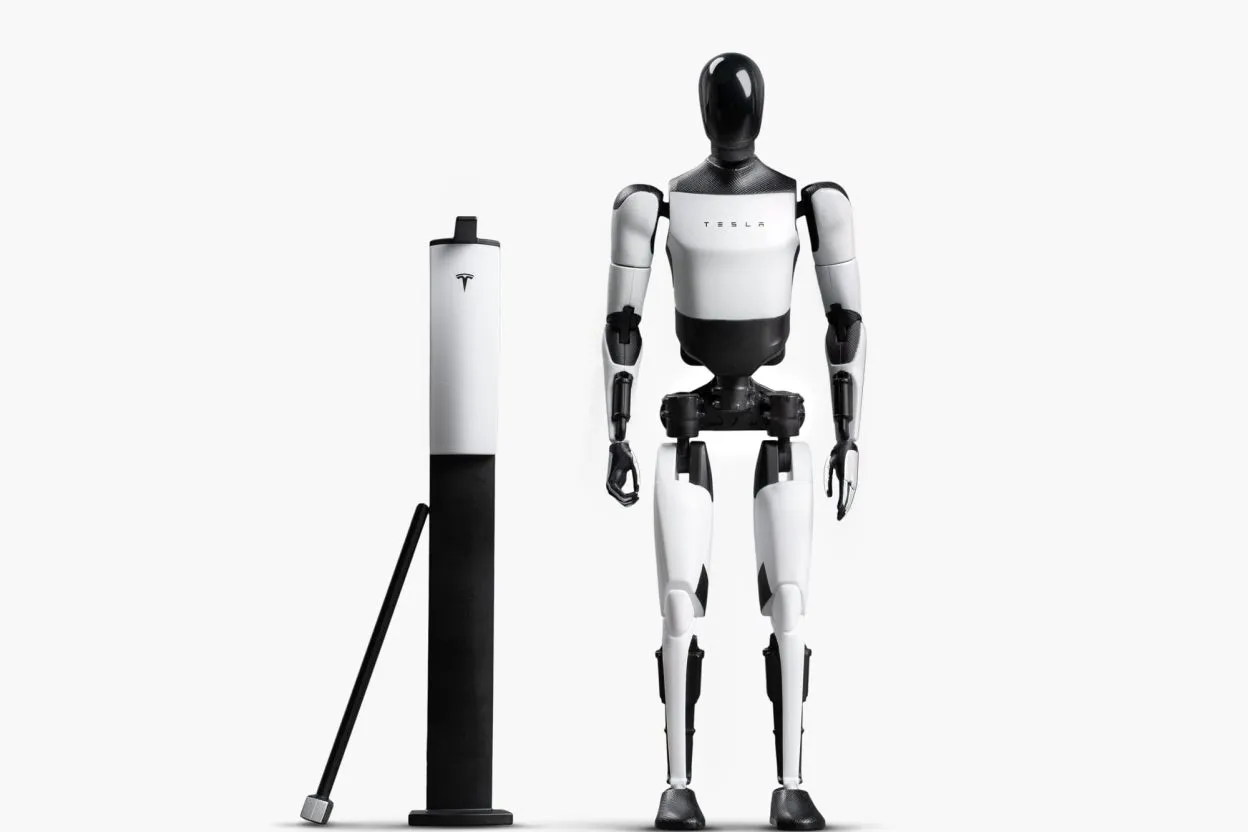
Tesla has started initial production of its Optimus humanoid robot at its Fremont factory in California. The industrial milestone comes as the company reports a 43% drop in net profit for the third quarter of 2026.
On 21 October 2026, Tesla announced it had begun building Optimus at a site previously dedicated to electric cars. The move extends the company’s push into humanoid robotics, artificial intelligence and automated driving, even as its spending rises sharply.
Tesla begins initial Optimus production at its Fremont factory
In its third-quarter 2026 shareholder letter, Tesla says it has built its first production-grade Optimus robots on a manufacturing line in Fremont, California.
The company says it has validated a manufacturing process suited to a commercial product, while it continues to make changes to the hardware and to its production process.
AGCO to pilot Agility Robotics’ Digit humanoid robot at its Kansas factory from 2027
Elon Musk nevertheless describes this as initial production. On the earnings call, the chief executive warned that the volume ramp would be slow and uneven because the product is new.
Building Optimus is a new use of Tesla’s manufacturing capacity in Fremont, where the company ended production of the Model S and Model X in part to free up space for the robotics programme.
Elon Musk targets 20,000 Optimus robots per week by end of 2027
During the results presentation on 21 October 2026, Elon Musk said Tesla could reach a production rate of 20,000 Optimus robots per week by the end of 2027.

That figure is a target set out by Musk, not a production capacity the company has reached.
Musk also acknowledged that parts of the robot’s design still need to change to meet safety, reliability and durability requirements.
Unitree’s H2-X humanoid robot can do kung fu, but it is mainly designed for security and rescue
Software is another work in progress. According to Musk, Tesla still needs to improve Optimus’s artificial intelligence so the robot can carry out varied, open-ended tasks beyond predefined scenarios.
Tesla Q3 2026 earnings: net profit down 43%
Optimus enters production against a less favourable financial backdrop for Tesla.
According to the quarterly results published by the company, net profit came to $787 million in the third quarter of 2026, compared with $1.37 billion in the same period of 2025. That is a 43% decline year on year.
Total revenue for the quarter was $28.04 billion, compared with $28.09 billion in the third quarter of 2025 and $28.23 billion in the second quarter of 2026, according to Tesla.
Spending on artificial intelligence projects, Optimus and automated driving is weighing on the group’s profitability. Lower revenue from regulatory credits also contributed to the drop in profit.
Car sales remain Tesla’s main business
Despite its diversification into robotics, Tesla still earns most of its revenue from electric vehicles.

The company reports automotive revenue of around $20 billion in the third quarter of 2026, broadly flat year on year.
Over the period, Tesla says it delivered 486,532 electric vehicles, about 6,000 more than in the previous quarter but fewer than in the third quarter of 2025.
The other businesses showed mixed results:
- Solar and storage: Tesla reports revenue of $2.8 billion, down 16% year on year. The company attributes the decline in part to refunds granted to customers in connection with tariffs.
- Services: revenue from this business, which includes subscriptions to the Full Self-Driving driver-assistance software, rose 33% year on year to $4.6 billion.
- Services profitability: Tesla reports a record quarterly gross profit of $734 million for this segment.
These results show that Optimus is being funded by a company whose revenue still depends mainly on cars.
Self-driving: Tesla’s other investment priority
Alongside Optimus, Tesla continues to develop its Full Self-Driving (FSD) software and its robotaxi services.
On the earnings call, Elon Musk, chief financial officer Vaibhav Taneja and head of AI software Ashok Elluswamy defended the outlook for this business.
The version of FSD currently offered to drivers remains supervised: the driver must monitor traffic and be ready to take back control of the vehicle.
Ashok Elluswamy pointed to the second quarter of 2027 as a possible timeframe for starting to add some customer vehicles to the robotaxi network, through a software update enabling unsupervised driving.
That date remains a Tesla forecast. Elon Musk had previously suggested the technology could be available in the fourth quarter of 2026.
Developing Optimus and automated driving at the same time is absorbing the company’s investment, while its automotive and services businesses continue to generate most of its revenue.