

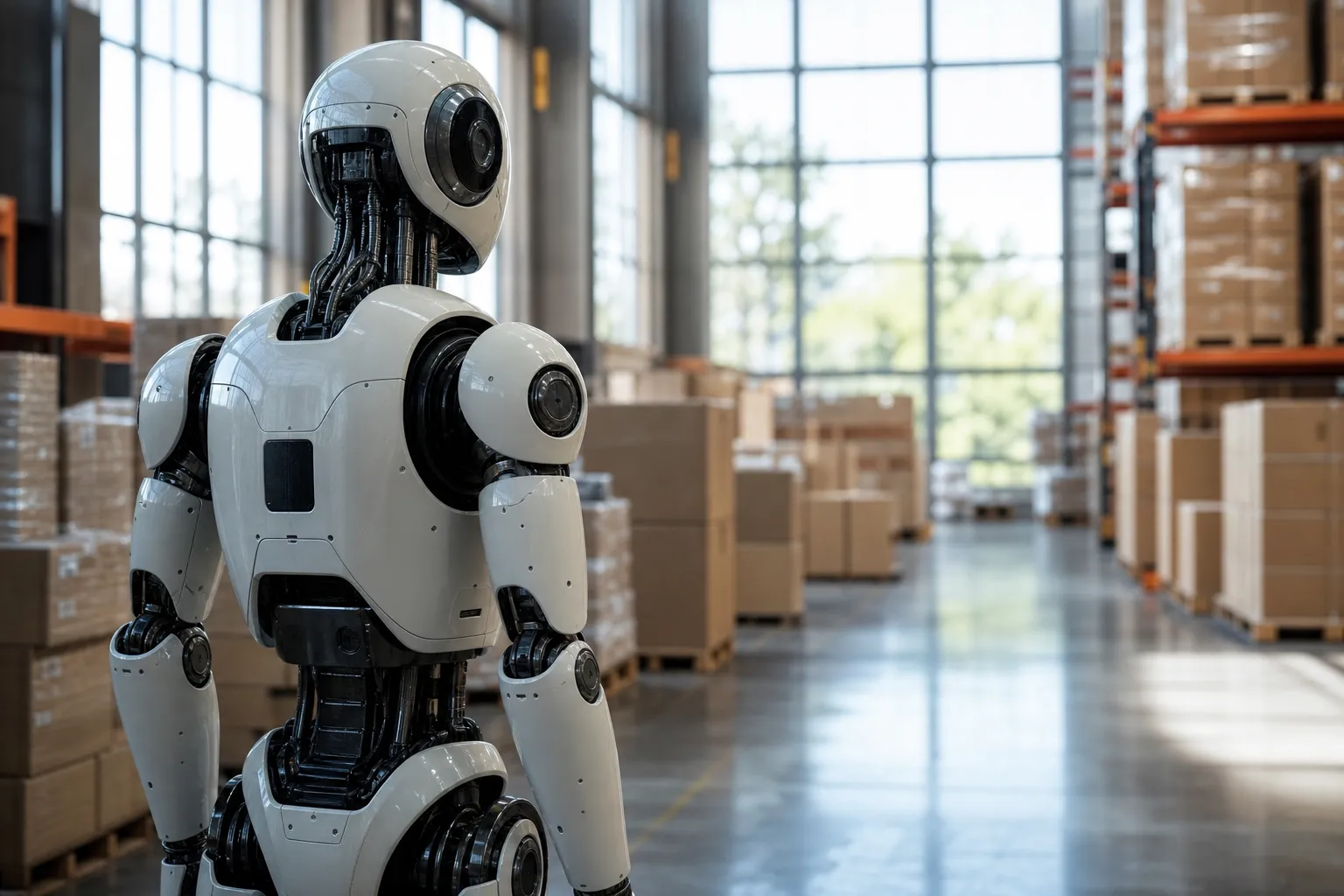
Cumulative shipments of artificial intelligence accelerators for humanoid robots could exceed one million units worldwide by 2030. Counterpoint Research also expects average annual growth of 144% between 2026 and 2030, driven by a diversification of computing architectures.
The forecast comes from Counterpoint Research’s Global Humanoid Robot Tracker Report, cited by the Chinese technology outlet ITHome. The study describes a fast-changing market for computing components, in which chipmakers are trying to meet the growing needs of humanoid robots.
GPUs still lead in humanoid robots as ASIC chips gain ground
In the short term, GPUs should remain the dominant architecture for onboard computing in humanoid robots. NVIDIA currently holds a leading position thanks to its integrated ecosystem, which combines computing chips, artificial intelligence models and simulation tools.
The company has partnerships with several robot makers, including AgiBot, Unitree, UBTECH, GALBOT, Figure AI, Neura Robotics and Noetix.
At the same time, application-specific integrated circuits (ASICs) designed for artificial intelligence are gaining ground. Tesla and Xpeng are among the carmakers bringing chip technologies developed in-house for their vehicles into their robotics businesses.
Qualcomm’s humanoid robot chips: lower power use and lower costs
Qualcomm is taking an approach based on a heterogeneous computing architecture, aiming to limit power consumption and reduce material costs. The company has already signed design partnerships with Neura Robotics, VinMotion, Booster Robotics and Figure AI.
Its shipment volumes remain lower than NVIDIA’s, however, according to Counterpoint Research. The competition therefore pits different approaches to onboard computing against each other: integrated GPU ecosystems on one side, architectures combining different types of components on the other.
Why WAM models increase computing power needs in robots
The evolution of artificial intelligence models is another factor reshaping the market. Vision-language-action (VLA) architectures are gradually converging with world models, while robotics models are moving towards world action models (WAM).
Soumen Mandal, an analyst at Counterpoint Research, believes this shift will make computing performance more important. It will also increase the need for energy efficiency, lower power consumption and better heat dissipation management.
GPUs are expected to continue powering the most advanced edge computing environments. ASIC architectures, for their part, could benefit from the position of carmakers with chip technologies developed in-house, notably Tesla.
Humanoid robot AI chip competition expected to intensify from 2027
Counterpoint Research expects competition to intensify from 2027, as next-generation AI accelerators capable of handling artificial general intelligence (AGI) workloads enter mass production. The coexistence of several computing architectures should then play a larger role in equipping humanoid robots.