

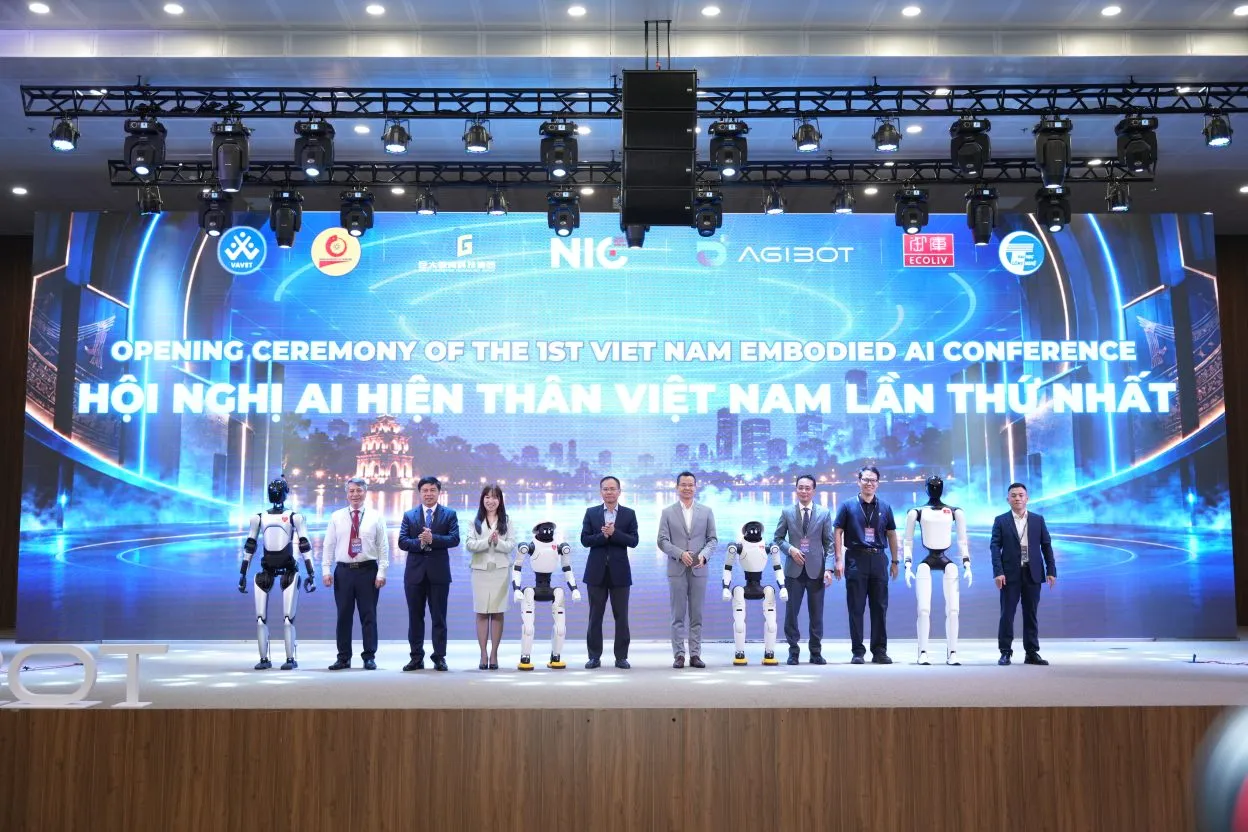
AGIBOT has set foot in Vietnam. On 2 October in Hanoi, the Chinese manufacturer held the country’s first conference on embodied artificial intelligence. It co-organised the event with Vietnam’s National Innovation Center (NIC) and two local partners, ECOLIV and Great Education. According to AGIBOT, more than 550 people attended. They included representatives of the NIC, the Ministry of Science and Technology, the Ministry of Education and Training and the Ministry of Industry and Trade, the heads of more than 50 schools and representatives of more than 20 research institutions.
The timing was deliberate. The conference coincided with Vietnam’s National Innovation Day on 1 October and its Day for Encouraging Learning on 2 October.
AGIBOT’s “Yuan Sheng” programme for education and research in Vietnam
The most concrete part of the announcement concerns education. AGIBOT has launched a programme for Vietnam called “Yuan Sheng”, aimed at education and research. According to the manufacturer, it will cover curriculum development, joint laboratories, teacher training, hands-on student practice and research projects. The goal is to bring embodied AI robots into Vietnam’s education and research system.
During the conference, the NIC presented AGIBOT with an innovation partner award. The manufacturer in turn recognised its first group of ecosystem partners in Vietnam at a plaque ceremony.
Robots-as-a-Service (RaaS): renting robots to lower the cost of entry
On the industrial side, AGIBOT announced the launch of a Robots-as-a-Service (RaaS) model, meaning customers rent robots rather than buy them. According to the manufacturer, the aim is to let companies, universities and other users deploy robotic applications more flexibly, relying on the service network built by its local partners, in order to lower the initial barrier to entry.
Industrial deployment will go through ECOLIV, the Vietnamese partner with which AGIBOT says it is strengthening local operational capabilities: commercial expansion, project delivery and the creation of an after-sales service system.
Abel Deng, AGIBOT’s president for the Middle East and Asia-Pacific region, said the goal is to bring large AI models, robot bodies and ecosystem capabilities to the Vietnamese market. He added that the company wants to validate embodied intelligence across several fields: education and research, retail services, cultural tourism and hospitality, and industrial manufacturing. Steve Chen, CEO of ECOLIV, pointed to Vietnam’s strengths in manufacturing base, human resources and innovation policy.
Which robots AGIBOT showed in Hanoi, and what remains unclear
AGIBOT presented a range of machines at the event: humanoid robots, quadruped robots, wheeled robots and solutions for education and industry. Two models, the A3 and the X2, gave a demonstration on stage. The manufacturer has not said how autonomous that performance was.