

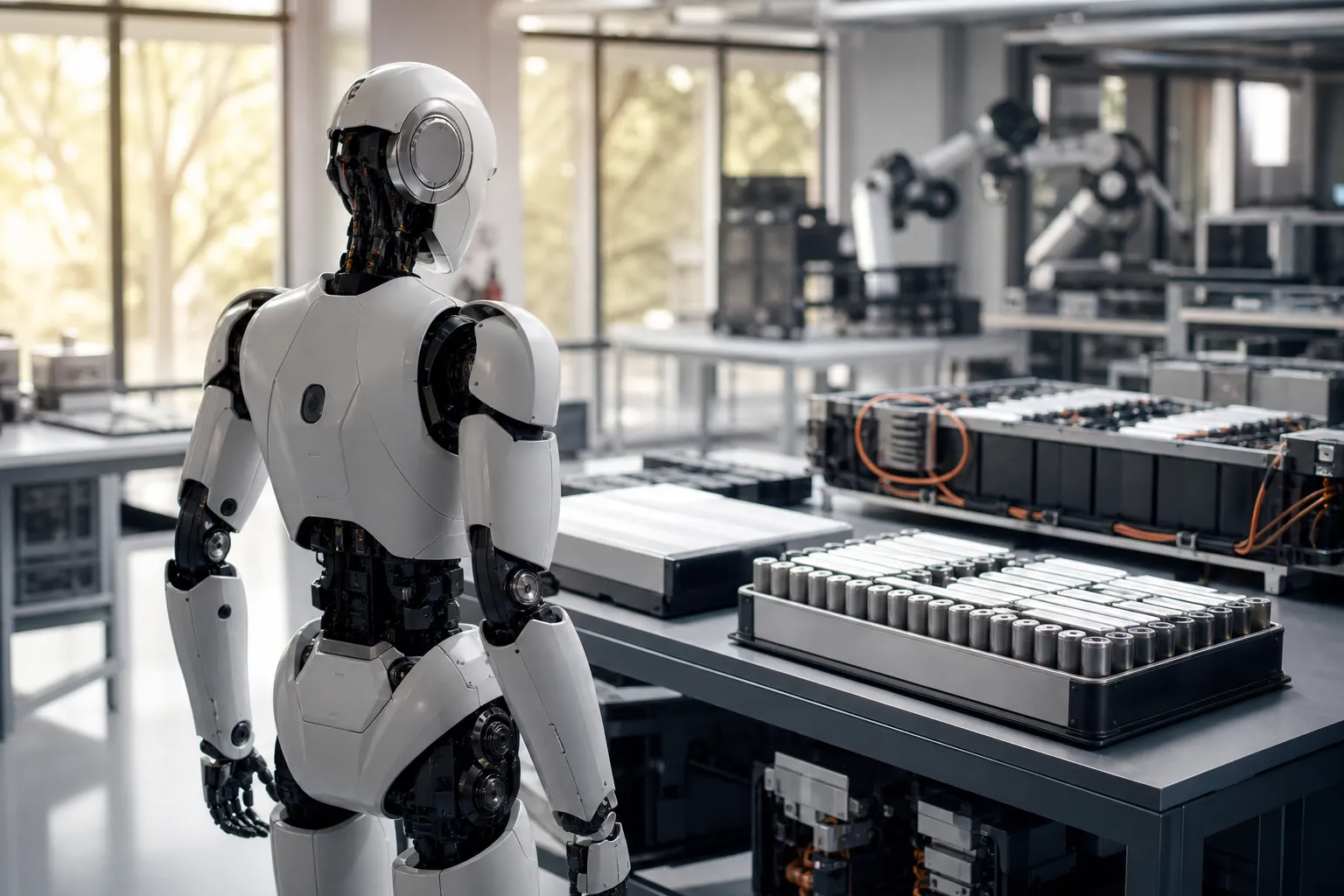
Demand for humanoid robot batteries could reach 10.5 GWh in 2037, according to IDTechEx. The research firm identifies NMC lithium-ion batteries as the dominant technology today and examines two alternatives for the next generations.
In its report “Batteries for Humanoid Robots 2027-2037: Technologies, Players, and Forecasts”, IDTechEx analyses the technologies that could support the commercial development of humanoid robots. Because these robots are expected to carry out a range of tasks in environments designed for humans, they place specific demands on their batteries. These must supply enough energy, allow fast charging and keep their performance over repeated charge cycles.
NMC lithium-ion batteries dominate current humanoid robots
According to IDTechEx, lithium-ion batteries with NMC cathodes, made of nickel, manganese and cobalt, are currently the most widely used technology in humanoid robots.
Their main advantage is the balance they offer between energy density, fast-charging capability, cycle life and industrial maturity. Their use in many other applications also helps ensure supply as the market grows.
IDTechEx distinguishes several NMC cathode compositions by nickel content: mid, high and very high. Raising the nickel share can improve energy density while reducing dependence on cobalt, a costly material subject to supply constraints.
LFP batteries, which use lithium iron phosphate cathodes, have an energy density that IDTechEx considers too low to meet the general needs of humanoid robots.
Solid-state batteries target 400 to over 500 Wh/kg
Among the technologies under consideration for future generations, IDTechEx gives significant weight to solid-state batteries. Their development benefits in particular from heavy investment by the automotive industry.
Unlike conventional lithium-ion cells, they replace the liquid electrolyte with a solid material. This design also makes it possible to remove the separator used in standard cells.
According to IDTechEx, the target energy density for this technology is around 400 to over 500 Wh/kg, a measure of the energy stored per kilogram of battery. This potential performance relies in particular on a lithium metal anode, paired with high-voltage, high-energy-density cathodes, including NMC.
Higher energy density would let humanoid robots carry more energy for a given battery mass, an important factor for tasks that require high power.
Removing the flammable liquid electrolyte is also a potential safety advantage. IDTechEx stresses the importance of this criterion for machines meant to operate near people, especially in the event of a cell failure.
Lithium-sulfur batteries are also being studied
Besides the various NMC compositions and solid-state batteries, IDTechEx identifies lithium-sulfur batteries as another technology that could power future humanoid robots.
The firm compares these chemistries based on their energy performance and technological maturity. The distinction matters for the market: NMC solutions already have a developed supply chain, while the newer technologies are being evaluated for future applications.
How big will the humanoid robot battery market be? 10.5 GWh in 2037
IDTechEx forecasts demand for humanoid robot batteries reaching 10.5 GWh in 2037. This figure is a forecast of cumulative demand in battery capacity, not a measure of the electricity robots consume while operating.
The projection appears in the study covering 2027-2037, which focuses on the technologies, industry players and market outlook for humanoid robot batteries.
For battery manufacturers, the growth of this market depends in particular on their ability to offer cells that combine high energy density, fast charging and good cycle life. IDTechEx sees NMC batteries as suited to the sector’s current growth, while solid-state and lithium-sulfur batteries are among the technology options being studied for the following generations.