

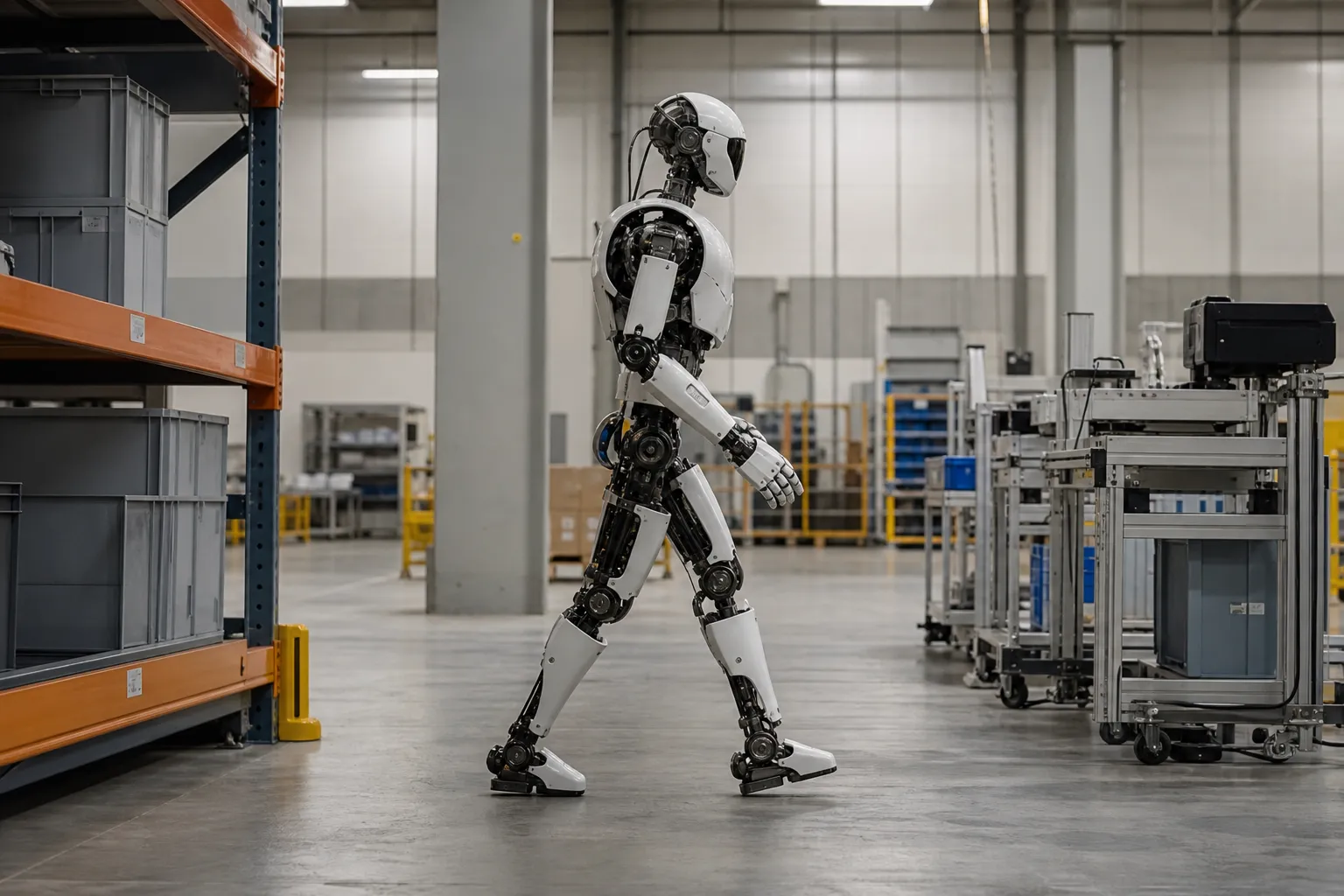
Xiaomi has announced a new stage in its humanoid robot trials: an 8-hour task at a station in its car factory, and sequences of more than 50 tasks in apartments. These results rely in part on its embodied intelligence model, Xiaomi-Robotics-1.
Xiaomi presented these results on 3 November 2026 at the World Internet Conference, held in Wuzhen, China, from 2 to 5 November. The group received the “Outstanding Contribution” award in the innovative breakthroughs category, while its robotic manipulation technologies designed for large-scale deployment won the “Cutting-Edge Technology” award. These awards come as its humanoid robots enter a new testing phase in two environments: car manufacturing and household services.
An 8-hour task at an automotive production station
At its car factory, Xiaomi says its humanoid robots completed, for the first time, an 8-hour task at a station that sorts the side panels of the centre console. According to the manufacturer, this corresponds to a full day’s production requirements at that station.
The robots also corrected anomalies that arose during operations on their own. Xiaomi reports that they coordinated with the production line system and presents these results as a first validation of their operational capabilities at this scale.
This is a trial in a real industrial environment, not an announcement that the humanoid robots will go on sale.
Assembly station success rate rises from 90.2% to 98%
This latest trial builds on several steps taken in 2026. In March, Xiaomi brought its humanoid robots into its car factory for training operations at a station that supplies self-tapping nuts.
According to the results released by Xiaomi, the robots then worked autonomously for 3 consecutive hours, with a 90.2% success rate for installation on both sides, while keeping to a production cycle time of 76 seconds.
In July 2026, Xiaomi announced that the success rate at the same station had risen to 98%. At the same time, the manufacturer extended the trials to two further operations: sorting the side panels of the centre console, and folding and retrieving material bins.
These new stations made it possible to test extended handling of flexible parts, which differs from the nut installation work carried out in the first trials.
More than 50 household tasks across 3 rooms
Xiaomi is also testing its embodied intelligence technology in its apartments for young people. The manufacturer has announced the start of a trial operation phase for its robotic system in these homes.
Building on the pre-trained Xiaomi-Robotics-1 model, its engineers developed an Agent system that combines data collection, model inference and task execution. Several optimisation cycles were carried out using post-training data.
According to Xiaomi, the system has validated work sequences lasting more than 30 consecutive minutes, covering 3 rooms and comprising more than 50 tasks.
The operations tested include:
- Preparing the tools needed for each job.
- Tidying the sofa and table surfaces.
- Collecting and cleaning up rubbish.
- Sorting objects and putting them back in place.
- Inspecting the various rooms of the home.
- A final check of the whole apartment before leaving.
These trials aim to validate the chaining of several actions in a real home environment. The deployment remains small-scale, in apartments that Xiaomi uses for its trials.
Xiaomi-Robotics-1: trained on 100,000 hours of real-world manipulation data
The industrial and household trials draw on Xiaomi’s work on foundation models for embodied intelligence. The group says it has developed two successive generations of these models.
Its latest generation, Xiaomi-Robotics-1, was pre-trained on 100,000 hours of real-world manipulation data, according to the manufacturer. This data is used to develop manipulation capabilities that can be applied across different environments.
Xiaomi also says it has systematically verified, in China, that scaling laws apply to embodied intelligence. The manufacturer claims first place worldwide for its model in benchmarks such as RoboCasa365 and RoboDojo.
In the test apartments, Xiaomi uses a closed-loop architecture linking the technology, the product, usage scenarios and the data collected. This setup feeds new training phases with data from the operations carried out in the homes.
Two awards at the 2026 World Internet Conference
The progress Xiaomi presented coincided with two awards at the Wuzhen Summit.
The “Outstanding Contribution” award, created in 2024, recognises companies and individuals who have contributed to Internet-related sectors. For the 2026 edition, more than 230 companies from nearly 20 countries and regions applied. After two rounds of evaluation, 15 companies received the award, including Xiaomi on its first entry.
The “Cutting-Edge Technology” award recognised Xiaomi’s work on the key technologies behind a general-purpose foundation model for large-scale robotic manipulation. According to conference figures, more than 430 entries from 43 countries and regions were submitted. A jury of 30 Chinese and international experts selected 20 finalists.
For Xiaomi, the next trials will continue the work already under way in its factories and apartments. The manufacturer plans to use the data gathered in both environments to keep improving its embodied intelligence models and to prepare future applications of humanoid robots in manufacturing and household services.