

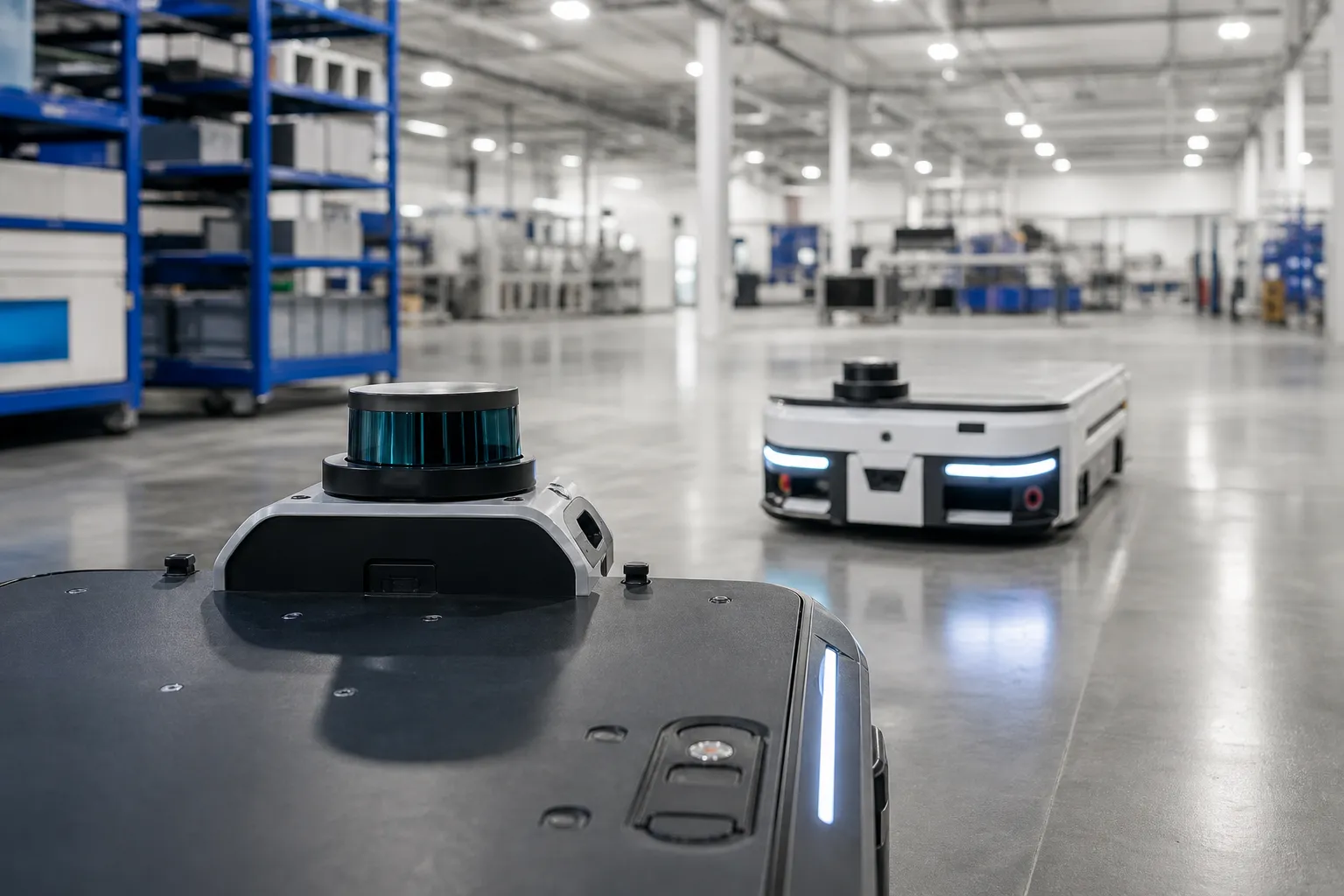
The international standard ISO 21423:2026 sets out a common framework for communication between industrial mobile robots from different manufacturers. Announced by the Association for Advancing Automation (A3), it is intended to make mixed fleets easier to manage in factories.
For manufacturers that use mobile robots from several suppliers, interoperability is an operational issue. Until now, coordinating equipment from different brands could make it harder to manage robot movements. Developed by ISO/TC 299, the technical committee dedicated to robotics, ISO 21423:2026 defines common requirements for exchanging information and requesting actions between industrial mobile robots (IMRs), fleet managers and other equipment.
How ISO 21423 standardises data exchange in mixed-brand robot fleets
Under the standard, industrial mobile robots can share several types of information needed for coordination:
- Their position within the facility.
- Their speed and direction of travel.
- Their operating status.
- The tasks assigned to them.
- Their availability for new operations.
According to A3, these exchanges should reduce situations in which robots interfere with each other’s paths or with the planning of their movements. The association expects this to improve equipment availability and make robotic systems more efficient.
The scope of ISO 21423 goes beyond robot-to-robot exchanges. It also covers communication with the machines the robots serve, enterprise resource planning (ERP) software and building equipment in industrial facilities, including lifts, automatic doors and alarms. People carrying mobile devices can also share comparable information to coordinate their work with the robots.
What the standard means for robot makers and industrial buyers
For companies investing in automation, the aim is to be able to choose the right robot for each application without having to commit the whole facility to a single supplier.
Carole Franklin, director of robotics standards development at A3, says companies want to “choose the robots suited to their applications and make them work together on the same shop floor”.
According to A3, major industrial users had been calling for an interoperability standard for several years. ISO 21423:2026 now provides a common basis for communication between fleets that can be used across different countries.
The association also believes a common protocol could encourage competition between manufacturers and support innovation. For operators, this standardisation should make it easier to expand automated facilities with equipment from different suppliers, while making better use of robots already in service.
How much does ISO 21423:2026 cost? From $320 for A3 members
A3 sells the ISO 21423:2026 document through its online store at a list price of $373. Members of the association can buy the same standard for $320.
According to A3, ISO 21423 is also the first non-safety robotics standard the association has contributed to. It marks a new stage in its involvement in international standardisation work on industrial robotics.