

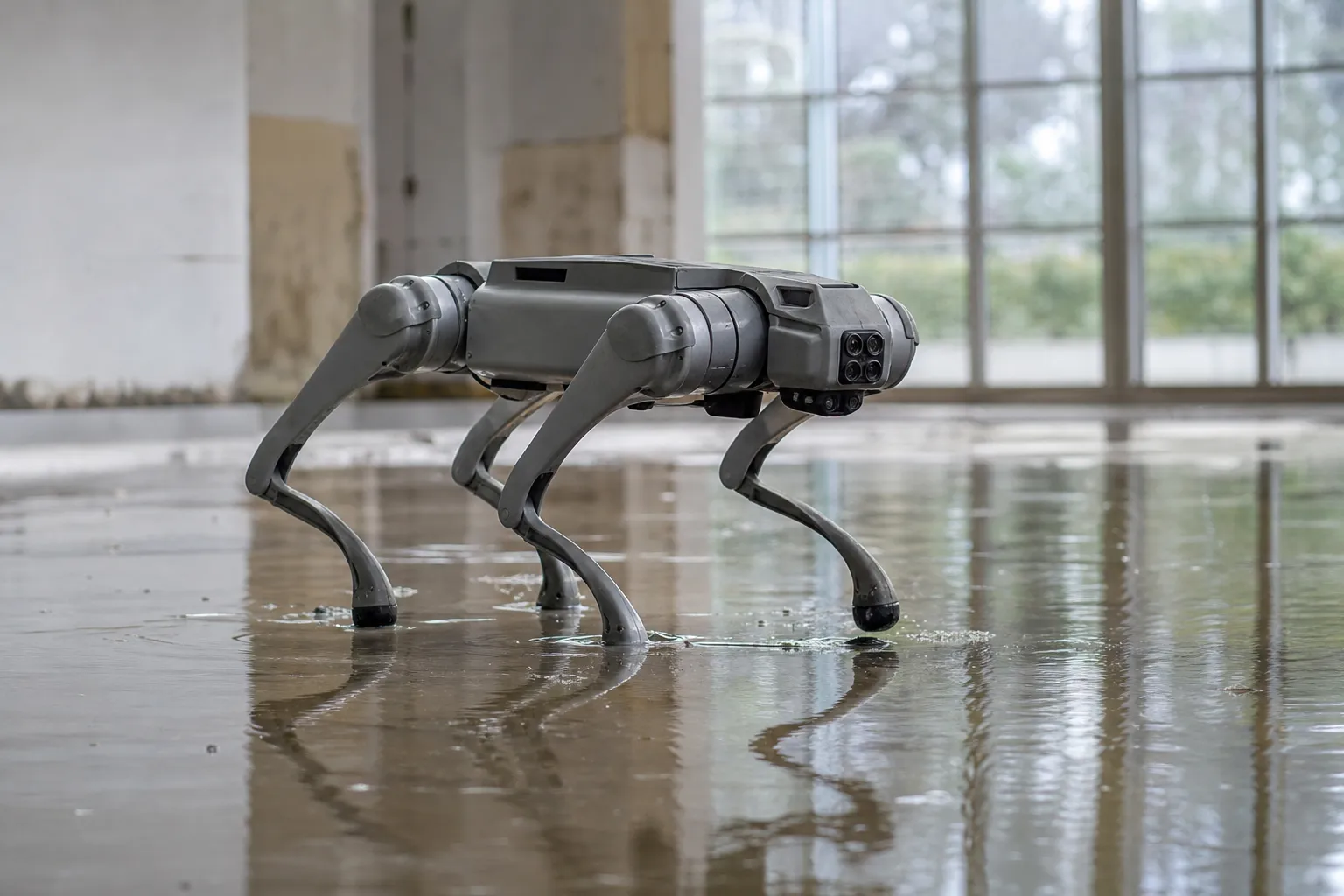
Maum AI presented its JINDO BOT Guard quadruped robot in South Korea on 28 October 2026. In a demonstration, the robot showed how its cameras and artificial intelligence can detect falls or floods and alert the managers of an industrial site.
The presentation took place on the Siheung campus of Seoul University, during an event on physical artificial intelligence organised by Gyeonggi Province. With JINDO BOT Guard, South Korean company Maum AI is promoting the use of mobile robotics to monitor industrial environments, particularly areas that pose risks to workers.
How JINDO BOT Guard uses AI to detect hazards
At the event, JINDO BOT Guard demonstrated its ability to analyse images from its cameras to recognise predefined hazardous situations. The scenarios shown included a person falling and a flood.
The system uses artificial intelligence to interpret the images, identify the type of hazard, generate an explanation and send a report to the site managers. The aim is to make it easier to identify incidents that require human intervention.
Unlike fixed CCTV cameras, the quadruped robot can move between several observation points. Maum AI therefore sees it being used for security patrols and inspections of large industrial facilities or hard-to-reach areas.
This mobility could also allow some repetitive inspections to be handed over to the robot and reduce workers’ exposure to hazardous environments.
Onboard AI and a Vision-Language-Action model
Maum AI is developing autonomous navigation and environment recognition technologies for its robots based on onboard artificial intelligence. This approach involves running AI processing directly on the robot.
The company is also working on a Vision-Language-Action (VLA) model, designed to link visual information, natural-language instructions and the robot’s physical actions.
The technology is intended to let the robotic system use information from its surroundings to carry out missions. It is part of Maum AI’s work on physical AI, which combines perception, information processing and movement.
Maum AI also uses a fleet management system, called the Robot Management System (RMS), to centralise the monitoring of missions and the operational status of its machines.
A patrol robot within Gyeonggi Province’s physical AI programme
The JINDO BOT Guard demonstration was held during the launch ceremony for a Gyeonggi Province initiative focused on physical AI. The programme places particular emphasis on modernising manufacturing, assistive applications for people and safety.
On this occasion, Maum AI joined the Gyeonggi Province Physical AI Council, a body that brings together industrial companies, universities and research organisations.
This membership is intended to encourage cooperation on technology development, real-world trials and industrial applications of robotics.
Son Byung-hee, head of defence AI and robotics at Maum AI, described solving concrete problems in the field as a priority for the company. He highlighted the use of robots to assist human teams with dangerous and repetitive tasks, with the goal of improving safety and operational efficiency at industrial facilities.