

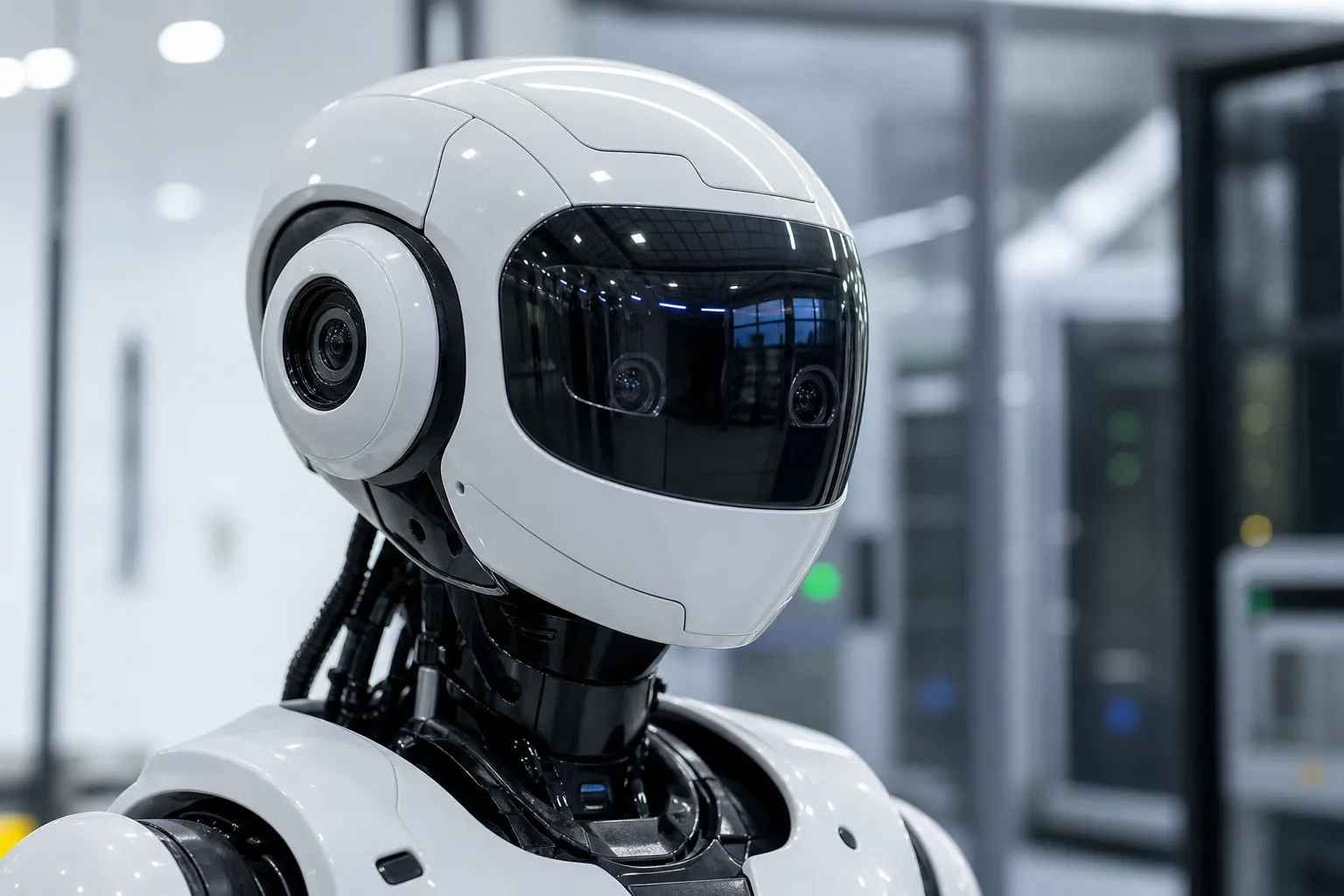
Generative Bionics plans to open a 5,000 m² training centre for its Gene.01 humanoid robots in Italy at the end of 2027. Backed by AMD’s computing infrastructure, the site will be the first in a network of three facilities.
Italian company Generative Bionics wants to build what it describes as Europe’s largest physical AI training infrastructure for humanoid robots. The project combines robots working in replicated industrial environments with digital simulations designed to speed up how the robots learn and how their capabilities are validated.
Where and when: a 5,000 m² centre in Italy by late 2027
According to Generative Bionics, the first facility will cover 5,000 m² in Italy and is expected to start operating in the fourth quarter of 2027. It will be the starting point for a network of three data factories dedicated to physical artificial intelligence.
The second site is planned elsewhere in Europe, while the third is meant to serve international markets. Generative Bionics thus plans to deploy an infrastructure that combines physical data collection, AI model training and industrial simulation.
How Gene.01 robot fleets will generate industrial training data
The facilities will replicate industrial environments in which fleets of Gene.01 humanoid robots can carry out tasks continuously. Generative Bionics says the goal is to generate data from physical interactions to train World Action Models, AI models designed to link a robot’s perception of the world to its actions.
Each environment and each robot configuration will also be replicated as a digital twin. Tasks can then be simulated in thousands of variants, covering equipment layout, the objects being handled, materials, operating conditions and failure scenarios, among other factors.
Models trained and tested virtually will then be transferred to the physical robots for validation. Generative Bionics describes the process as a continuous cycle running from the real world to simulation, then from simulation back to the real world.
Daniele Pucci, CEO of Generative Bionics, sums up the goal: “We are replicating the world, physically and digitally, to train humanoid robots at scale before they enter it.”
AMD Helios: the computing infrastructure behind the project
The partnership will use the AMD Helios architecture, a rack-scale computing infrastructure. According to the two companies, it will be used to process physical and synthetic data, train AI models and run many digital twin simulations in parallel.
The collaboration extends an existing technology relationship between the two companies. AMD computing technologies are also built into the Gene.01 robot.
Keith Strier, senior vice president for global AI markets at AMD, presents the infrastructure as a way to strengthen Europe’s capacity to develop and deploy intelligent robotics applications.
AMD Ventures and Generative Bionics’ €70 million seed round
The partnership follows AMD Ventures’ participation in Generative Bionics’ €70 million seed funding round. That figure is the total amount raised by the company, not AMD Ventures’ stake alone.
For Generative Bionics, the network should make it possible to develop and operate in Europe the data, AI models and infrastructure its industrial humanoids require.
The project therefore links three activities: data generation by Gene.01 robots, computational model training and validation in physical environments. The first announced launch remains the Italian centre, scheduled for the fourth quarter of 2027.