

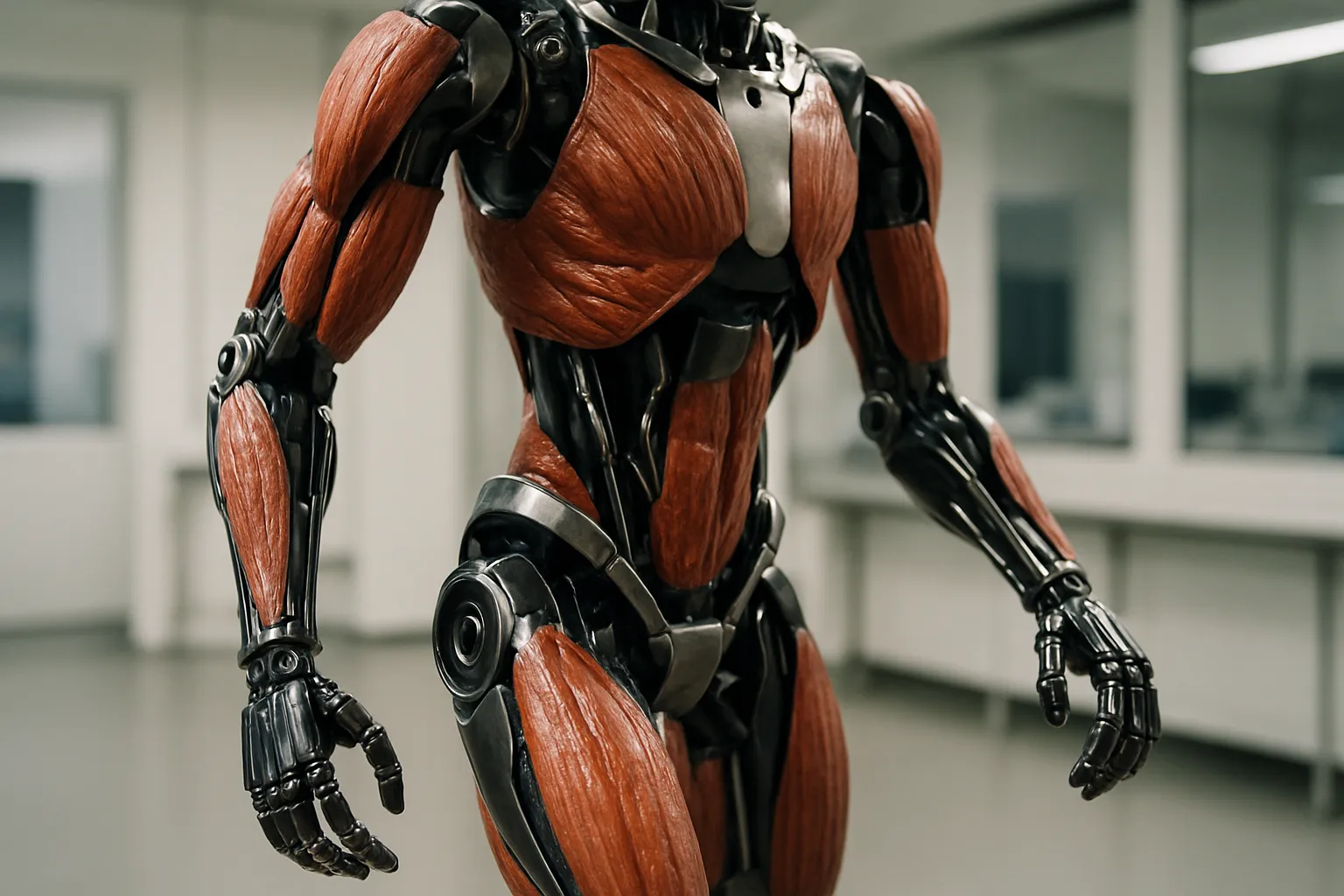
Researchers at ETH Zurich have developed robotic actuators that combine lab-grown living muscle with 3D-printed structures. These biohybrid components can jump, swim, move across a surface and grasp objects.
At the Soft Robotics Lab led by Professor Robert Katzschmann, an ETH Zurich team is working on an approach to biohybrid robotics that uses living muscle tissue as the source of movement. The work, published in Nature Communications, relies on designing the muscles and their artificial support together, so that the deformation produced by their contractions is amplified.
How ETH Zurich combines mouse muscle cells with 3D-printed supports
The researchers use skeletal muscle tissue grown from mouse cells. The muscles are integrated into a hydrogel structure, a soft, water-rich material that can bend and stretch in a similar way to biological tissue.
What sets the method apart is the joint design of the muscle and its support. Instead of making the two parts separately, the scientists work out their configuration using a computer simulation.
AGIBOT WORLD 2026: fourth dataset release trains robots to reason before they act
Aiste Balciunaite and Mike Y. Michelis, the study’s lead co-authors, developed this approach. An algorithm searches for the configurations in which muscle contraction produces the largest displacement of the whole component.
The selected structures are then fabricated in the laboratory by xolography, a light-based 3D printing technique. According to the ETH Zurich researchers, printing one support takes about a minute. The experimental results are then used to refine the material properties and fabrication parameters in the simulations.
Movements up to eleven times larger than in previous systems
The resulting bioactuators are about 1.5 centimetres long, according to the ETH Zurich team. Their deformation is large enough to be seen with the naked eye, unlike some earlier devices whose movements could only be observed under a microscope.
The researchers report a range of motion up to eleven times greater than that of previous systems using a comparable amount of muscle tissue. The comparison concerns the range of motion, not muscle force or speed.
Former OpenAI science chief Kevin Weil’s Warp Sciences raises $215 million to automate labs
The laboratory demonstrations cover several types of movement: jumping, swimming, moving across a surface and grasping objects.
In one jumping test, a single contraction lifted an actuator about 5 millimetres above the bottom of a lab dish, or one third of its body length, according to ETH Zurich.
A version designed for walking also reached a speed of 6.2 millimetres per second, measured during the tests reported by the researchers.
What the research means for biohybrid robotics
The work points to a technological path that differs from conventional mechanical actuators: generating robotic movement from the contractions of living biological tissue, while optimising the artificial structure that goes with it.
For the robotics industry, the main interest of this research lies in the digital design method. The ETH Zurich team shows that the performance of a biohybrid actuator depends as much on how the soft support is organised as on the amount of muscle tissue used.
The devices presented are still small experimental components, not complete humanoid robots. The demonstrations concern their ability to move in the laboratory.
Robert Katzschmann’s team now has a method that combines computer simulation, muscle cell culture and additive manufacturing to design and test different biohybrid actuator architectures.