

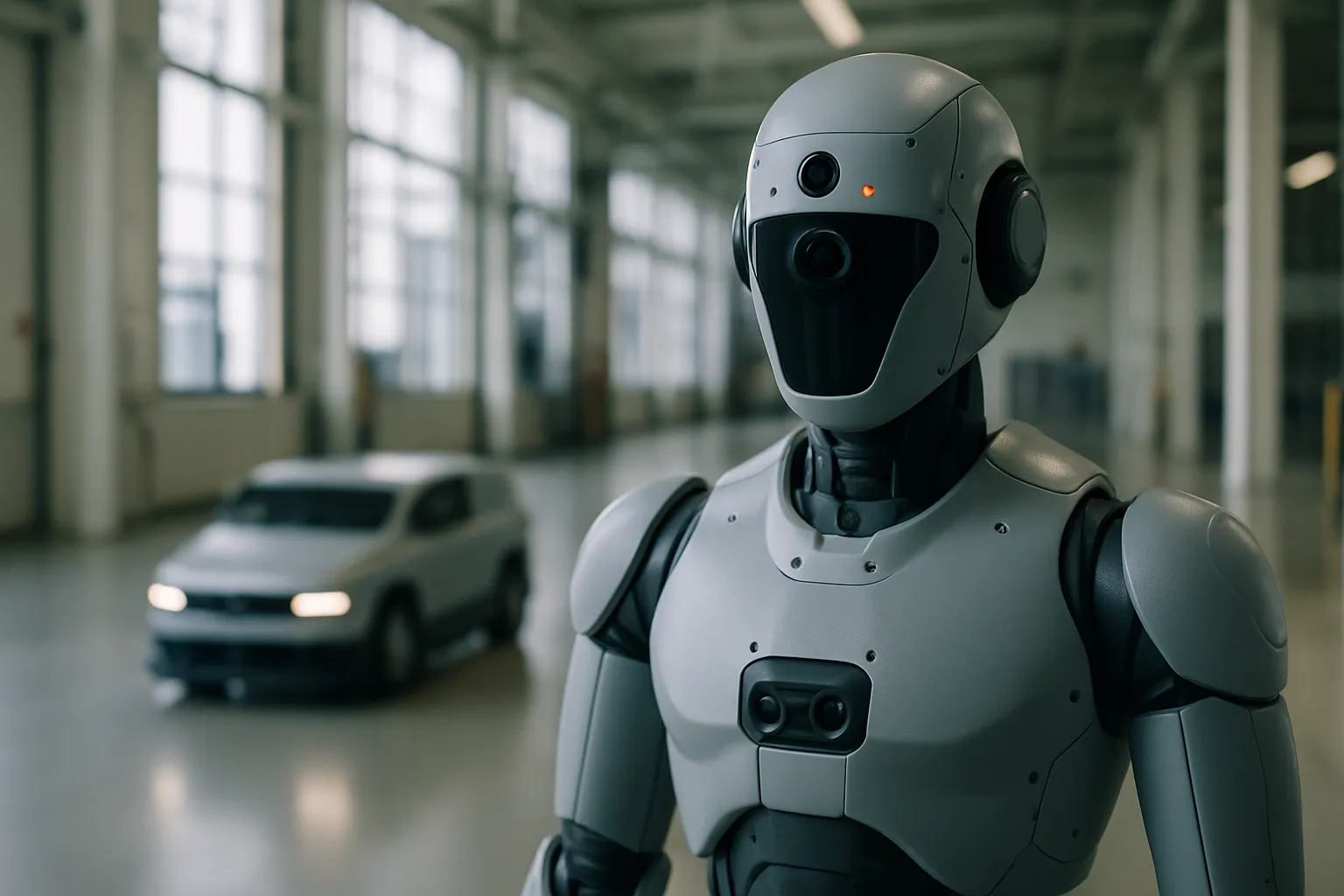
Laplace Intelligence is developing a simulation platform that uses AI agents to provoke dangerous situations and test robots before they are deployed. A spin-out from the University of Michigan, the startup already has industrial customers and is looking to raise funds.
Based in Ann Arbor, in the United States, Laplace Intelligence is targeting an emerging market: verifying the safety of artificial intelligence systems that act in the physical world. Its approach is to automate adversarial testing, or “red teaming”, to identify potential failures in robots, autonomous vehicles and intelligent traffic management systems.
Who founded Laplace Intelligence: a University of Michigan spin-out
Laplace Intelligence was founded in 2025 by Howie Sun, chief executive officer, and Henry Liu, chief scientific officer. The two entrepreneurs built their technology on work carried out at the University of Michigan.
Howie Sun says he spent eight years of university research on methods for putting autonomous driving systems under pressure in simulated environments. In 2023, he and Henry Liu published a study on this problem in the scientific journal Nature.
NEURA Robotics prices 4NE1 Mini humanoid robot from €19,999, with a refundable €100 reservation
This work drew interest from autonomous vehicle manufacturers and developers. The two researchers then set up Laplace Intelligence to turn their experimental methods into a commercial product.
The company took part in Startup Battlefield 200, a competition held as part of TechCrunch Disrupt in San Francisco from 13 to 15 October 2026. It was one of the 20 startups selected to present their business during the competition.
How Laplace’s AI agents generate virtual accidents
Laplace’s technology relies on a simulation environment built from real geographic and visual data. It uses an adapted version of Cosmos, the physical world simulation platform developed by Nvidia.

Used Booster T1 humanoid robot on sale in France for €31,200 incl. VAT at Génération Robots
The system can, for example, recreate a motorway in Arizona or a pedestrian crossing in Paris. The environments combine geographic maps, reference images and traffic data. According to Howie Sun, Laplace also uses traffic information supplied by navigation services such as TomTom.
Developers can change traffic conditions using natural language instructions. Vehicles and other virtual actors then react to the changes in their environment.
During a demonstration, Howie Sun told a simulated vehicle to swerve into the opposite lane. The oncoming vehicle responded with an avoidance manoeuvre. The demonstration shows how the simulator works interactively, but it is not a measure of safety in real traffic.
Laplace’s commercial edge lies in its AI agents, which automatically design critical scenarios. These agents can draw on news stories, police collision reports and other information to build unusual situations intended to expose weaknesses.
The aim is to reduce the manual work needed to create test scenarios, which have traditionally been based on driving recordings or situations imagined by engineers.
Laplace Intelligence customers: Bot Auto and a Japanese carmaker
Laplace Intelligence is already generating revenue and has reached modest profitability, according to statements by its executives reported on 19 October 2026.
Most of its revenue currently comes from autonomous driving applications. Its customers include Bot Auto, a Texas company specialising in autonomous trucks, and a major Japanese carmaker.
Laplace’s commercial contracts are mainly project-based. The company wants to gradually build recurring revenue rather than rely solely on one-off assignments.
This shift in business model goes hand in hand with its ambition to expand its customer base beyond the automotive sector.
Smart city traffic pilot in San José with Nvidia and T-Mobile
Laplace is also working with Nvidia and T-Mobile on a free traffic management pilot project in San José, California.
The trial covers city-wide traffic operations. It illustrates another potential application of the simulation technology, beyond autonomous vehicle testing.
At the same time, Laplace has begun preliminary collaborations with partners developing humanoid robots for warehouses.
Howie Sun points out that general-purpose robots have less experience data than autonomous vehicles. This makes it harder to identify in advance the rare events these machines might face in professional environments.
Laplace Intelligence funding plans and competition from Applied Intuition
Laplace Intelligence is now seeking to raise capital to grow its business and strengthen its position against companies already established in simulation and validation software for autonomous systems.
Its competitor Applied Intuition has far greater financial resources. According to figures reported by TechCrunch on 19 October 2026, that company has raised a total of $1.2 billion in funding and reached a post-money valuation of $15 billion. These figures relate to Applied Intuition, not Laplace Intelligence.
Howie Sun sees the ability of his AI agents to search for failures automatically as Laplace’s main differentiator. The company aims to offer robot and autonomous vehicle manufacturers an interactive validation method based on continuously confronting their systems with new scenarios.
In the short term, Laplace intends to use the visibility it gained at TechCrunch Disrupt to support its search for funding, expand its commercial activities and gradually turn its project-based contracts into recurring revenue.