
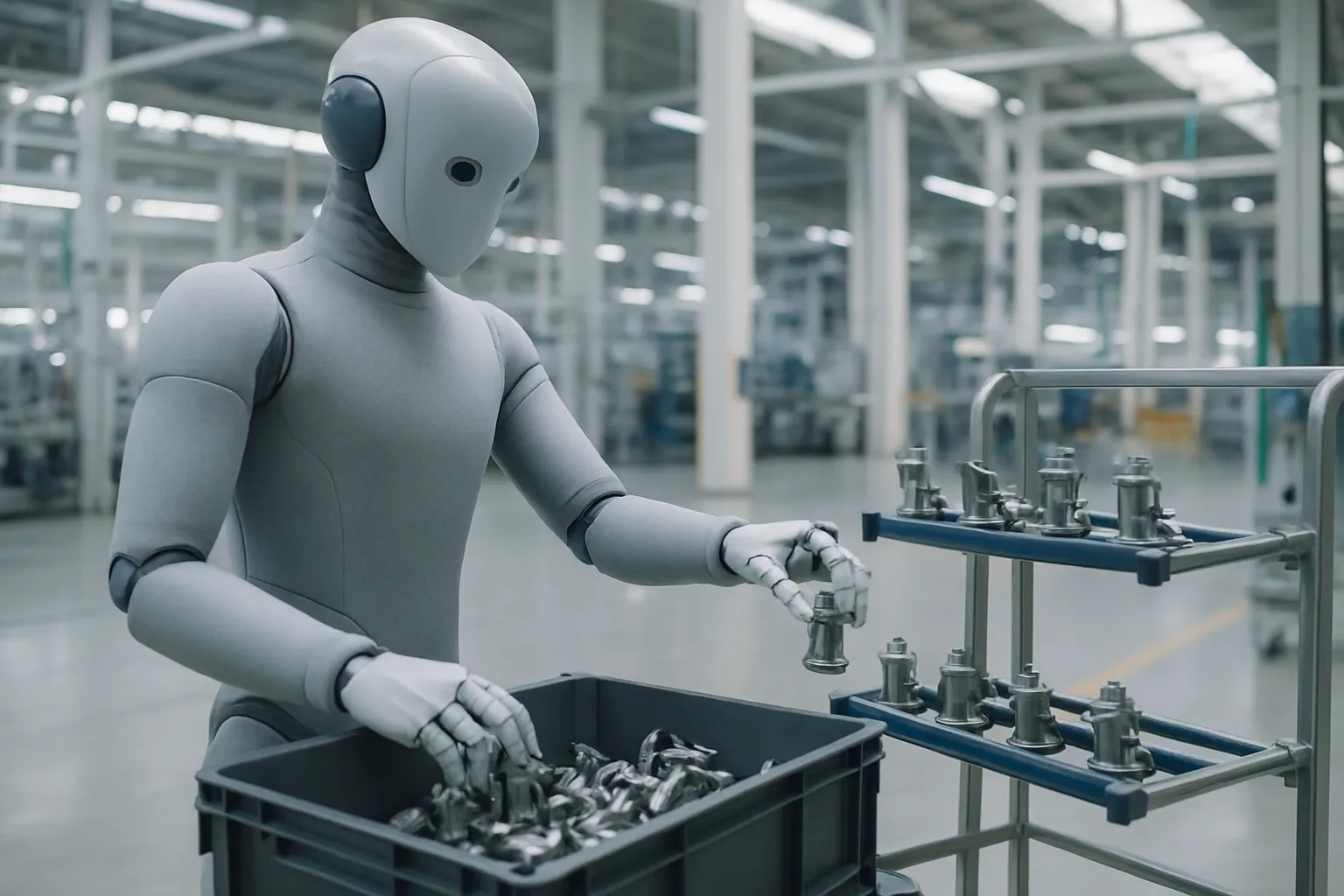
The Figure 03 is Figure AI’s electric humanoid robot, unveiled on 9 October 2025. It stands 1.73 m tall, weighs 61 kg, and has a stated payload of 20 kg and a battery life of five hours. The manufacturer presents it as a home assistant able to handle household chores, while BMW is integrating it into logistics operations at its US plant in Spartanburg.
The Figure 03 succeeds the Figure 02, the first generation the company deployed at BMW. It combines a design suited to mass production, hands fitted with tactile sensors and an artificial intelligence system that controls its movements and its interactions with the environment. Its development is part of the strategy of Figure AI, which works on both the robot hardware and its Helix artificial intelligence system.
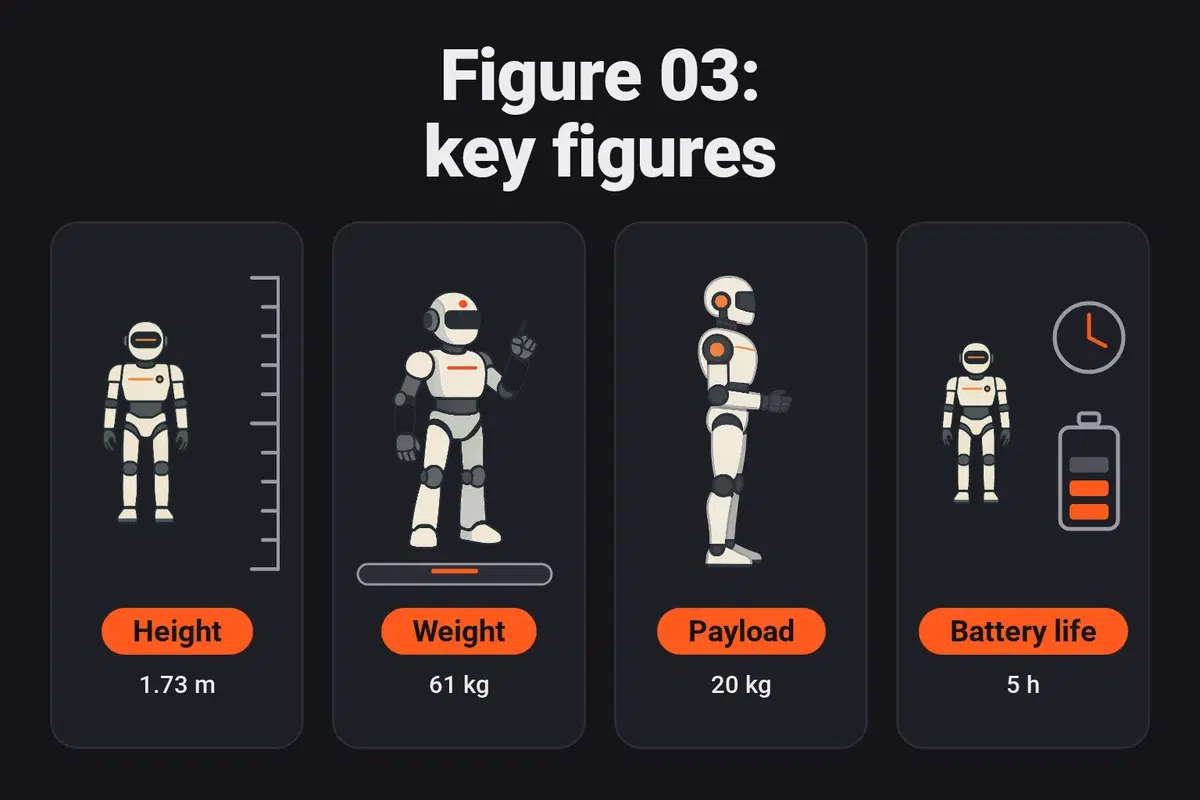
Figure 03 specifications: height, weight, payload and speed
The spec sheet published by Figure lists five main characteristics: height, weight, payload, battery life and speed. These values are the specifications announced by the manufacturer, as consulted on 20 October 2026.
| Specification | Figure 03 |
|---|---|
| Manufacturer | Figure AI |
| Model | Figure 03 (F.03) |
| Type | Electric humanoid robot |
| Height | 1.73 m (5 ft 8 in) |
| Weight | 61 kg |
| Payload | 20 kg |
| Stated battery life | 5 hours |
| Stated speed | 1.2 m/s |
| Control system | Helix, a Vision-Language-Action artificial intelligence model |
| Official unveiling | 9 October 2025 |
At 61 kg for 1.73 m, the Figure 03 keeps human proportions. Its 20 kg payload is one of the key figures on its spec sheet, particularly for object handling. Its stated speed of 1.2 m/s works out to 4.32 km/h.
The five-hour battery life is also part of the official specifications. BMW cites the same order of magnitude in its presentation of the robot’s industrial deployment.
Figure 03 as a home robot: household chores
Figure presents the Figure 03 as a general-purpose humanoid robot for everyday life. Its official communication puts particular emphasis on help at home, with three types of task: laundry, cleaning and dishes.
The manufacturer says it designed the robot to move around real homes, including stairs, narrow passages and spaces whose layout changes. This approach requires the ability to adapt movements to objects and surroundings rather than simply repeating fixed trajectories.
Figure also highlights voice interaction. Users can talk to the robot, ask it questions and give it tasks. These functions link understanding instructions with carrying them out physically.
Figure’s communication therefore stresses the Figure 03’s versatility: a single robot is presented for a range of everyday activities, rather than being limited to one specific household chore.
Helix: the AI that controls the Figure 03
The Figure 03 runs on Helix, the artificial intelligence system developed by Figure. The manufacturer describes it as a generalist Vision-Language-Action (VLA) model that combines visual perception, language understanding and the generation of physical actions.
Figure says Helix controls the entire perception, movement and reasoning loop directly on board the robot, in real time. The system is presented as able to operate the Figure 03 without following a predefined script.
The software has gone through several stages announced by Figure: Helix 02, unveiled on 27 January 2026 with full-body autonomy, followed by Helix 2.5, announced on 17 September 2026 and focused on generalising behaviours across different homes.
Helix home tests: trials reported in 30 houses
Figure has presented an evaluation of Helix 2.5 in 30 homes in the San Francisco Bay Area, California. Three tasks were selected: tidying a living room containing 13 to 15 toys, folding towels and making a bed.
The manufacturer says it used the same model checkpoint for all 30 homes, with no specific adaptation for each house. It describes the evaluation as a “zero-shot” generalisation test, with a success criterion that gives no partial credit.
In the results announced by Figure, a policy trained from scratch reached a 9% success rate, compared with 56% for a policy pre-trained on Index, the company’s large-scale dataset of human behaviour. Figure also says Helix 2.5 matches the success rate of Helix 02 with half as much adaptation data.
These figures are the experimental results published by Figure for the tasks and conditions of this evaluation. They do not represent an overall success rate for the Figure 03 across all household activities.
How the system works and how it has evolved is covered in detail on the page dedicated to Helix, Figure’s artificial intelligence.
Figure 03 at BMW: parts logistics in Spartanburg
The Figure 03 deployment at BMW shows a different use for the robot, separate from the home-focused image promoted by its manufacturer. The carmaker uses it at its plant in Spartanburg, South Carolina, notably in the expanded Hall 52.
BMW describes a specific logistics task: the Figure 03 sorts loose components and places them on a sequencing cart. The job involves organising parts for the next stages of the production process.
This work differs from what the Figure 02 previously did at the same plant. The first pilot involved positioning body parts for welding, while the Figure 03 handles the preparation and organisation of components.
Figure 03 hands: tactile sensors and palm cameras
In its presentation of the Figure 03, BMW mentions several hardware changes. The hands have been redesigned and include tactile sensors as well as cameras built into the palms.
The tactile sensors provide information about contact with objects, while the cameras add visual perception at hand level. This equipment supports the grasping and handling operations needed to sort components.
BMW also mentions audio functions, in addition to the interaction capabilities Figure highlights for its robot.
Soft textile covering and wireless charging
The Figure 03’s exterior includes sections covered in soft textile. According to BMW, this material is found on parts of the head, torso, arms and legs.
The carmaker presents this choice as a measure intended to improve safety in the event of a collision. It is a stated design goal linked to integrating the robot into an industrial environment.
BMW also says the Figure 03 supports wireless charging, a feature that complements its stated battery life of around five hours.
Details of the operations and hardware changes are covered in the Figure 03 deployment at BMW in Spartanburg.
Figure 03 vs Figure 02: what changed in the new generation
The Figure 03 takes over from the Figure 02, whose deployment at BMW was an important milestone for Figure AI. According to BMW, the 2025 pilot with the Figure 02 lasted ten months and contributed to the production of more than 30,000 BMW X3s.
Figure also credits the Figure 02 with several firsts in its development: its first deployment at BMW, the debut of Helix, the first household chores performed by one of its robots and a first deployment in logistics.
The documented changes between the two generations include the Figure 03’s hands, its soft covering, its wireless charging and its suitability for industrial mass production. The transition also comes with a change in the tasks assigned to the robots at the BMW plant.
Figure 02 fleet retired for good
Figure announced the retirement of its Figure 02 fleet on 30 September 2026. The old robots were destroyed in a molten steel furnace in Finland, in an operation filmed with Arnold Schwarzenegger.
The manufacturer explains the decision by the ramp-up of the Figure 03, which in its view made keeping the previous generation unnecessary.
The operation marks a complete hardware transition: Figure is not simply adding the F.03 to its experimental line-up, but ending operation of the F.02 fleet covered by its announcement.
The circumstances of the operation are described in the retirement and destruction of the Figure 02 robots in Finland.
Figure 03 climbing a ladder: what the video shows
A video posted on X by Brett Adcock, Figure’s CEO, shows a Figure 03 climbing three steps of a steep staircase fitted with a fixed handrail.
In the clip, the robot moves slowly. It appears to scan its surroundings several times before continuing upwards, adjusting its movements to the structure.
According to Brett Adcock, the robot performs this demonstration autonomously, without remote control. This statement concerns the conditions of the clip the CEO presented.
In its analysis, the German outlet heise online considers it likely that Helix, the Vision-Language-Action model running on board the robot, was used, with stereo cameras providing perception of the robot’s own posture. This technical explanation is the outlet’s hypothesis, not a confirmed description of the system used in the video.
The demonstration covers climbing three steps. It illustrates a specific motor behaviour and is not a repeated performance measurement across different conditions.
The clip and its context are covered in detail in the Figure 03 demonstration on a three-rung ladder.
Figure 03 production: BotQ output and capacity figures
The Figure 03 was redesigned to make larger-scale manufacturing easier. Figure uses industrial processes such as die casting, injection moulding and stamping.
This approach goes hand in hand with the development of BotQ, the company’s production site. In April 2026, Figure said it had delivered more than 350 Figure 03 robots from this facility.
The manufacturer also presented several indicators on how its production has developed:
- A move from one Figure 03 per day to a demonstrated cycle time of one robot per hour, a 24-fold improvement in less than 120 days.
- A first-pass yield of 99.3% on the battery line, with more than 500 packs shipped.
- An end-of-line yield above 80% for complete robots.
- A stated capacity of up to 12,000 humanoid robots per year for the first generation of the BotQ line.
The rate of one robot per hour is the cycle time demonstrated by Figure. The capacity of 12,000 units a year is the stated potential of the production line, not the number of robots actually produced or sold.
Figure says the new design significantly reduces the manufacturing cost of each Figure 03 compared with the Figure 02. These industrial savings come from the choice of materials, manufacturing processes and how assembly is organised.
What we do not know yet
Several important pieces of information are missing from the public documentation available as of 20 October 2026. Figure has not disclosed a selling price for the Figure 03 or an availability timeline for consumers. No sale in France or elsewhere in Europe has been confirmed. Access to any waiting list, ordering arrangements and after-sales service have not been specified.
The official spec sheet also gives no details on battery capacity, the electrical characteristics of charging, or full specifications for the hands and sensors. The safety functions linked to the soft textile are not backed by quantified test results. Nor is there any information on access to an SDK or software openness.
On performance, no independent measurement campaign is documented in the available information. Success rates for the video demonstrations, including the ladder clip, remain unknown. Figure also does not publish an overall success rate for the robot across all the household tasks it showcases.
Finally, the public data on Helix does not cover every version, the full training volumes or quantified results for each demonstration. The production figures announced for BotQ shed light on industrialisation but do not establish the total number of Figure 03 units sold or actually deployed.
For questions about sales and access to the robot, see also Can you buy a Figure robot? Price and availability.
See also: Helix, Figure’s artificial intelligence; Can you buy a Figure robot?; BMW replaces Figure 02 robots with Figure 03s in Spartanburg; Figure 03 climbs a three-rung ladder; Figure destroys its Figure 02 fleet in Finland.
The newsletter
Get the latest on humanoid robots
A selection of announcements, prices and demonstrations, with no advertising. Unsubscribe in one click.