
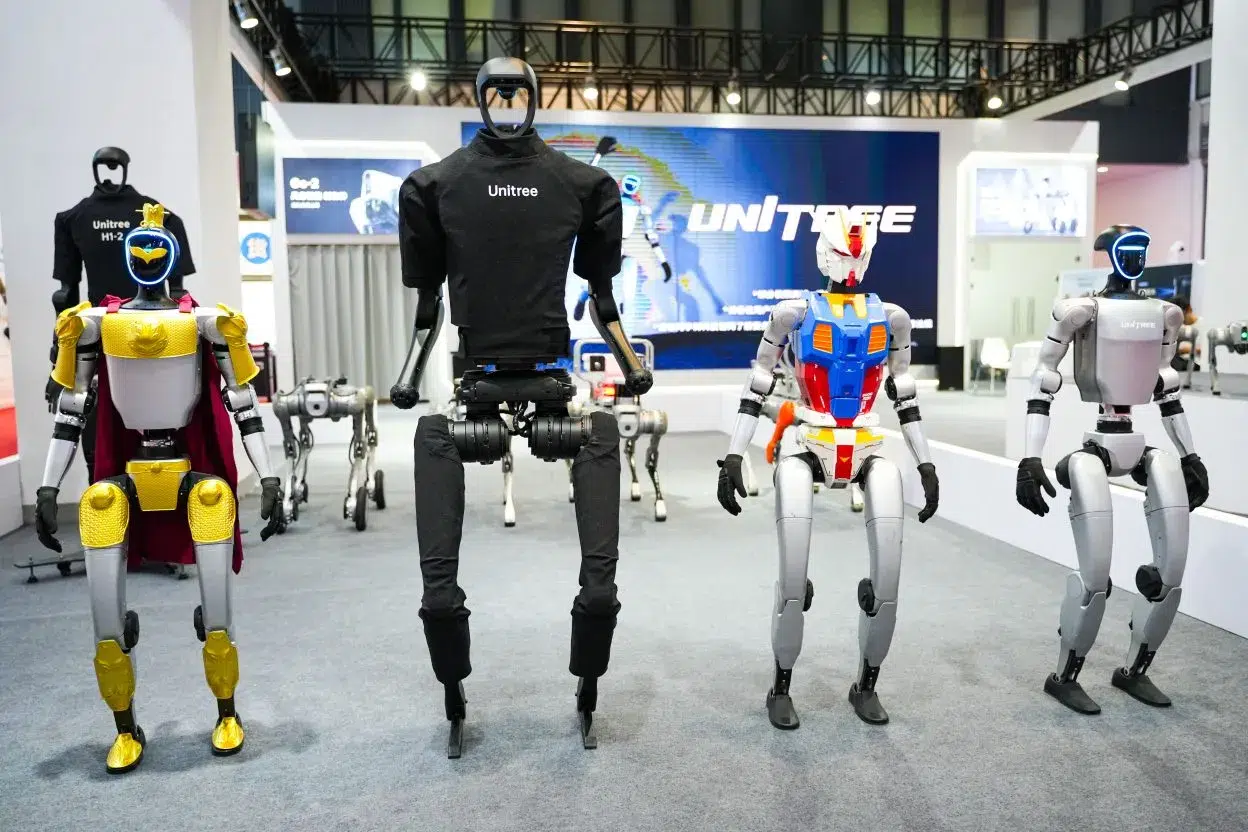
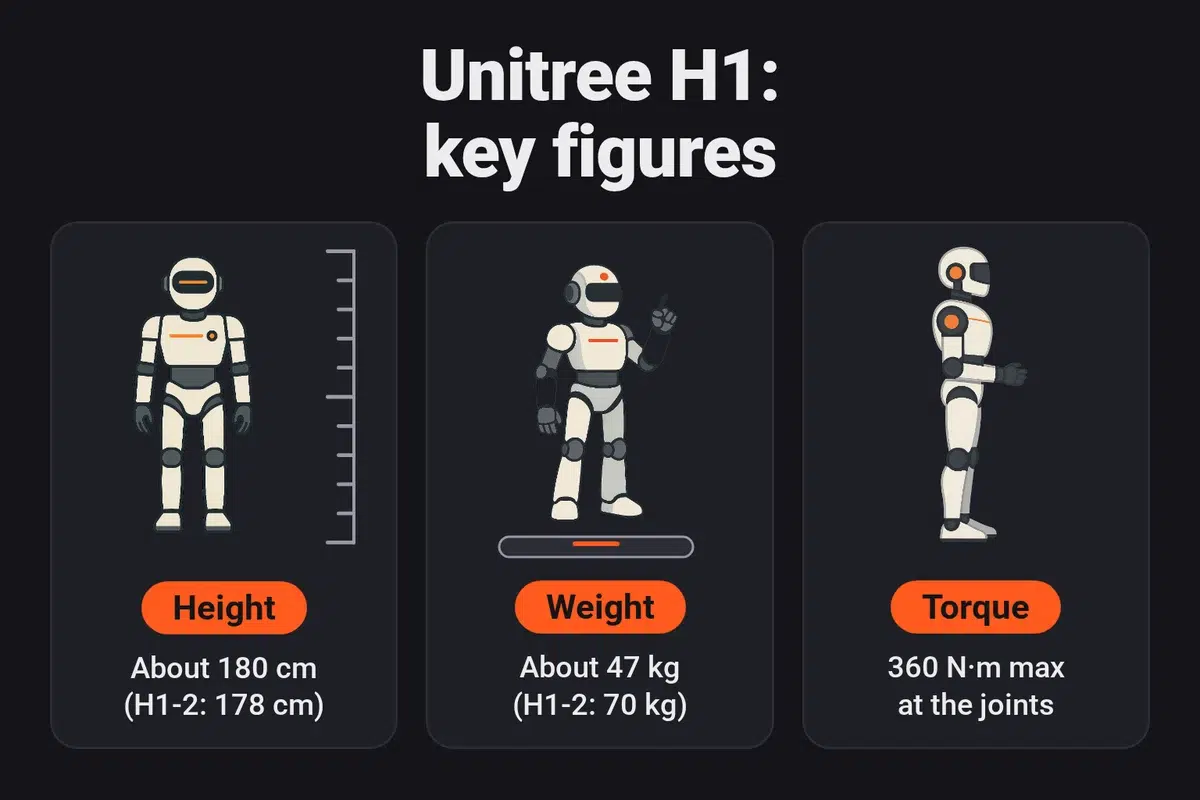
The Unitree H1 is a humanoid robot standing 1.80 metres tall and weighing about 47 kg. It also comes as the H1-2, which measures 1.78 metres and weighs 70 kg. Both models share a perception setup combining 3D LiDAR and a depth camera, a 0.864 kWh battery and several onboard computing options. They differ mainly in their number of joints, available torque and the stated capabilities of their arms.
Within the line-up of Chinese manufacturer Unitree, the H1 stands out for its claimed speed of 3.3 m/s, with potential above 5 m/s according to the company. The H1-2, for its part, uses a 27-degree-of-freedom architecture and arms with a stated rated payload of 7 kg. The official specifications allow a precise comparison of the two configurations.
Unitree H1 and H1-2 specifications
Unitree’s spec sheet, consulted on 20 October 2026, lists two distinct configurations. The H1 is lighter, while the H1-2 has more degrees of freedom and a different arm design. The figures below are those published by Unitree.
| Specification | Unitree H1 | Unitree H1-2 |
|---|---|---|
| Height | About 180 cm | About 178 cm |
| Weight | About 47 kg | About 70 kg |
| Degrees of freedom | 5 per leg, 4 per arm (expandable) | 27 in total, including 6 per leg and 7 per arm |
| Maximum joint torque | 360 N·m | 360 N·m in the legs, 120 N·m in the arms |
| Peak torque density | 189 N·m/kg | 189 N·m/kg |
| Arm payload | Not disclosed | About 7 kg rated, 21 kg peak |
| Claimed speed | 3.3 m/s, potential above 5 m/s | Value below 2 m/s in the H1-2 column |
| Battery | 15 Ah, 0.864 kWh | 15 Ah, 0.864 kWh |
| Maximum battery voltage | 67.2 V | 67.2 V |
| Quick-swap battery | Yes | Yes |
| Perception | 3D LiDAR and depth camera, 360° | 3D LiDAR and depth camera, 360° |
| Standard computing | Intel Core i5 and Intel Core i7 | Intel Core i5 and Intel Core i7 |
| Computing options | Other brands or Orin NX | Up to 3 Core i7 or Orin NX modules |
| Dexterous hand | Optional | Optional, Dex5-1 or others |
Unitree H1 vs H1-2: size and degrees of freedom
At about 180 cm tall and 47 kg, the Unitree H1 is 23 kg lighter than the H1-2. According to the official specifications, the H1-2 measures about 178 cm and weighs 70 kg.
The H1 has five degrees of freedom per leg: three at the hip, one at the knee and one at the ankle. Each arm has four degrees of freedom in the configuration listed by Unitree, with the option of expanding them.
The H1-2 has 27 degrees of freedom in total: six per leg and seven per arm. This difference directly affects how the limbs can move, particularly the arms, which each gain three degrees of freedom over the H1’s base configuration.
Unitree H1 joint torque: up to 360 N·m in the legs
Unitree quotes a maximum joint torque of 360 N·m for the H1. This figure applies to the knee in particular, while the other joints have different torque values.
Unitree H1 torque figures
- Knee: about 360 N·m.
- Hip: about 220 N·m.
- Ankle: about 59 N·m.
- Arm: about 75 N·m.
The H1-2 keeps a maximum torque of 360 N·m in the legs, but Unitree quotes up to 120 N·m for the arms. The official breakdown also covers the waist, shoulder, elbow and wrist joints.
Unitree H1-2 torque figures
- Knee: about 360 N·m.
- Hip: about 220 N·m.
- Waist: about 220 N·m.
- Ankle: about 75 N·m × 2.
- Shoulder: about 120 N·m.
- Elbow: about 120 N·m.
- Wrist: about 30 N·m.
Both models have the same peak torque density of 189 N·m/kg. This figure describes the ratio between the maximum torque and the mass of the joint system in question.
In the arms, the H1-2 therefore reaches a claimed maximum torque of 120 N·m, against about 75 N·m for the H1. Knee and hip torque remain identical in the figures published by the manufacturer.
Unitree H1 top speed: 3.3 m/s claimed
Unitree presents the H1 with a speed of 3.3 m/s, or about 11.9 km/h. The company calls this a world record and states a potential above 5 m/s, which equates to more than 18 km/h.
The two figures do not carry the same weight: 3.3 m/s is the speed Unitree highlights, while the threshold above 5 m/s is a stated potential.
For the H1-2, the corresponding column of the official spec sheet shows a value below 2 m/s, or under 7.2 km/h. This figure appears without a specific label on the manufacturer’s page.
Unitree H1-2 arm payload: 7 kg rated, 21 kg peak
The H1-2 has two arms with seven degrees of freedom each. Unitree gives them a rated payload of about 7 kg and a peak value of about 21 kg.
Rated payload and peak payload refer to two different levels of capacity. The first is the nominal value stated for the arm, while the second is a maximum peak value.
This design comes with torque of about 120 N·m at the shoulders and elbows, against about 30 N·m at the wrists. It is one of the main technical differences between the H1-2 and the H1.
Unitree H1 sensors, onboard computing and optional hands
3D LiDAR and depth camera
Both versions pair a 3D LiDAR with a depth camera. Unitree presents this setup as a 360° perception system shared by the H1 and the H1-2.
Two Intel processors as standard
Unitree separates onboard computing into two roles. An Intel Core i5 processor handles platform functions, while an Intel Core i7 is reserved for user development.
The manufacturer also offers configurations with processors from other brands or with Orin NX modules.
For the H1-2, computing options extend to up to three Core i7 or Orin NX modules. The official spec sheet lists this among the robot’s configurable features.
Dexterous hands available as an option
Dexterous hands are not presented as a standard feature on either configuration. Unitree offers them as an option.
For the H1-2, the manufacturer cites the Dex5-1 hand among other possibilities. The H1 also has a dexterous hand option.
Unitree H1 battery: 0.864 kWh with quick swap
The Unitree H1 and H1-2 share the same battery specifications in the manufacturer’s spec sheet: a capacity of 15 Ah, 0.864 kWh of energy and a maximum voltage of 67.2 V.
Unitree also lists a quick-swap battery system on both models. This means the power module can be replaced, rather than being presented as a fixed battery built into the robot.
The electrical specifications are therefore the same on both versions despite their difference in weight, from 47 kg for the H1 to 70 kg for the H1-2.
How much does the Unitree H1 cost? The $90,000 reference
The official H1 spec sheet consulted on 20 October 2026 does not list any price.
The outlet eWeek reports that Unitree’s online store lists the H1 at $90,000, while inviting visitors to contact the company to find out the “real price”. eWeek therefore treats this amount as an indicative reference rather than a firm price.
The figure reported by eWeek is a commercial indication, separate from the technical specifications published on the official H1 page. It is not a confirmed contractual price for a specific configuration.
What we do not know yet
Several pieces of information remain undisclosed or unconfirmed for the Unitree H1 and its H1-2 variant.
- Current price: no firm price is published on the official spec sheet consulted on 20 October 2026. The amount reported by eWeek does not specify which options are included, any additional fees or the applicable commercial terms.
- Availability in France: neither availability in France nor sales terms for that market have been confirmed.
- Warranty: duration, coverage and terms not disclosed.
- SDK: features, contents, access and terms of use not disclosed. Unitree only mentions the Core i7 reserved for user development.
- Battery life: no operating time in hours is given, despite the battery’s electrical specifications.
- Independent performance data: no independent measurement of speed, payload or endurance is available among the established information.
- H1 degrees of freedom: Unitree does not give the total, unlike the 27 degrees of freedom stated for the H1-2.
- H1 arm payload: rated value and peak capacity not disclosed.
- H1-2 speed: the value below 2 m/s appears without an explicit label in the corresponding column of the official spec sheet.
Unitree states that technical specifications may change and that the product delivered may differ from the one shown on its website. The manufacturer says the purchase order and the information provided by its sales teams are what define the configuration actually supplied.
See also: Unitree: manufacturer and robot line-up; Unitree G1: humanoid robot profile; Unitree R1: humanoid robot profile; Unitree Go2: quadruped robot profile; Humanoid robot prices: from $4,900 to $100,000.
The newsletter
Get the latest on humanoid robots
A selection of announcements, prices and demonstrations, with no advertising. Unsubscribe in one click.