
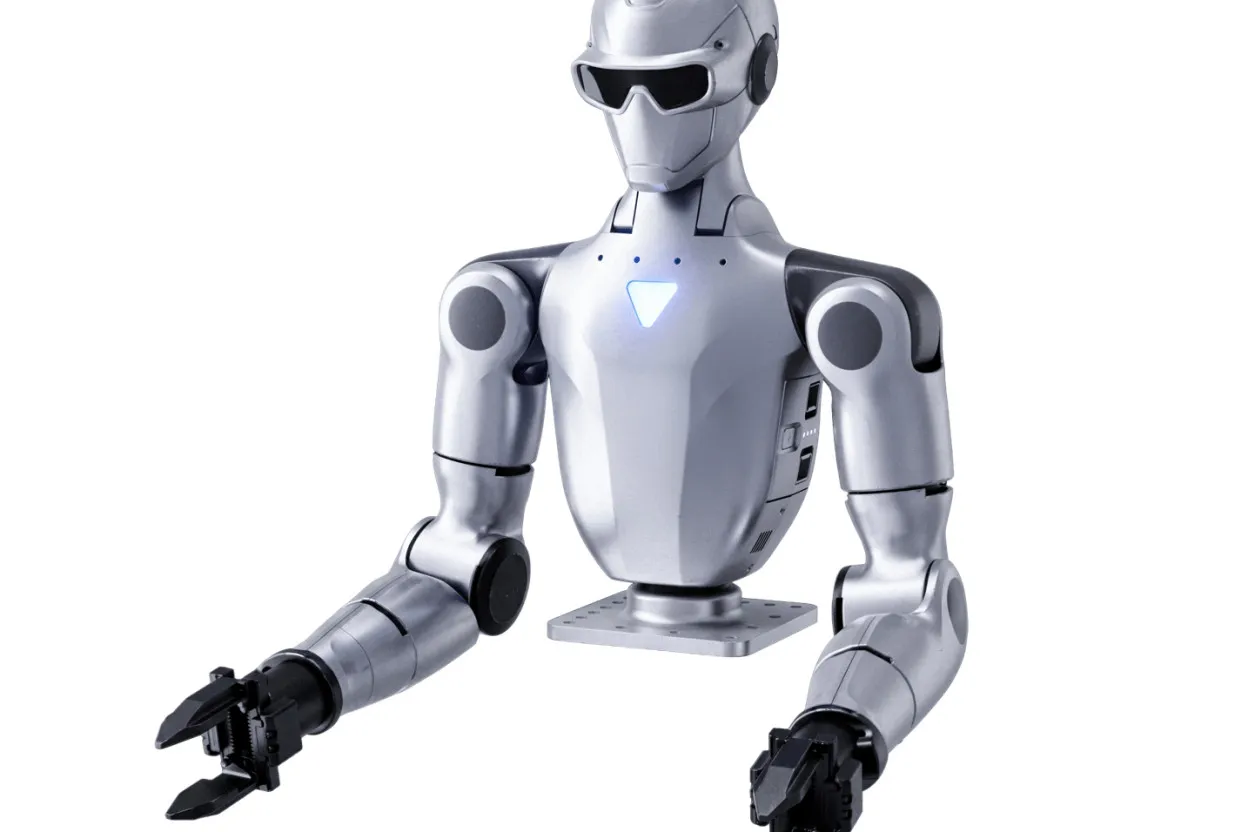
The Unitree R1 is a civilian humanoid robot offered in three versions: R1 AIR, R1 and R1 EDU. With an entry price of $4,900 excl. taxes and shipping, it stands out for its compact size, a weight of about 27 to 29 kg and a stated battery life of about one hour. The differences between the versions mainly concern joint mobility, sensors and software development options.
The R1 is part of the robot lineup from Chinese manufacturer Unitree. Its official product page, consulted on 20 October 2026, lists three configurations that share the same dimensions but not the same number of degrees of freedom. The AIR version is the entry-level model, while the EDU version adds extra equipment and advanced development options.
The manufacturer also showcases the R1 in a promotional video focused on athletic movements and acrobatic sequences. Separately, the press reported that it was available for pre-order on AliExpress, with price and delivery estimates for France that differ from the official dollar prices.
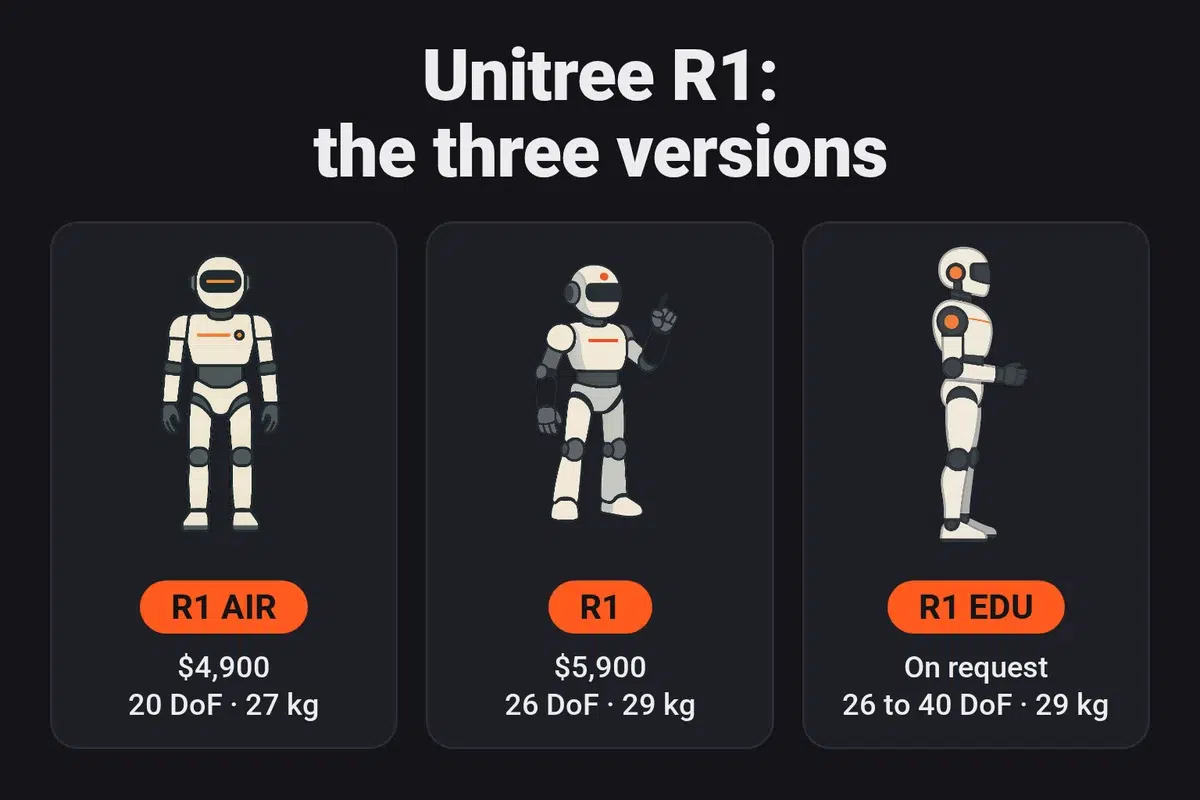
Unitree R1 versions: three configurations with different specs
All three R1 configurations are based on a humanoid standing 1.23 m tall. Unitree varies the number of movable joints, the arm configuration, the torso and head movements and the equipment intended for development work.
The R1 AIR has 20 degrees of freedom. The R1 version goes up to 26, notably with an articulated waist and head. The R1 EDU keeps this architecture and can reach 40 degrees of freedom depending on the equipment chosen.
Unitree R1 official specifications
| Specification | R1 AIR | R1 | R1 EDU |
|---|---|---|---|
| Manufacturer price | $4,900 | $5,900 | On request |
| Standing dimensions (H × W × D) | 1,230 × 357 × 190 mm | 1,230 × 357 × 190 mm | 1,230 × 357 × 190 mm |
| Weight with battery | About 27 kg | About 29 kg | About 29 kg |
| Degrees of freedom | 20 | 26 | 26 to 40 |
| Leg joints | 6 DoF per leg | 6 DoF per leg | 6 DoF per leg |
| Arm joints | 4 DoF per arm | 5 DoF per arm | 5 DoF per arm |
| Stated battery life | About 1 h | About 1 h | About 1 h |
| Stated warranty | 6 months | 8 months | 12 months |
The two public prices are those on Unitree’s official product page, consulted on 20 October 2026. They are excl. taxes and shipping. The warranty periods of six, eight and twelve months are those attributed to the manufacturer in the model’s technical presentation.
R1 AIR vs standard R1 vs EDU: equipment differences
R1 AIR: 20 degrees of freedom and a monocular camera
The R1 AIR is the lightest configuration, at about 27 kg including the battery. Each leg has six degrees of freedom and each arm four. The head and waist lack the movable joints found on the standard version.
Visual perception relies on a monocular camera. On this base version, the hands cannot grip, as stated in the pre-order presentation published in the press.
Its manufacturer price of $4,900 makes it the cheapest of the three configurations.
Standard R1: articulated head and waist
The standard R1 weighs about 29 kg and has 26 degrees of freedom. Each arm has five degrees of freedom, compared with four on the AIR. Unitree adds a waist that moves on two axes and a head that is also articulated on two axes.
The vision system is upgraded to a binocular camera in place of the AIR’s monocular one. This change comes alongside the greater number of available joint movements.
The official price is $5,900 excl. taxes and shipping, which is $1,000 more than the R1 AIR.
R1 EDU: up to 40 degrees of freedom
The R1 EDU has the same form factor and approximate weight as the standard model, with a stated configuration of 26 to 40 degrees of freedom.
This version offers optional dexterous hands and an additional computing module. Unitree mentions Orin boards delivering 40 to 100 TOPS of computing power depending on the configuration. The manufacturer also highlights advanced software development features.
The R1 EDU is listed commercially with a “Contact sales” label, meaning it is priced on request.
Unitree R1 hardware: computing, connectivity and payload
Beyond the differences in joints, Unitree describes an electronic architecture that includes an eight-core processor, four microphones and a speaker. Connectivity covers Wi-Fi 6 and Bluetooth 5.2.
The robot uses a quick-release battery. This allows the power pack to be removed, although the official spec sheet does not link this feature to any operating time beyond the stated one hour.
According to Unitree, the arms can carry about 2 kg depending on posture. This figure therefore depends on the position of the robot and its joints.
The manufacturer also says the control interfaces for the joints and sensors are open. It presents them as compatible with the main simulation platforms, which is particularly relevant for configurations that include software development features.
Unitree R1 battery life and dimensions: a 1.23 m humanoid
All three versions share a standing height of 1,230 mm, a width of 357 mm and a depth of 190 mm. Weight differs by two kilograms between the R1 AIR and the other two versions, battery included.
Unitree claims about one hour of battery life for each configuration. The higher number of degrees of freedom on the R1 and EDU versions therefore does not come with a different nominal battery life in the published specifications.
The removable battery is one of the common features highlighted by the manufacturer. The weight given for each version includes this battery, so the three configurations can be compared on the same basis.
What does the Unitree R1 promo video show?
The R1’s promotional presentation uses the theme “born for sport”. It shows a humanoid able to string together dynamic movements, including cartwheels, spinning kicks and mock fighting.
These sequences showcase the robot’s range of motion and the coordination of its joints. They illustrate mobility well beyond simply standing upright or walking in a straight line.
How these demonstrations were controlled is not specified: the footage is not identified as autonomous or pre-programmed. It should therefore be treated as promotional movement demonstrations, with no particular control mode attributed to them.
Unitree also states that some of the features shown are still in development. The manufacturer classifies the R1 as a civilian robot and asks users to keep a safe distance while it is operating.
How much does the Unitree R1 cost? Official prices and AliExpress pre-order
Unitree’s published price list sets two clearly distinct entry prices: $4,900 for the R1 AIR and $5,900 for the standard R1. These amounts are shown excl. taxes and shipping on the official product page consulted on 20 October 2026.
The press also reported that the R1 was available for pre-order on AliExpress and on the manufacturer’s website. In that sales presentation, shipments from the official website were announced for May 2026, while AliExpress shipments were due to start as early as 30 June 2026.
Unitree R1 price in euros for France
The article on the AliExpress pre-order gave the following equivalents. These are conversions published by the press, not euro prices confirmed by Unitree:
- R1 AIR: $4,900, or about €4,150 according to the article.
- Standard R1: $5,900, or about €5,000 according to the article.
- Shipping to France: €680, the amount reported by the article.
- Standard R1 delivered to France: about €5,700 according to the estimate published in the article.
The euro amounts and shipping costs therefore come from the press coverage of the pre-order. The dollar amounts are the prices displayed by the manufacturer. The two sets of figures cover different scopes: an official price excl. taxes and transport on one side, a commercial estimate for delivery to France on the other.
How does the R1 price compare with other humanoid robots?
The R1 AIR’s entry price puts it at the bottom of the range of public humanoid prices reported by eWeek, which runs from $4,900 to $100,000. This range covers machines with different configurations and is not a like-for-like comparison.
Unitree also offers a dual-arm platform, the R1-D, announced from $4,290. This platform is not directly comparable with the walking humanoids AIR, R1 and EDU.
On the industrial side, the press, drawing notably on TrendForce, reports that Unitree shipped more than 5,500 humanoid robots in 2025. This figure covers the manufacturer’s humanoid shipments as a whole, not the R1 alone.
The R1’s price positioning should also be weighed against its different configurations. Between the AIR and the EDU, the number of degrees of freedom can double, from 20 to 40. Optional dexterous hands, additional computing capacity and advanced software features are among the equipment differences between versions.
Unitree R1 safety precautions and stated limitations
Unitree presents the R1 as a civilian robot and stresses the precautions to take while it is operating. In particular, the manufacturer asks users to keep a safe distance from the machine.
The manufacturer also advises private buyers to assess the current limitations of a humanoid robot before making any purchase. This warning accompanies the sales presentation and the demonstrations of dynamic movements.
The arm payload, given as about 2 kg depending on posture, is one example of a specification that depends on operating conditions. Likewise, joint capabilities vary widely by version, with 20 degrees of freedom on the AIR and up to 40 on the EDU.
What we do not know yet
Several pieces of information remain undisclosed in the documentation available as of 20 October 2026. The official price of the R1 EDU is not published, and Unitree refers buyers to its sales team. Full warranty terms are set out in a separate booklet, while only the durations of six, eight and twelve months appear in the available specifications.
The exact model of the eight-core processor and the battery’s energy capacity in Wh are not specified. Real-world battery life has not been established by independent measurements, and neither has the R1’s physical performance in independent tests.
For the French market, actual availability, the existence of local after-sales service and an official euro price are not confirmed. The delivery estimates published by the press do not confirm that Unitree provides local support.
Finally, the manufacturer does not say whether the movements in the promotional video are autonomous or pre-programmed. Any level of assistance used during these sequences remains unknown, as does the timeline for completing the features Unitree still describes as in development.
See also: Unitree: manufacturer and robot lineup; Unitree G1: humanoid robot profile; Unitree G1 price; Unitree Go2: quadruped robot profile; The R1’s official spec sheet explained; The R1 on pre-order on AliExpress; Humanoid robot prices from $4,900 to $100,000.
The newsletter
Get the latest on humanoid robots
A selection of announcements, prices and demonstrations, with no advertising. Unsubscribe in one click.