

Humanoid robots for the home are starting to take shape in 2026. The offerings cover very different uses. The NEO from 1X Technologies is designed to work inside a home, AiMOGA’s Mobo is presented as a domestic companion, and Unitree sells its own platforms. Prices, manipulation capabilities, teleoperation and sales terms show how far apart these machines are.
The market is still dominated by developer platforms that can walk, dance or wave but have limited household functions. A roundup published by MonsterDealz.de on 2 September 2026 notes in particular that the humanoids available at the time could not fold laundry. Manipulation demos also need to be judged on whether they rely on remote control, a repeated sequence or task-specific training.
In the Usages category, the home robot differs from industrial or reception humanoids in the environment it operates in: the home. Several manufacturers now present machines intended for companionship, assistance or everyday tasks, at different stages of development.
1X NEO: a humanoid robot built for household chores
Developed by 1X Technologies, the NEO is presented as a home robot available to consumers through a pre-order programme. It combines a humanoid architecture, articulated hands and an artificial intelligence called Redwood.
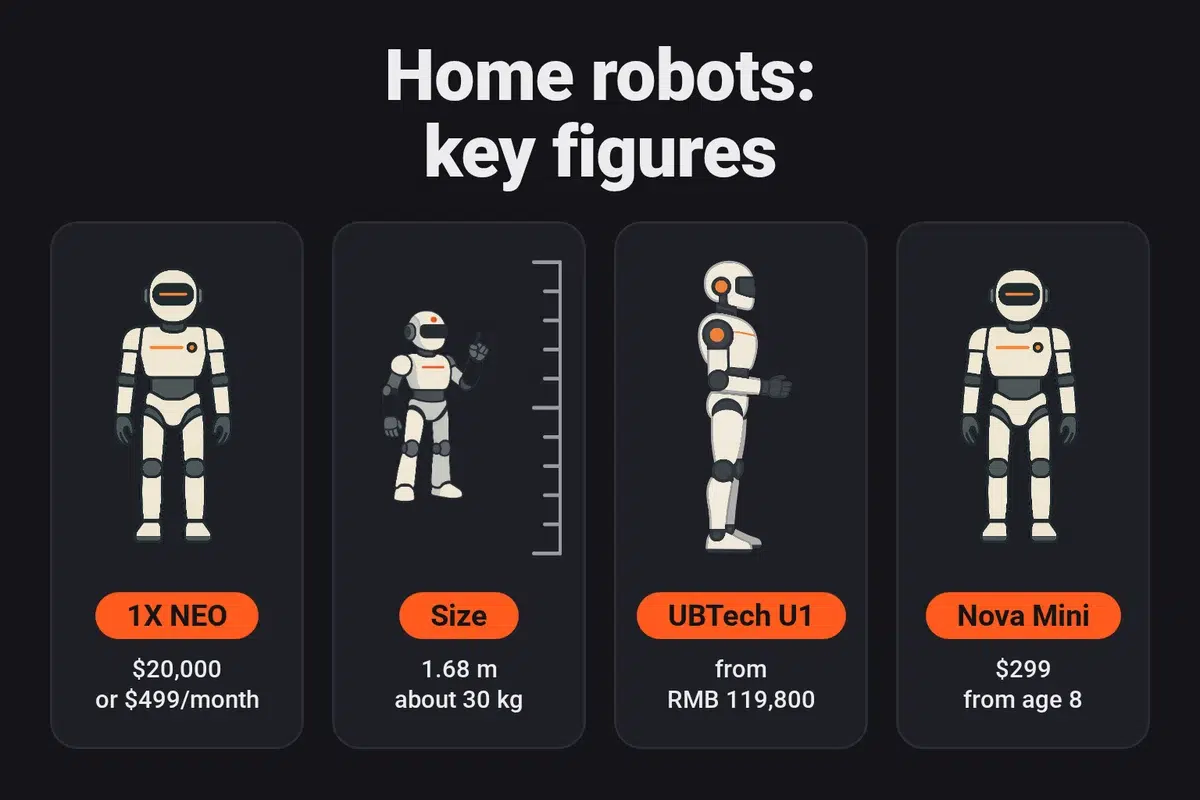
1X’s official spec sheet gives a height of 1.68 m and a weight of around 30 kg. Each hand has 22 degrees of freedom. The claimed lifting capacity is around 70 kg, while the carrying capacity is given as around 25 kg.
The manufacturer states four hours of battery life and a noise level of 22 dB. The hands are rated IP68, against IP44 for the body. The announced accessories include a charger, a lint roller and a case.
NEO household chores tested under teleoperation
The NEO was tested by the Wall Street Journal, as reported by Notebookcheck. During this demonstration, the robot vacuumed and loaded a dishwasher. It took more than a minute to take a bottle out of the fridge and failed to crack a walnut.
These tasks were carried out with a teleoperated unit. What was shown was therefore not fully autonomous execution of every task.
1X plans basic functional autonomy at launch, with capabilities improving over time. The company mentions a horizon of around five years before the NEO can work fully autonomously.
NEO Expert mode and remote operation
Expert mode lets a 1X operator take control of the robot remotely during scheduled time slots. According to information reported by t3n, the system blurs faces and lets users define no-go zones.
This is a central feature of the NEO: some household tasks can be performed with direct assistance from a person outside the household.
How much does the 1X NEO cost? Price and pre-order programme
1X offers an Early Access plan at $20,000. It includes a three-year warranty, premium support and priority delivery. A Standard plan is announced at $499 a month.
Joining the waiting list requires a deposit of $200. It is fully refundable for up to fourteen days after the invitation to order is sent, after which it becomes non-refundable. Signing up does not constitute a firm order.
Deliveries are announced for the United States in 2026. One article mentions a European launch in 2027. The different plans are covered in detail on the page dedicated to the price of the 1X NEO humanoid robot.
AiMOGA Mobo: a humanoid companion robot for the home
AiMOGA, a brand linked to the Chinese carmaker Chery, presents Mobo as its first consumer humanoid companion robot for the home.
Worldwide pre-orders opened at the Chery International User Summit, held in Wuhu, China, from 19 to 23 October 2026.
Unlike the NEO, whose presentation highlights the handling of household objects, Mobo is described in terms of companionship, navigation around the home and educational support.
Mobo home navigation and learning household routines
AiMOGA announces 22 degrees of freedom for the whole body. The robot runs MoAgent, a system designed for task planning.
The manufacturer also describes navigation adapted to the home, including dynamic obstacle avoidance. Mobo is presented as able to remember the household’s routines in order to adapt its interactions.
AiMOGA says privacy protection was built into the system from the design stage. These features reflect the manufacturer’s descriptions, not performance measured in an independent test.
The brand claims more than 3,000 units delivered in total, across all models, in more than 60 countries and regions. This figure covers all of its robots, not just Mobo deliveries.
UBTech Uworld U1: customisable companion humanoid robots
Chinese manufacturer UBTech is developing the Uworld U1 series, a family of humanoids presented for companionship, emotional support, elderly care, reception and hospitality.
The range comes in three versions: U1 Lite, U1 Pro and U1 Ultra. The U1 Lite has a torso-only configuration, while the U1 Pro has a full body.
The configurations shown include robots measuring 168 cm (female version) and 183 cm (male version), according to AI Weekly; the weight is not disclosed in the sources consulted. UBTech announces up to 88 degrees of freedom, hands included, and a silicone covering that imitates skin.
Customisable appearance and voice
UBTech says Uworld robots can be modelled on real people, both in appearance and in voice.
This customisation is one of the distinctive features of the U1 family. It fits the manufacturer’s focus on social interaction, companionship and emotional support.
Uworld U1 price and pre-orders
UBTech lists a starting price of RMB 119,800.
The company claims 13,361 orders registered by 30 June 2026, with pre-orders having opened on 2 June. This figure refers to pre-orders announced by UBTech, not to the number of robots delivered.
Unitree R1 and G1: primarily technical humanoid platforms
Unitree robots occupy a different position among humanoids that could be used in a home. The R1 and G1 are mainly described as developer platforms, with distinct locomotion and manipulation capabilities.

Unitree R1 price: two versions and one hour of battery life
The Unitree R1 is available in an AIR version at $4,900 and a standard version at $5,900.
Its claimed battery life is around one hour. The R1 is a developer platform that can perform humanoid movements, but the base model has non-grasping hands.
It therefore cannot directly carry out household tasks that require picking up objects. Washing dishes, in particular, is not among the tasks it can perform in this configuration.
Unitree G1 price, payload and battery life of around two hours
The Unitree G1 is listed at $13,500. Its payload is around 2 kg per arm, with a claimed battery life of close to two hours.
Household tasks require specific preparation. Videos of humanoid robots performing complex actions may show repeated sequences, remote-controlled interventions or behaviours trained in a lab for a single task.
The G1 therefore illustrates the difference between the mechanical ability to handle an object and the autonomous completion of a full household activity.
Faraday Future FF Nova: small humanoid robots for learning and development
Faraday Future offers the FF Nova family, made up of small humanoid robots whose specifications differ sharply from full-size home machines.
FF Nova specs and price: 49.7 cm and ROS 2 support
The FF Nova is 49.7 cm tall and weighs 2.8 kg. It has 20 degrees of freedom and supports ROS 2.
It is aimed at developers, universities and schools. The announced price is $2,490, with an optional software pack costing $390.
FF Nova Mini: a version for children
The FF Nova Mini is presented for children aged eight and over. It weighs less than one kilogram and its announced price is $299.
Faraday Future plans a first phase limited to 100 units, 20 of them ready to ship. The FF Nova family is therefore geared more towards learning and development than towards household chores.
Home humanoid robot specs compared
The specifications below are the figures announced by the manufacturers. The different brands do not necessarily publish the same technical indicators.
| Model | Dimensions and weight | Joints | Claimed battery life | Announced price |
|---|---|---|---|---|
| 1X NEO | 1.68 m; around 30 kg | 22 DoF per hand | 4 h | Early Access: $20,000; Standard: $499/month |
| AiMOGA Mobo | Not disclosed | 22 DoF for the whole body | Not disclosed | Not disclosed |
| UBTech Uworld U1 | 168 cm (female) or 183 cm (male); weight not disclosed | 88 DoF, hands included | Not disclosed | From RMB 119,800 |
| Unitree R1 | Not disclosed | Not disclosed | Around 1 h | AIR: $4,900; standard: $5,900 |
| Unitree G1 | Not disclosed | Not disclosed | Around 2 h | $13,500 |
| Faraday Future FF Nova | 49.7 cm; 2.8 kg | 20 DoF | Not disclosed | $2,490 |
| Faraday Future FF Nova Mini | Less than 1 kg | Not disclosed | Not disclosed | $299 |
For the NEO, 1X also announces a carrying capacity of around 25 kg, a lifting capacity of around 70 kg and a noise level of 22 dB. For the G1, Unitree states a payload of around 2 kg per arm. These figures describe different characteristics and are not directly comparable measurements.
Which home functions does each humanoid robot offer?
Beyond the spec sheets, the models differ in the household functions they present, how they operate and how they are positioned.
| Robot | Stated positioning | Documented functions | Announced sales status |
|---|---|---|---|
| 1X NEO | Household assistance | Vacuuming, loading the dishwasher and handling a bottle during a teleoperated test | Waiting list and US deliveries announced for 2026 |
| AiMOGA Mobo | Companionship and educational support | Navigation, obstacle avoidance and learning routines, as described by AiMOGA | Worldwide pre-orders open |
| UBTech Uworld U1 | Companionship, emotional support and care | Customisable appearance and voice, as announced by UBTech | 13,361 orders claimed as of 30 June 2026 |
| Unitree R1 | Developer platform | Humanoid locomotion; non-grasping hands on the base model | Public prices announced |
| Unitree G1 | Humanoid developer platform | Manipulation with a payload of around 2 kg per arm | Public price announced |
| Faraday Future FF Nova | Development and teaching | Articulated platform with ROS 2 support | First phase of 100 units announced |
| Faraday Future FF Nova Mini | Learning for children aged 8 and over | Small humanoid robot | Part of the FF Nova family |
The NEO is the model for which concrete household tasks are described in a press test. Mobo and Uworld U1 focus more on companionship and interaction, while the Unitree and FF Nova robots are mainly technical and educational platforms.
What to look for in a humanoid robot for the home
Which tasks have actually been demonstrated
Walking, dancing or waving show a humanoid’s locomotion and coordination. Household chores also require grasping objects, moving them and chaining several operations together.
The NEO performed household tasks during a teleoperated test, with both successes and failures. The base R1 has non-grasping hands and the G1 requires preparation for household chores. Mobo and Uworld U1 are presented around other functions, notably companionship and interaction with the occupants.
Teleoperation and human intervention
Teleoperation lets a human control a robot remotely. It plays an explicit role in how the NEO works, notably through Expert mode.
Pre-programmed sequences and behaviours trained for a specific operation are other modes of operation seen in humanoid demos. They are distinct from the autonomous execution of a series of household tasks.
Battery life and manipulation capabilities
Claimed battery life ranges from around one hour for the Unitree R1 to two hours for the G1 and four hours for the NEO.
The ability to carry or lift a load is another criterion. 1X states a carrying capacity of around 25 kg for the NEO, while the G1 is rated at around 2 kg per arm. The number of degrees of freedom, hand design and control functions also shape what a robot can handle.
Operating noise
Noise level matters particularly in a home, where a robot may operate close to the occupants. 1X announces 22 dB for the NEO, a manufacturer figure to take into account when assessing how well it fits into a household.
Safety around children and older people
The physical characteristics of humanoids vary widely. The NEO weighs around 30 kg, while the FF Nova weighs 2.8 kg and the FF Nova Mini less than one kilogram; the weight of the Uworld U1 is not disclosed.
The target users cited by the manufacturers also differ: UBTech mentions elderly care, while Faraday Future presents the Nova Mini for children aged eight and over.
Personal data and privacy
Navigating a home, learning routines and remote control raise questions specific to the domestic environment.
AiMOGA claims privacy protection was built into Mobo from the design stage. For the NEO, information reported by t3n describes an Expert mode with scheduled teleoperation slots, face blurring and the ability to define no-go zones.
These features are concrete points to examine when a robot moves around the private spaces of a household.
What we do not know yet
Several key pieces of information remain undisclosed or insufficiently documented to fully compare these humanoids in a home setting.
- Mobo price and timeline: AiMOGA has opened worldwide pre-orders but has given neither a price nor a delivery date.
- Availability in France: no French launch has been announced for the NEO, Mobo or the Uworld U1 series. One article mentions the NEO arriving in Europe in 2027. Delivery terms for the U1 series are not specified.
- Faraday Future: no date has been given for wider sales or a consumer launch. No European availability is specified.
- Real-world battery life: running times in continuous home use, with varied tasks, have not been established by comparable independent measurements. Battery life for Mobo, Uworld U1 and FF Nova has not been disclosed.
- Reliability of household tasks: success rates, repeatability and the ability to chain operations without human assistance have yet to be documented. The level of autonomy in the Uworld U1 demonstrations is not specified.
- NEO privacy: the detailed policy on processing, retaining and accessing personal data, particularly during Expert mode sessions, has yet to be clarified.
- Home safety: the performance of protective systems around children and older people has not been documented in comparable tests. Safety conditions during movement, manipulation and close interaction have yet to be established.
See also: Reception and service robots; Industrial humanoid robots; Educational robots; 1X Technologies; 1X NEO profile; Unitree robots; Unitree R1 profile; Unitree G1 profile; Buying a humanoid robot in France; Humanoid robot prices; 1X NEO price and subscription.
The newsletter
Get the latest on humanoid robots
A selection of announcements, prices and demonstrations, with no advertising. Unsubscribe in one click.