

Industrial humanoid robots are starting to appear in factories, assembly shops and logistics operations. BMW uses Figure machines to handle components, Hyundai is working on deploying Atlas, and Agility Robotics is preparing Digit 5 for repetitive material handling. These projects sit at different levels of maturity, from industrial trials to phased deployments and production targets.
In the Usages section, the industrial humanoid robot stands out for its ability to work in environments designed for human operators. Documented applications include sorting parts, positioning them, handling totes, assembly and shipyard welding.
Figure 03 at BMW: a humanoid robot in real factory logistics
BMW has assigned the Figure 03 to logistics operations at its Spartanburg plant in the United States. The robot sorts components delivered loose in large bins, then places them on a sequencing cart. This step prepares the parts for use on the production line.
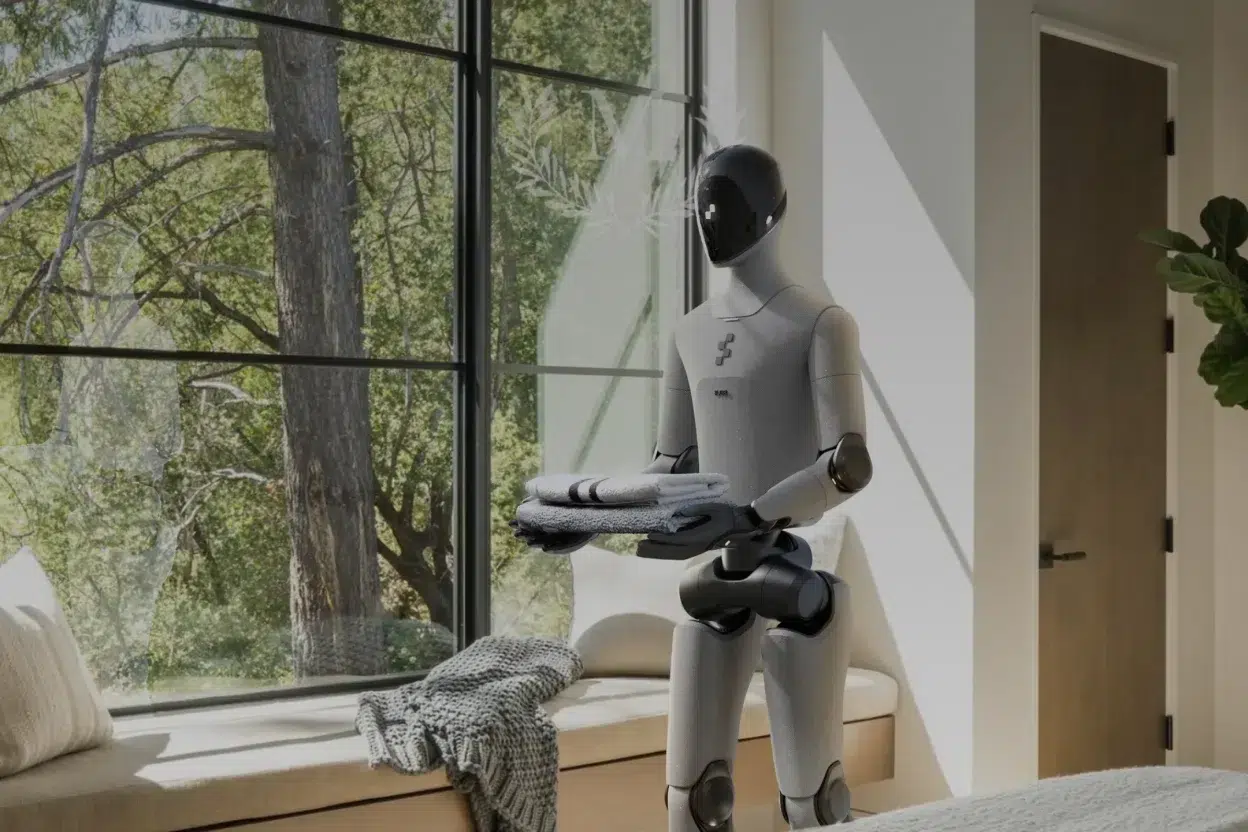
The Figure 03 succeeds the Figure 02 units used in body shop operations in 2025. According to BMW, the earlier pilot lasted ten months and covered the production of more than 30,000 BMW X3s. The Figure 02 robots positioned body parts for welding.
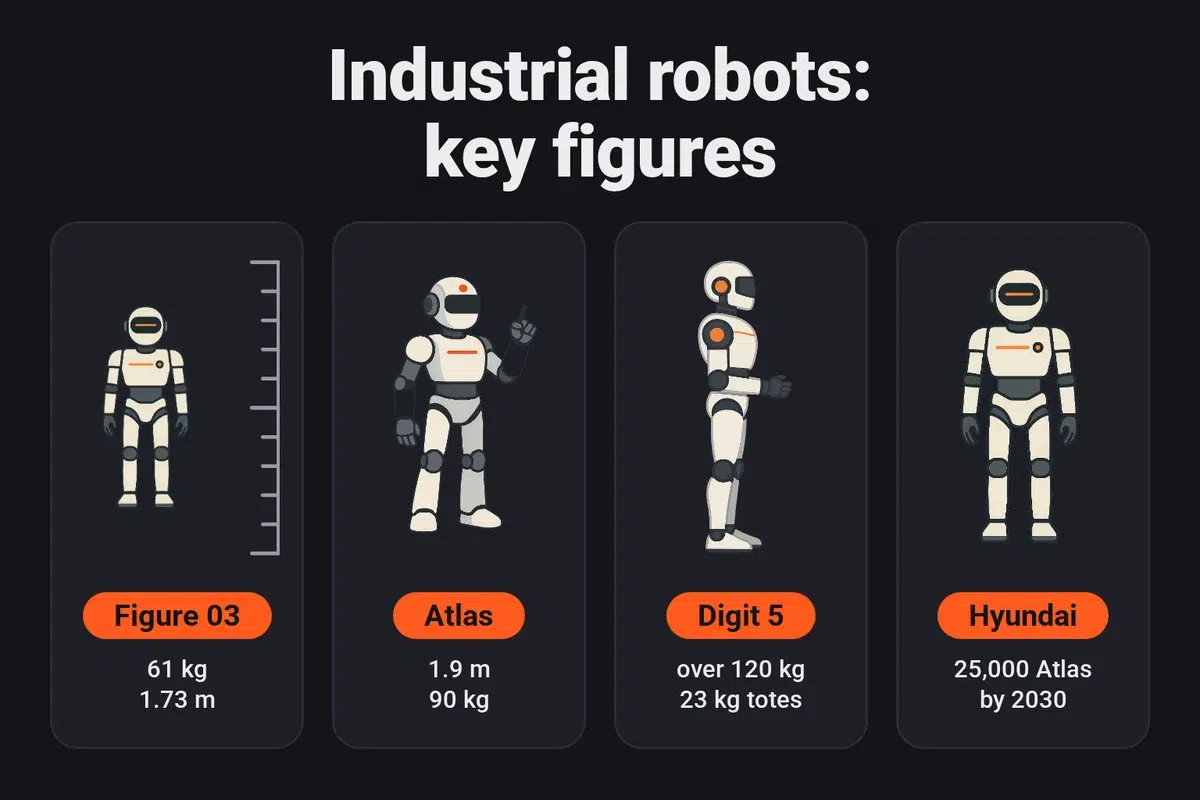
The new model is 1.73 m tall and weighs 61 kg. It has a soft textile covering on the head, torso, arms and legs. Its hands include tactile sensors and cameras built into the palms. Figure quotes around five hours of runtime and wireless charging.
Figure is also developing BotQ, its manufacturing facility. The company says it had delivered more than 350 Figure 03 units in April 2026 and announces a manufacturing capacity of up to 12,000 humanoids per year. That figure is a stated industrial capacity, not the number of robots actually produced.
Boston Dynamics Atlas at Hyundai: an all-electric humanoid robot
The Boston Dynamics Atlas features in an industrial demonstration in which it sorts roof rack components for a Hyundai assembly line. The operation is presented as autonomous.
According to the manufacturer’s spec sheet, Atlas is a fully electric humanoid standing 1.90 m tall and weighing 90 kg. Its training relies in part on human demonstrations using a virtual reality headset and motion capture systems.
The project is part of a phased deployment strategy. Permanent integration of Atlas into industrial facilities could take several years. Hyundai plans to deploy 25,000 Atlas robots in its plants by 2030, according to the announcement reported in the press.
The Hyundai plant mentioned in this programme employs more than 1,000 industrial robots and nearly 1,500 people, according to the reported figures. Atlas is therefore joining an environment where several forms of industrial automation are already in place.
Agility Robotics Digit 5: specs for repetitive handling and fast charging
Unveiled by Agility Robotics on 15 September 2026, Digit 5 is an evolution of Agility Robotics’ industrial humanoid robot. This generation focuses on repetitive material handling.

The robot weighs more than 120 kg. Agility Robotics is targeting repeated handling of 23 kg totes and placing them on shelves up to 1.75 m high. Digit 5 drops running and jumping capabilities to concentrate on its intended industrial tasks.
The company quotes 90 minutes of runtime, followed by a full recharge in nine minutes. The charging station runs at 48 V with a stated current of 240 A.
Agility Robotics has set a target of up to 20 hours of operation per day. This is an announced technical target, not a duration validated in continuous operation at a customer site.
Industrial humanoid robots compared: Figure 03 vs Atlas vs Digit 5
As of 21 October 2026, three models from different manufacturers have specifications and use cases documented well enough to be compared. The physical and energy figures below come from manufacturer spec sheets or announcements. Applications are attributed to the companies concerned.
| Criterion | Figure 03 | Boston Dynamics Atlas | Agility Robotics Digit 5 |
|---|---|---|---|
| Manufacturer | Figure AI | Boston Dynamics | Agility Robotics |
| Documented application | Component sorting and sequencing at BMW | Roof rack component sorting at Hyundai | Repetitive tote handling, announced target |
| Height | 1.73 m | 1.90 m | Not disclosed |
| Weight | 61 kg | 90 kg | More than 120 kg |
| Payload handled | Not disclosed | Not disclosed | 23 kg, announced target |
| Shelving height | Not disclosed | Not disclosed | Up to 1.75 m, announced target |
| Announced runtime | About 5 h | Not disclosed | 90 min |
| Charging | Wireless | Not disclosed | 9 min for a full recharge, as announced |
| Distinctive features | Tactile hands, palm cameras, soft textile covering | Fully electric drive, learning from human demonstration | 48 V, 240 A charging station |
| Industrial status | Logistics deployment at BMW | Development and phased deployment at Hyundai | New generation unveiled on 15 September 2026 |
| Data source | Figure AI and BMW | Boston Dynamics and Hyundai | Agility Robotics, announcement of 15 September 2026 |
The three machines reflect different approaches. Figure 03 has a documented logistics use case at BMW. Atlas combines learning by demonstration with component sorting in the Hyundai environment. Digit 5 highlights quantified targets for handling, charging and daily operating time.
Other documented humanoid robot deployments in factories
Agile Robots: humanoid robot production in Germany
Agile Robots runs a humanoid assembly line in Fürstenfeldbruck, near Munich. The facility occupies a 10,000 m² hall. Production began in January 2026, with the move to series production at the end of the summer.
The German company claims more than 20,000 automation solutions deployed. This figure covers all of its solutions, not only its humanoid robots.
Agile Robots says most of the humanoids it currently ships are fitted with wheels. The company is also working with Hitachi on physical AI, an approach that combines artificial intelligence with interaction in the physical world.
Schaeffler: six humanoid robots assembling robot components
On 20 October 2026, Schaeffler opened a 7,500 m² industrial facility in Taicang, China, dedicated to series production of linear and rotary actuators.
Six humanoid robots are assigned to five assembly stations building joint modules for other humanoids. The case shows humanoid robotics being applied to the manufacture of its own industrial components.
Persona AI and Calvin: shipyard welding and trials at Renault
Persona AI is developing a welding humanoid for shipyards, in a project involving Hyundai and Posco. The application targets a specialised industrial environment.
In France, Renault and Wandercraft are testing the Calvin robot at the Douai plant. The programme aims for around ten robots by the end of 2026, according to published information.
How to compare industrial humanoid robots: key criteria
Choosing an industrial platform depends first on the intended task and how far it has been validated. The documented projects point to several technical and operational criteria.
- Type of operation: component sorting and sequencing at BMW, parts sorting at Hyundai, the repetitive handling announced for Digit 5 and assembly at Schaeffler are distinct applications.
- Payload and handling height: Digit 5 has quantified targets of 23 kg per tote and 1.75 m for shelf placement.
- Battery runtime: Figure quotes about five hours for Figure 03, against 90 minutes for Digit 5, which relies on short recharges.
- Manipulation and perception: Figure 03 has tactile sensors and palm cameras, while Atlas learns in part from human demonstrations.
- Deployment stage: a documented operation at a carmaker, an autonomous demonstration and an announced technical target represent different stages.
- Industrial integration: workstations, safety, data management, maintenance and fleet coordination all feed into the total cost of operation.
Any comparison must also take the physical environment into account. Tote handling, component sequencing and small-part assembly each place different demands on manipulation, movement and peripheral equipment.
Industrial humanoid robot production numbers and deployment targets
The figures published by companies do not all describe the same thing. They may refer to robots delivered, annual manufacturing capacity, machines present in a facility or a future deployment target.
| Company or programme | Published figure | What the figure measures | Source and period |
|---|---|---|---|
| Figure AI, BotQ | More than 350 Figure 03 | Robots delivered, according to Figure | Figure statement, April 2026 |
| Figure AI, BotQ | Up to 12,000 robots/year | Stated annual capacity | Figure AI, 2026 |
| BMW, Figure 02 pilot | More than 30,000 BMW X3s over ten months | Vehicles covered by the industrial pilot | BMW, 2025 pilot |
| Hyundai, Atlas | 25,000 robots | Deployment target by 2030 | Hyundai announcement reported in the press |
| Agile Robots | More than 20,000 solutions | Automation solutions deployed, all types combined | Company statement, 2026 |
| Schaeffler, Taicang | 6 humanoids on 5 stations | Facility configuration | Opening on 20 October 2026 |
| Renault and Wandercraft | Around ten Calvin units | Target for end of 2026 | Trial programme in Douai |
These data shed light on the sector’s industrialisation without serving as a single measure of commercial uptake. The BMW programme documents an application in car production, while the Figure AI and Hyundai figures describe an industrial capacity and a deployment ambition respectively.
How much does an industrial humanoid robot cost? Price and integration
The most advanced industrial humanoids are often presented without a public price, as eWeek points out. Figure AI, Boston Dynamics and Agility Robotics do not publish selling prices for the industrial models compared here.
For a company, the cost of a humanoid robot goes beyond the machine itself. An economic assessment covers several items:
- Safety of the installation and of interactions with people.
- Integration with workstations and existing equipment.
- Battery runtime and the organisation of recharging.
- Management of the data used or generated by the robots.
- Maintenance and keeping the robots operational.
- Management and coordination of robot fleets.
Pricing and commercial deployment are also covered in the guides Humanoid robot prices and Buying a humanoid robot in France.
What we do not know yet
Despite the demonstrations and the first documented installations, several key pieces of information remain undisclosed or insufficiently established to compare industrial humanoids on a consistent economic and operational basis.
- Selling prices: no verified public price is available for Figure 03, Atlas or Digit 5.
- Volumes actually in operation: the number of robots working regularly in production at customer sites, by model and by site, has yet to be specified. Delivery figures, manufacturing capacity and future targets are no substitute for this data.
- Availability rates: performance measured over extended periods, downtime, maintenance interventions and operational reliability are not documented in a comparable way. Announced runtimes are not independent measurements under industrial conditions.
- Certification of bipedal robots: according to Agile Robots, there is not yet a specific regulatory framework or certification standards suited to bipedal humanoid robots working alongside humans in Europe and North America.
- Purchase terms in France: commercial availability, contract terms and integration conditions for the industrial models presented have not been disclosed.
Productivity, profitability and possible job replacement data have not been established for the models compared. The industrial programmes described provide use cases and technical targets, but no economic assessment that can be generalised.
See also: Uses of humanoid robots; Figure AI and its humanoid robots; Boston Dynamics and Atlas; Unitree and its humanoid platforms; Unitree G1 robot profile; Unitree R1 robot profile; Humanoid robot price guide; Guide to buying a humanoid robot in France.
The newsletter
Get the latest on humanoid robots
A selection of announcements, prices and demonstrations, with no advertising. Unsubscribe in one click.