

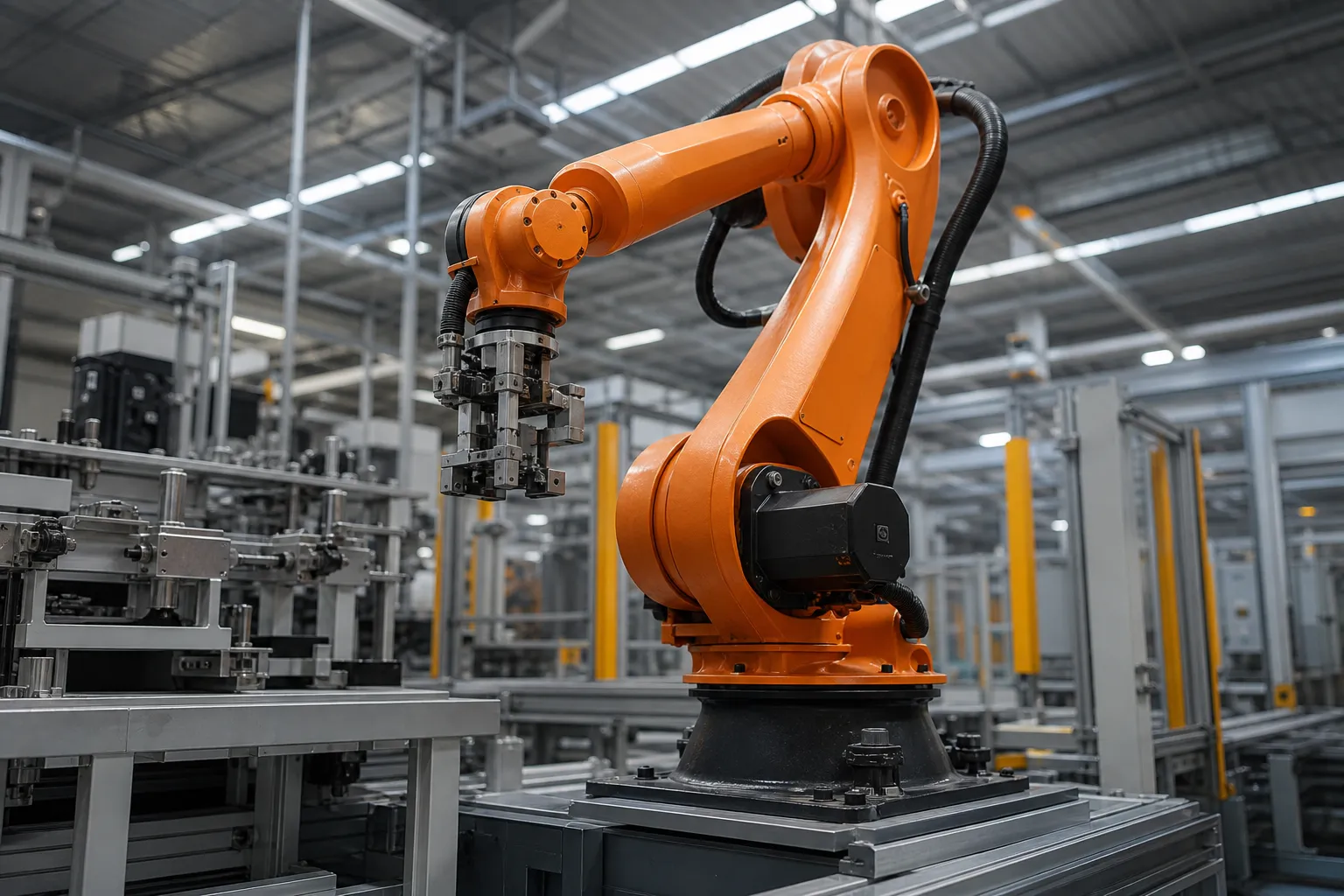
South Korea has the highest density of industrial robots in the world, but its robotics industry scores only 72.9 points for competitiveness in 2025, according to KIET. The institute identifies five priorities to strengthen the country’s robotics sector.
The Korea Institute for Industrial Economics & Trade (KIET) points to a gap between the heavy use of robots in South Korean factories and the country’s ability to build a competitive robotics industry. In its report on the reshaping of global competition, the institute argues that competition no longer rests only on machine performance and price. It now depends on control of components, software, artificial intelligence, industrial data and large-scale production.
South Korea scores 72.9 points for robotics competitiveness in 2025
According to a KIET survey of experts, the overall competitiveness of South Korea’s industrial robot industry stands at 72.9 points in 2025, the lowest score among the six countries studied.
The main weakness is the supply of components and software, which scores 64.0 points. According to the institute, this segment is the weakest link in the national robotics value chain.
The contrast with robot use in factories is stark. South Korea ranks first in the world for robot density, with 1,066 robots per 10,000 manufacturing workers. It also ranks fourth worldwide for new industrial robot sales.
KIET notes that China overtook South Korea in industrial robotics competitiveness in 2023 and continues to widen the gap, helped in particular by its domestic market, its manufacturing capacity and the integration of home-grown technologies.
Why South Korea’s robotics industry is 97.9% SMEs
The structure of the South Korean sector is another issue. According to data presented by KIET, the country had 2,509 robotics companies in 2024, 97.9% of them small and medium-sized enterprises.
Only 3.2% of these companies generated annual robotics revenue of at least 10 billion won. According to the institute, this distribution limits the sector’s ability to fund research and development over the long term, organise mass production and win international markets.
KIET therefore recommends strengthening ties between large industrial groups, specialist manufacturers, component suppliers and end-user companies. The aim is to turn the experience built up in South Korean factories into locally developed technologies, products and production capacity.
Global industrial robot sales forecast: 806,000 units in 2029
The analysis comes as the global industrial robot market grows. According to figures in the report, 603,307 industrial robots were sold worldwide in 2025, described as an all-time record.
The International Federation of Robotics (IFR) expects around 806,000 new industrial robot sales worldwide in 2029, according to forecasts cited by KIET.
Demand remains highly concentrated. In 2025, five countries (China, the United States, Japan, South Korea and Germany) together accounted for 80.2% of new global sales. China alone accounted for 58.7% of the market.
For KIET, this concentration favours countries that can combine a large domestic market, a solid industrial base and integrated supply chains. The development of physical AI also increases the importance of intelligent software, data collected in factories and testing capacity.
KIET’s five priorities for South Korean robotics
KIET recommends refocusing South Korea’s industrial policy. Rather than concentrating only on installing new robots, the institute proposes building the technological and commercial capabilities of domestic companies along five lines:
- Master three families of strategic components: actuators, robotic hands and sensors, identified as areas of technological weakness.
- Pool industrial data: create infrastructure to collect, store and share data from production sites.
- Expand testing in industrial conditions: work with end-user companies to assess robot performance and economic viability.
- Support mass production: help specialist manufacturers grow, build their industrial capacity and secure customer references.
- Develop integrated export offerings: combine core components, artificial intelligence and robotic solutions to gain access to global supply chains.
Physical AI and supply chains in industrial robot competition
The report describes a shift in the criteria for competition. The quality of an industrial robot no longer depends only on its technical performance or purchase price. Component availability, software reliability, access to data and the ability to manufacture in volume are becoming increasingly important.
In this context, KIET considers that investment by large companies and public policies devoted to physical AI should also benefit specialist domestic manufacturers. It recommends building lasting industrial relationships between suppliers, software developers, integrators and end users.
The institute stresses in particular the need to link factory trials to the commercialisation of robotic solutions. Specialist companies could then use test results to improve their products, increase production volumes and win international orders.
Finally, KIET recommends an export strategy based on complete solutions combining robotic hardware, software and artificial intelligence, rather than on selling components or machines on their own.